Komatsu PC350LL-7E0 Logging Excavator Operation and Maintenance Manual CEAM024602
$30.00
- Type Of Manual: Operation and Maintenance Manual
- Manual ID: CEAM024602
- Format: PDF
- Size: 6.4MB
- Number of Pages: 325
Description
-
Model List:
- PC350LL-7E0 Logging Excavator
- 1. INTRODUCTION
- 1.1. FOREWORD
- 1.2. SAFETY INFORMATION
- 1.3. INTRODUCTION
- 1.3.1. Intended Use
- 1.3.2. Features
- 1.3.3. Directional Reference of Machine
- 1.3.4. Breaking in a New Machine
- 1.3.5. Plate Locations
- 1.3.6. Komatsu Forestry Front S/N Plate
- 1.3.7. Table To Enter Serial Numbers And Distributor
- 1.4. TABLE OF CONTENTS
- 2. SAFETY
- 2.1. SAFETY AND WARNING DECALS
- 2.1.1. Location of the Safety Decals
- 2.1.2. Normal Excavator Decals
- 2.1.3. Safety Labels
- 2.1.4. Unique Safety Decals for Log Loader and Road Builder Excavators
- 2.2. GENERAL SAFETY RULES AND PRECAUTIONS
- 2.2.1. General Safety Rules
- 2.2.2. Safety Features
- 2.2.3. Personal Protective Equipment
- 2.2.4. Fire and Explosion Prevention
- 2.2.5. Action if Fire Occurs
- 2.2.6. Dust Hazard Precautions
- 2.2.7. Keep Operators Compartment Clean
- 2.2.8. Leaving Operators Seat with Lock
- 2.2.9. Mounting and Dismounting
- 2.2.10. Fire Extinguisher and First Aid Kit
- 2.2.11. Inside Operators Compartment
- 2.2.12. Protection Against Falling or Flying Objects
- 2.2.13. Precautions for Attachments
- 2.3. PRECAUTIONS BEFORE STARTING OPERATIONS
- 2.3.1. Preoperational Checks
- 2.3.2. Starting Your Work Operations
- 2.3.3. Work Site Hazards
- 2.3.4. Avoiding Dangerous Situations
- 2.3.5. Working Clearances
- 2.3.6. Operations on Slopes
- 2.3.7. Operations on Snow
- 2.4. RULES FOR ROAD TRAVEL
- 2.4.1. Traveling with Carriage Reversed
- 2.4.2. Travel on Slopes
- 2.4.3. Shipping the Machine
- 2.4.4. Parking the Machine
- 2.5. PRECAUTIONS DURING MAINTENANCE OPERATIONS
- 2.5.1. Warning Tags
- 2.5.2. Equipment Storage
- 2.5.3. Working Under The Machine
- 2.5.4. Using Drop Lamps
- 2.5.5. Keeping The Machine Clean
- 2.5.6. Performing General Maintenance Procedures
- 2.5.7. Running the Engine during Maintenance
- 2.5.8. Proper Tools
- 2.5.9. Welding, Grinding or Cutting
- 2.5.10. Adjusting Track Tension
- 2.5.11. Do Not Disassemble Recoil Springs
- 2.5.12. When Using Hammer
- 2.5.13. Rules for Refueling the Machine
- 2.5.14. Cooling System Precautions
- 2.5.15. Battery Precautions
- 2.5.16. Starting Precautions
- 2.5.17. High Pressure Hoses
- 2.5.18. Precaution For High Fuel Pressure
- 2.5.19. High Temperatures Areas
- 2.5.20. Disposal of Waste Materials
- 2.5.21. Mercury Containing Component(s)
- 2.5.22. Accumulator
- 2.5.23. Critical Parts
- 2.5.24. High Voltage
- 2.5.25. Towing
- 3. OPERATION
- 3.1. GENERAL VIEWS
- 3.1.1. General View of Log Loader Machine
- 3.1.2. General View of Road Builder Machine
- 3.1.3. View Controls and Gauges
- 3.2. MACHINE MONITOR SYSTEM
- 3.2.1. Monitor Layout
- 3.2.2. Basic Operation of Machine Monitor
- 3.3. MONITOR CHECK ITEMS
- 3.3.1. Emergency Alerts
- 3.3.2. Warning Alerts
- 3.3.3. Check Alerts
- 3.3.4. Meter Display
- 3.4. MONITOR SWITCHES
- 3.4.1. Switch Layout View
- 3.5. CONSOLE CONTROL SWITCHES
- 3.5.1. Switch Layout View
- 3.6. CONTROL LEVERS AND PEDALS
- 3.6.1. Lever Layout View
- 3.6.2. Cab Emergency Exit Window
- 3.7. SAFETY LOCKS AND SECURITY
- 3.7.1. Ignition Switch Key
- 3.7.2. Door Lock
- 3.7.3. Cap, Cover with Lock
- 3.7.4. Lockable Areas
- 3.8. ADDTIONAL FEATURES AND ACCESSORIES
- 3.8.1. Hot and Cool Box
- 3.8.2. Storage Box with Cup Holder
- 3.8.3. Ashtray
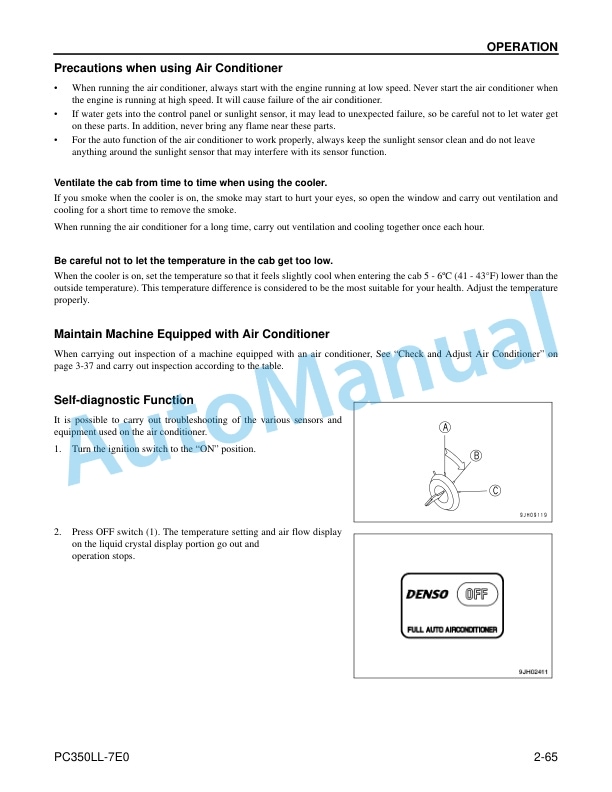
- 3.8.4. Autotemp Air Conditioner
- 3.8.5. Radio
- 3.8.6. Toolbox
- 3.8.7. Grease Gun Holder
- 3.8.8. Auxiliary Power Ports
- 3.9. FUSES AND FUSE LINKS
- 3.9.1. Fuses
- 3.9.2. Fusible Link
- 3.10. HANDLING THE ACCUMULATOR
- 3.10.1. Releasing Pressure in Control Circuit
- 3.11. PRECAUTIONS BEFORE STARTING WORK OPERATIONS
- 3.11.1. Preoperational Checks
- 3.11.2. Seat Belt Inspection
- 3.11.3. Starting the Engine
- 3.12. OPERATIONS AND CHECKS AFTER STARTING ENGINE
- 3.12.1. Breaking in the Machine
- 3.12.2. Stopping the Engine
- 3.13. MOVING, STOPPING AND PARKING THE MACHINE
- 3.13.1. Preparations for Moving the Machine
- 3.13.2. Moving Machine
- 3.13.3. Turning the Machine
- 3.13.4. Swinging
- 3.13.5. General Traveling
- 3.13.6. Stopping Machine
- 3.13.7. Parking Machine
- 3.14. STARTING YOUR WORK OPERATIONS
- 3.14.1. Avoiding Dangerous Situations
- 3.14.2. Working Clearances
- 3.14.3. Operations on Slopes
- 3.14.4. Operations on Snow
- 3.14.5. Work Equipment Overview
- 3.14.6. Operating Modes
- 3.14.7. Excavating Procedures
- 3.15. REPLACING WORK IMPLEMENTS
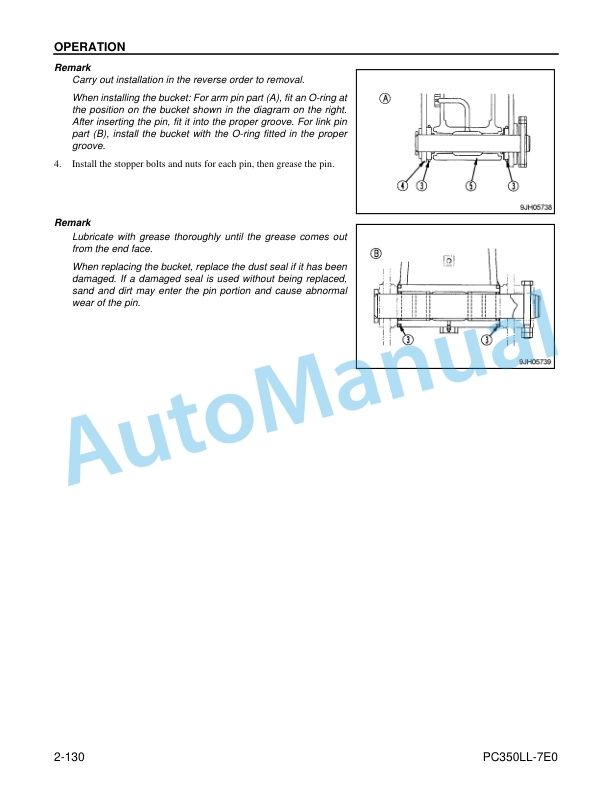
- 3.15.1. Bucket Replacement
- 3.16. TRANSPORTING THE MACHINE
- 3.16.1. Loading and Unloading a Trailer
- 3.16.2. Lifting the Machine
- 3.16.3. Towing the Machine
- 3.17. COLD WEATHER OPERATION
- 3.17.1. Fuel and Lubricants
- 3.17.2. Cooling System Coolant
- 3.17.3. Battery
- 3.17.4. Monitor
- 3.17.5. Precautions On Particular Jobsites
- 3.17.6. Discharged Battery
- 3.18. GENERAL TROUBLESHOOTING
- 3.18.1. After Running Out Of Fuel
- 3.18.2. Phenomena That Are Not Failures
- 3.18.3. Electrical System Problems
- 3.18.4. Chassis Problems
- 3.18.5. Engine Problems
- 3.18.6. Electronic Control System
- 3.18.7. Telephone When Error Occurs
- 3.19. LONG TERM STORAGE
- 3.19.1. Before Storage
- 3.19.2. During Storage
- 3.19.3. After Storage
- 4. MAINTENANCE
- 4.1. MAINTENANCE INFORMATION
- 4.1.1. Service Meter Reading
- 4.1.2. Komatsu Genuine Replacement Parts
- 4.1.3. Komatsu Genuine Lubricants
- 4.1.4. Windshield Washer Fluid
- 4.1.5. Fresh and Clean Lubricants
- 4.1.6. Check Drained Oil and Used Filter
- 4.1.7. Fuel Strainer
- 4.1.8. Welding Instructions
- 4.1.9. Do Not Drop Things Inside Machine
- 4.1.10. Selecting Fuel and Lubricants to Match Ambient Temperature
- 4.1.11. Dusty Jobsite
- 4.1.12. Avoid Mixing Lubricants
- 4.1.13. Locking the Inspection Covers
- 4.1.14. Hydraulic System Air Bleeding
- 4.1.15. Hydraulic Hose Installation
- 4.1.16. Checks after Inspection and Maintenance Works
- 4.2. LUBRICANTS, COOLANT AND FILTERS
- 4.2.1. Outline of Service
- 4.2.2. Handling Oil, Fuel, Coolant, and Performing Oil Clinic
- 4.2.3. Electric System Maintenance
- 4.2.4. Handling Hydraulic System
- 4.3. WEAR PARTS LIST
- 4.4. RECOMMENDED FUEL, COOLANT, AND LUBRICANT
- 4.4.1. Recommended Products Other Than Komatsu Genuine Oils
- 4.5. TIGHTENING TORQUE SPECIFICATIONS
- 4.6. PERIODIC REPLACEMENT OF SAFETY CRITICAL PARTS
- 4.6.1. Safety Related Critical Parts
- 4.7. MAINTENANCE SCHEDULE
- 4.7.1. Maintenance Schedule Chart
- 4.7.2. Maintenance Interval for Hydraulic Breaker
- 4.8. MAINTENANCE PROCEDURE
- 4.8.1. Initial 1000 Hours Maintenance (Only after the First 1000 Hours)
- 4.8.2. When Required
- 4.8.3. Check Before Starting
- 4.8.4. Every 50 Hours Maintenance
- 4.8.5. Every 250 Hours Maintenance
- 4.8.6. Every 500 Hours Maintenance
- 4.8.7. Every 1000 Hours Maintenance
- 4.8.8. Every 2000 Hours Maintenance
- 4.8.9. Every 4000 Hours Maintenance
- 4.8.10. Every 5000 Hours Maintenance
- 4.8.11. Every 8000 Hours Maintenance
- 4.8.12. Lifting Capacity
- 5. OPTIONS, ATTACHMENTS
- 5.1. GENERAL PRECAUTIONS
- 5.1.1. Precautions Related to Safety
- 5.1.2. Precautions for Attachment Removal and Installation
- 5.1.3. Precautions When Using Large Implements
- 5.1.4. Handling Bucket with Hook










Reviews
There are no reviews yet.