
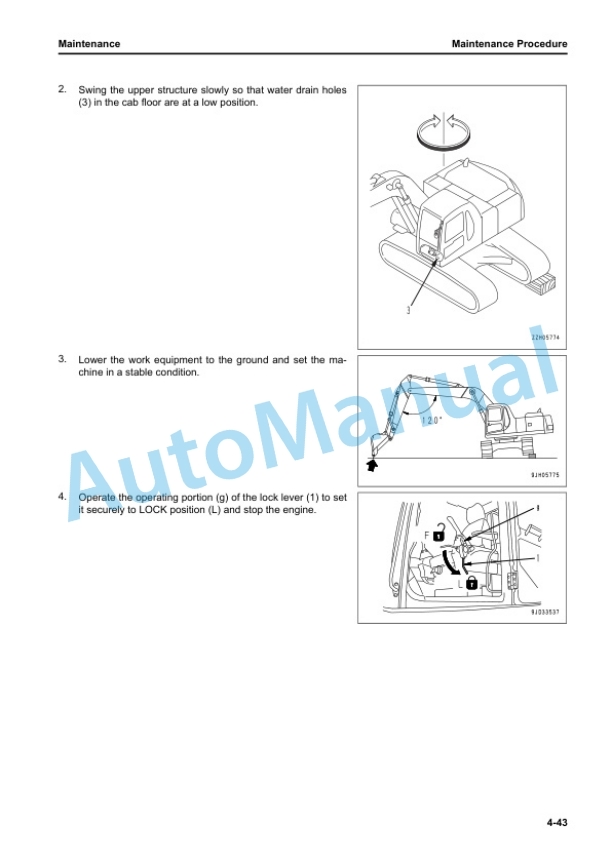
Description
-
Model List:
- PC950-11E0 Hydraulic Excavator
- PC950LC-11E0 Hydraulic Excavator
- 1. Cover
- 2. Foreword
- 2.1. Table of Contents
- 2.2. Read This Manual
- 2.3. Safety Information
- 2.4. Introduction
- 2.4.1. Main Use of Machine
- 2.4.2. Directions of Machine
- 2.4.3. Visibility from Operators Seat
- 2.5. Engine Technology to Conform Exhaust Gas Emission
- 2.6. Product Information
- 2.6.1. Location of Product Identification Number (PIN) and Machine Serial No. Plate
- 2.6.2. Location of Engine Number Plate
- 2.6.3. Service Meter Location
- 2.6.4. Your Machine Serial Numbers and Distributor
- 2.7. Abbreviation List
- 3. Safety
- 3.1. Safety Labels
- 3.1.1. Location of Safety Labels
- 3.1.2. Safety Labels
- 3.2. General Precautions Common to Operation and Maintenance
- 3.2.1. Precautions Before You Start Operation
- 3.2.2. Prepare for Safety Operation
- 3.2.3. Precautions to Prevent Fire
- 3.2.4. Precautions When You Get on or Off Machine
- 3.2.5. Do Not Get Caught
- 3.2.6. Precautions Related to Protective Structures
- 3.2.7. Protection Against Objects Which Fall, Fly, or Enter
- 3.2.8. Unauthorized Modification
- 3.2.9. Precautions Related to Attachments and Options
- 3.2.10. Precautions for CAB Glass
- 3.2.11. Precautions When You Operate Engine Inside Building
- 3.3. Precautions for Operation
- 3.3.1. Precautions for Jobsite
- 3.3.2. Start Engine
- 3.3.3. Precautions for Operation
- 3.3.4. Precautions for Transportation
- 3.3.5. Towing and being Towed
- 3.3.6. Lifting Operation by Bucket with Hook
- 3.4. Precautions for Maintenance
- 3.4.1. Precautions Before Inspection and Maintenance
- 3.4.2. Precautions for Check and Maintenance
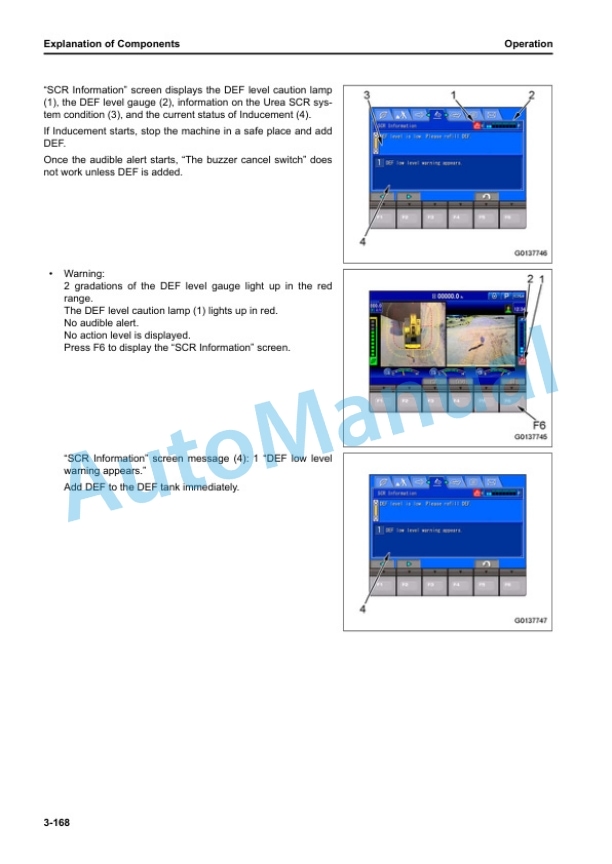
- 3.5. Precautions for DEF
- 3.5.1. General Character and Precautions for Handling
- 3.5.2. Precautions When You Add
- 3.5.3. Precautions for Storage
- 3.5.4. Precautions for Fire Hazard and Leakage
- 3.5.5. Other Precautions
- 4. Operation
- 4.1. General View
- 4.1.1. Machine Equipment Name
- 4.1.2. Cab Equipment Name
- 4.1.3. Controls and Gauges Names
- 4.2. Explanation of Components
- 4.2.1. Machine Monitor Equipment
- 4.2.2. Switches
- 4.2.3. Control Levers and Pedals
- 4.2.4. Other Equipment
- 4.3. Machine Operations and Controls
- 4.3.1. Checks and Adjustment Before You Start Engine
- 4.3.2. How to Start Engine
- 4.3.3. Operations and Checks After You Start Engine
- 4.3.4. How to Stop Engine
- 4.3.5. How to Start Machine (Travel FORWARD and REVERSE) and Stop Machine
- 4.3.6. Steer Machine
- 4.3.7. How to Swing Machine
- 4.3.8. Operate Work Equipment
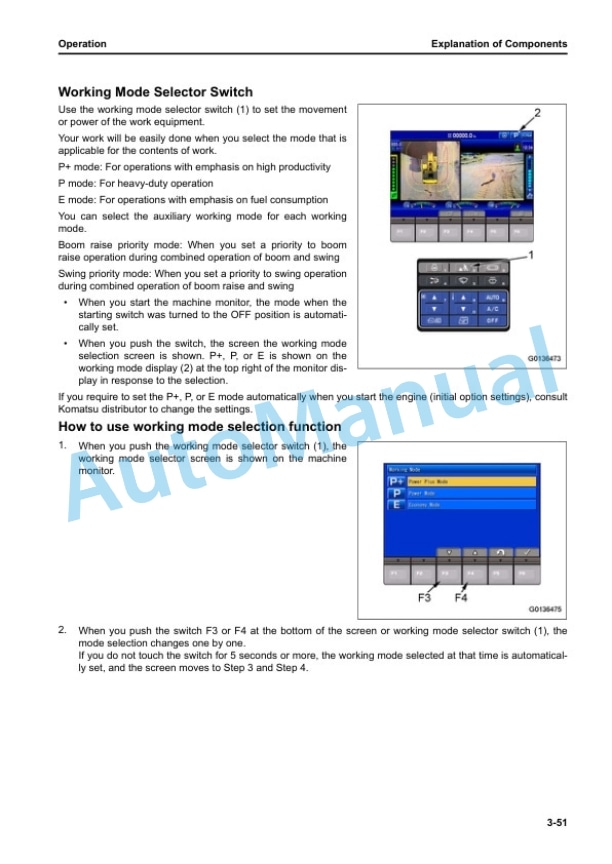
- 4.3.9. Handle Working Mode
- 4.3.10. Prohibited Operations
- 4.3.11. Precautions for Operation
- 4.3.12. Precautions When You Operate Machine on Slopes
- 4.3.13. How to Escape from Mud
- 4.3.14. Recommended Applications
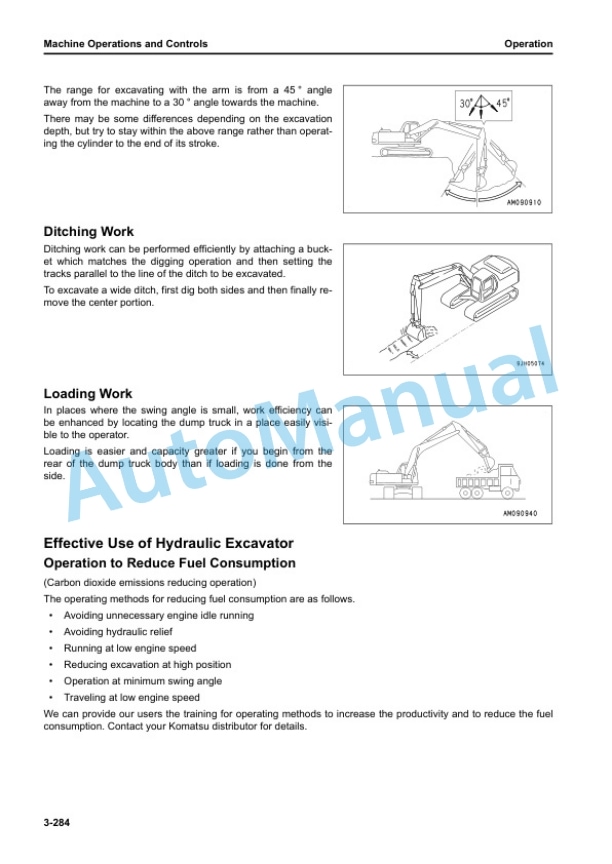
- 4.3.15. Effective Use of Hydraulic Excavator
- 4.3.16. How to Replace Bucket
- 4.3.17. Park Machine
- 4.3.18. How to Examine After You Complete Work
- 4.3.19. Lock
- 4.4. Handle Air Conditioner
- 4.4.1. Explanation of Air Conditioner Components
- 4.4.2. Operate Air Conditioner
- 4.5. Radio (Bluetooth)
- 4.5.1. Explanation of Radio Equipment
- 4.5.2. Operate Radio
- 4.5.3. Radio Setting
- 4.5.4. Stow Antenna
- 4.6. Handle KomVision
- 4.6.1. Precautions When You Use KomVision
- 4.6.2. Monitor Display
- 4.7. Handle Anchor Point for Tieoff
- 4.8. Transportation
- 4.8.1. Precautions When You Transport Machine
- 4.8.2. Select Transportation Method
- 4.8.3. How to Lift Machine
- 4.8.4. Precautions When You Load Machine
- 4.8.5. Machine Configuration for Transportation
- 4.8.6. Spread and Narrow Track Frame Gauge
- 4.9. Cold Weather Operation
- 4.9.1. Cold Weather Operation Information
- 4.9.2. Precautions After Daily Work Ends in Cold Weather
- 4.9.3. After Cold Weather Season
- 4.10. Precautions for LongTerm Storage
- 4.10.1. Prepare for LongTerm Storage
- 4.10.2. Maintenance During LongTerm Storage
- 4.10.3. Start Machine After LongTerm Storage
- 4.11. Troubles and Procedures
- 4.11.1. Procedures When You Run Out of Fuel
- 4.11.2. Phenomena that are Not Failures
- 4.11.3. Precautions When You Tow Machine
- 4.11.4. Precautions for Severe Work Condition
- 4.11.5. Precautions for Discharged Battery
- 4.11.6. Other Trouble
- 5. Maintenance
- 5.1. Precautions for Maintenance
- 5.1.1. Examine Service Meter Reading
- 5.1.2. Komatsu Genuine Replacement Parts
- 5.1.3. Komatsu Genuine Lubricants
- 5.1.4. Always Use Clean Washer Fluid
- 5.1.5. Clean Lubricants
- 5.1.6. Examine Drained Oil and Used Filter
- 5.1.7. Precautions When You Refill Oil or Fuel
- 5.1.8. Precautions When You Add DEF
- 5.1.9. Precautions for Welding
- 5.1.10. Do Not Drop Things Inside Machine
- 5.1.11. Precautions for KDPF
- 5.1.12. Precautions for SCR Assembly
- 5.1.13. Dusty Jobsites
- 5.1.14. Avoid Mixing Oil
- 5.1.15. Lock Inspection Covers
- 5.1.16. Bleed Air from Hydraulic System
- 5.1.17. Precautions When You Install Hydraulic Hoses
- 5.1.18. Checks After Inspection and Maintenance
- 5.1.19. Select Fuel and Lubricants by Ambient Temperature
- 5.1.20. Close Engine Hood Securely
- 5.1.21. Precautions When You Clean Work Equipment Control Lever
- 5.1.22. Handle Anchor Point for Tieoff
- 5.2. Outline of Maintenance
- 5.2.1. Handle Oil, Fuel, Coolant, and Do Oil Clinic
- 5.2.2. Handle Electrical Components
- 5.3. Standard Tightening Torque for Bolts and Nuts
- 5.4. Maintenance Schedule
- 5.4.1. Maintenance Schedule Table
- 5.4.2. Maintenance Interval for Hydraulic Breaker
- 5.5. Maintenance Procedure
- 5.5.1. Initial 100 Hours Maintenance (Only After the First 100 Hours)
- 5.5.2. Initial 250 Hours Maintenance (Only After the First 250 Hours)
- 5.5.3. Initial 500 Hours Maintenance (Only After the First 500 Hours)
- 5.5.4. When Required
- 5.5.5. Examine Before You Start Operation
- 5.5.6. Every 10 Hours Maintenance
- 5.5.7. Every 100 Hours Maintenance
- 5.5.8. Every 250 Hours Maintenance
- 5.5.9. Every 500 Hours Maintenance
- 5.5.10. Every 1000 Hours Maintenance
- 5.5.11. Every 2000 Hours Maintenance
- 5.5.12. Every 2500 Hours Maintenance
- 5.5.13. Every 4000 Hours Maintenance
- 5.5.14. Every 4500 Hours Maintenance
- 5.5.15. Every 5000 Hours Maintenance
- 5.5.16. Every 8000 Hours Maintenance
- 5.5.17. Every 9000 Hours Maintenance
- 5.5.18. Every 6 Months Maintenance
- 6. Specifications
- 6.1. Specifications
- 6.1.1. Specifications PC95011E0
- 6.1.2. Specifications PC95011E0 SE Spec
- 6.1.3. Specifications PC950LC11E0
- 6.1.4. Specifications PC950LC11E0 SE Spec
- 6.1.5. Explanation of Lift Capacity Chart
- 7. Attachments and Options
- 7.1. Precautions When You Use Attachments and Options Safely
- 7.1.1. Precautions When You Select
- 7.1.2. Read the Operation and Maintenance Manual Thoroughly
- 7.1.3. Precautions When You Remove and Install
- 7.1.4. Precautions for Use
- 7.2. Handle Anchor Point for Tieoff
- 7.3. Attachments and Options
- 7.3.1. Install Attachment
- 7.3.2. Track Shoes Selection
- 8. Replacement Parts
- 8.1. Defined Life Parts
- 8.1.1. Defined Life Parts List
- 8.2. Consumable Parts
- 8.2.1. Consumable Parts List
- 8.3. Recommended Fuel, Coolant, and Lubricant
- 8.3.1. Lubrication Chart
- 8.3.2. How to Use Fuel, Coolant and Lubricants by Ambient Temperature
- 8.3.3. Recommended Brands and Qualities Other Than Komatsu Genuine Oils
- 9. Index






Reviews
There are no reviews yet.