
Description
-
Model List:
- BW22
- L10
- L10AS
- L10B
- L12
- L12AS
- L12I
- 1. Industrial truck for battery replacement
- 1.1. Table of content
- 1.2. Introduction
- 1.2.1. Your battery replacement truck
- 1.2.2. Conformity marking
- 1.2.3. Declaration that reflects the content of the declaration of conformity
- 1.2.4. Intended use
- 1.2.5. Impermissible use
- 1.2.6. Description of use and climatic conditions
- 1.2.7. Symbols used
- 1.2.8. Taking delivery of the industrial truck
- 1.2.9. Documentation
- 1.2.10. Disposing of gel and lead batteries
- 1.3. Safety
- 1.3.1. Residual risks
- 1.3.2. Stability
- 1.3.3. Safety regulations
- 1.3.4. Use of lubricants
- 1.3.5. Periodic safety inspection
- 1.4. General views
- 1.4.1. Data plates and adhesive labels
- 1.4.2. Nameplate
- 1.4.3. Overview
- 1.4.4. Operating devices
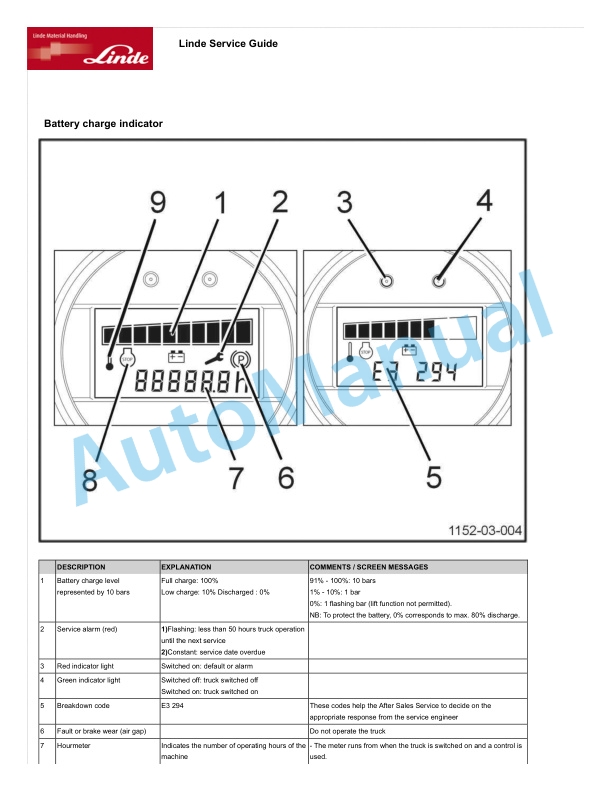
- 1.4.5. Battery charge indicator
- 1.4.6. Digicode option (LFM Go)
- 1.5. Operation
- 1.5.1. Technical description
- 1.5.2. Instructions for runningin
- 1.5.3. Preshift checks
- 1.5.4. Commissioning and driving
- 1.5.4.1. Information on commissioning
- 1.5.4.2. Commissioning
- 1.5.4.3. Using the truck on a slope
- 1.5.4.4. Braking, lifting, lowering, horn
- 1.5.5. Handling loads
- 1.5.6. Error codes
- 1.5.7. Handling the industrial truck in special operating situations
- 1.5.7.1. Emergency lowering
- 1.5.7.2. Truck towing procedure
- 1.5.7.3. Slinging, lifting, towing, transport, storage
- 1.5.8. Handling the battery
- 1.5.8.1. Battery type
- 1.5.8.2. Preparation
- 1.5.8.3. Opening.closing the battery compartment
- 1.5.8.4. Charging the battery using an external charger
- 1.5.8.5. Onboard charger
- 1.5.8.6. Battery replacement
- 1.5.9. Decommissioning
- 1.5.9.1. Parking the battery replacement truck
- 1.5.10. Storage
- 1.5.10.1. Measures to take if the battery replacement truck is to be decommissioned or stored for a long period of time
- 1.5.10.2. Recommissioning after storage
- 1.6. Maintenance
- 1.6.1. Summary of checks and maintenance work
- 1.6.1.1. General information
- 1.6.1.2. Maintenance and inspection intervals
- 1.6.1.3. List of inspections
- 1.6.1.4. Testing and maintenance operations
- 1.6.1.5. Table of maintenance characteristics
- 1.6.2. Safety regulations for maintenance
- 1.6.2.1. Safety measures for maintenance and repair
- 1.6.2.2. Working on the electrical equipment
- 1.6.2.3. Safety devices
- 1.6.2.4. Settings
- 1.6.3. Preparatory procedures for maintenance
- 1.6.3.1. Slinging and jacking up the truck
- 1.6.4. Cleaning
- 1.6.4.1. Cleaning the truck
- 1.6.5. Maintenance as required
- 1.6.5.1. Servicing wheels and rollers
- 1.6.5.2. Battery maintenance
- 1.6.5.3. Servicing the brake
- 1.6.5.4. Lifting device
- 1.6.5.5. Fuses
- 1.6.6. hour maintenance schedule
- 1.6.6.1. Checking the oil level and sealing of the hydraulic system
- 1.6.6.2. Servicing the pump motor
- 1.6.6.3. Maintaining the electrical system
- 1.6.6.4. Servicing the brake
- 1.6.6.5. Checking the air gap
- 1.6.6.6. Checking the lugs
- 1.6.6.7. Servicing the lift mast
- 1.6.6.8. Servicing the lifting accessory
- 1.6.7. hour maintenance schedule
- 1.6.7.1. Maintaining the hydraulic system
- 1.6.7.2. Servicing the lift mast
- 1.6.7.3. Servicing the battery according to the manufacturers instructions
- 1.6.7.4. Electrical insulation test
- 1.6.8. hour maintenance schedule
- 1.6.8.1. Reduction gear maintenance
- 1.7. Technical data
- 1.7.1. Technical data
- 1.7.2. Ecodesign requirements for electric motors and variable speed drives
- 1.7.3. Noise emission values
- 2. Pallet stacker1172_L10, 1172_L10 AS, 1172_L10B, 1172_L12, 1172_L12 AS, 1172_L12i
- 2.1. Table of content
- 2.2. Introduction
- 2.2.1. Forklift data
- 2.2.2. General information
- 2.2.3. How to Consult the Manual
- 2.2.4. Date of edition and latest update of this manual
- 2.2.5. Copyright and trademark rights
- 2.2.6. Delivery of the forklift and documentation
- 2.2.7. Conformity marking
- 2.2.8. Declaration that reflects the content of the declaration of conformity
- 2.2.9. Technical service and spare parts
- 2.2.10. Type of use
- 2.2.11. Working conditions
- 2.2.12. Modifications to Forklift
- 2.2.13. Applied equipment
- 2.2.14. User obligations
- 2.2.15. Environmental considerations
- 2.2.15.1. Disposal of components and batteries
- 2.2.15.2. Packaging
- 2.3. Safety
- 2.3.1. Safety guidelines
- 2.3.1.1. General Precautions
- 2.3.1.2. General Safety Rules
- 2.3.1.3. Flooring requirements
- 2.3.1.4. Battery connection cables
- 2.3.1.5. External electrical connections
- 2.3.1.6. Requirements for the tractionbattery charging area
- 2.3.1.7. Safety Regulations Relative to Forklift Use
- 2.3.1.8. Safety guidelines relating to operating materials
- 2.3.2. Residual risk
- 2.3.2.1. Residual dangers, residual risks
- 2.3.3. Electromagnetic radiation
- 2.3.4. Nonionised radiation
- 2.3.5. Noise
- 2.3.6. Electrostatic charge
- 2.3.7. Vibrations
- 2.3.8. Declaration of conformity in accordance with Radio Equipment Directive 2014.53.EU
- 2.3.9. Safety devices
- 2.3.9.1. Damage, defects and misuse of safety devices
- 2.4. Overview
- 2.4.1. Technical description
- 2.4.2. Plates and labels
- 2.4.3. General view
- 2.4.4. Commands
- 2.4.5. Battery charge indicator
- 2.4.6. Electronic key (option)
- 2.5.1. Authorised and safe use
- 2.5.1.1. Intended use of the trucks
- 2.5.1.2. Safety instructions relating to use of the truck
- 2.5.2. Transporting and lifting the truck
- 2.5.2.1. Transporting the truck
- 2.5.2.2. Climatic Conditions for Transport and Storage
- 2.5.2.3. Loading and unloading the truck
- 2.5.3. BreakingIn
- 2.5.4. Checks and operations prior to use
- 2.5.4.1. Commissioning
- 2.5.4.2. Checks before first use
- 2.5.4.3. Daily checks before use
- 2.5.5. Ergonomic dimensions
- 2.5.6. Commissioning and driving
- 2.5.6.1. Drive
- 2.5.6.2. Reversing the direction of travel
- 2.5.6.3. Truck brake systems
- 2.5.6.4. Driving on slopes
- 2.5.6.5. Braking, lifting, lowering, horn
- 2.5.6.6. Parking and stopping the truck
- 2.5.7. Load handling
- 2.5.7.1. Load handling safety rules
- 2.5.7.2. Load handling
- 2.5.7.3. Towing trailers
- 2.5.8. Cold store use
- 2.5.8.1. Forklift Use in ColdStorage Rooms.
- 2.5.9. Connect
- 2.5.9.1. connect access system (LFM)
- 2.5.10. Fault displays
- 2.5.10.1. Error codes
- 2.5.11. Charging the battery
- 2.5.11.1. Battery type
- 2.5.11.2. Preparation
- 2.5.11.3. Opening.closing the battery compartment
- 2.5.11.4. Charging the battery using an external charger
- 2.5.11.5. Onboard charger
- 2.5.11.6. Battery replacement
- 2.5.11.7. Using the truck with extension leads
- 2.6. Maintenance
- 2.6.1. General Information
- 2.6.2. Preliminary maintenance operations
- 2.6.3. Regular Service
- 2.6.3.1. Cleaning the Forklift
- 2.6.3.2. Lubricating and cleaning the lifting chains
- 2.6.4. Maintenance plans
- 2.6.4.1. Maintenance plans
- 2.6.4.2. Fuses
- 2.6.4.3. Replacing the battery from above for trucks with 1000 kg and 1200 kg capacity
- 2.6.4.4. Replacing the battery from above for trucks with 1400 kg capacity
- 2.6.4.5. Battery replacement for version with side removal
- 2.6.5. Decommissioning
- 2.6.5.1. General Information
- 2.6.5.2. Forklift Towing
- 2.6.5.3. Temporary Putting Out of Commission
- 2.6.5.4. Checks and Inspections After a Long Period of Inactivity
- 2.6.5.5. Permanent Putting Out of Commission (Demolition)
- 2.7. Technical specifications
- 2.7.1. Technical specification
- 2.7.2. Noise emission values
- 2.7.3. Supply table
- 2.7.4. Ecodesign requirements for electric motors and variable speed drives


There are no reviews yet.