
Description
-
Model List:
- 25 Compact Boomer Stage V Compact Tractor
- 1. GENERAL INFORMATION
- 1.1. Note to the Owner
- 1.2. Intended use statement
- 1.3. ElectroMagnetic Compatibility (EMC)
- 1.4. Product Identification Number (PIN)
- 1.5. Operators manual storage on the machine
- 1.6. Machine orientation
- 1.7. Note to the Owner
- 2. SAFETY INFORMATION
- 2.1. Safety rules and signal word definitions
- 2.2. Safety rules
- 2.3. Do not operate tag
- 2.4. Ecology and the environment
- 2.5. Safety aspects in accordance with Regulation (EU) 1322/2014 Annex XXII and subsequent amendments and modifications
- 2.6. Airborne noise emission
- 2.7. Vibration levels
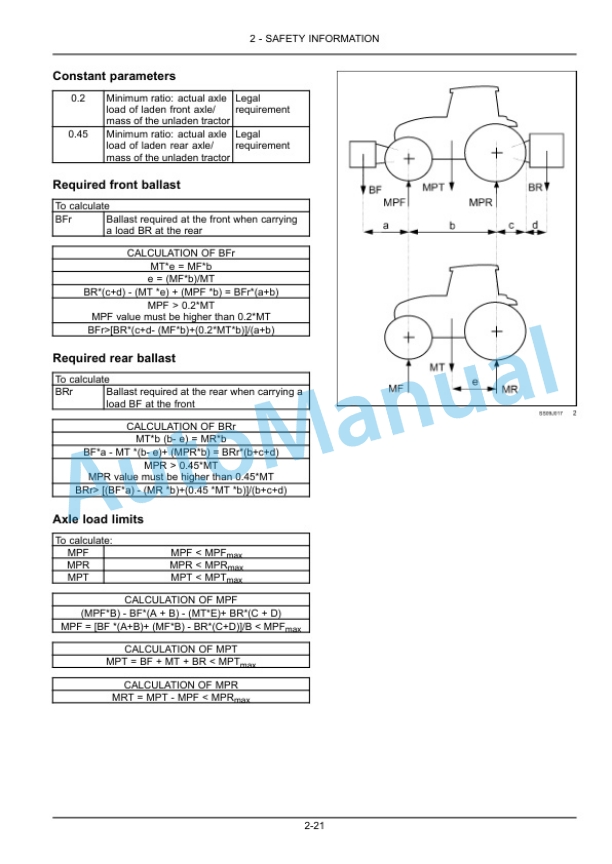
- 2.8. Machine stability
- 2.9. Safety signs
- 2.10. Instructional signs
- 3. CONTROLS AND INSTRUMENTS
- 3.1. Access to operators platform
- 3.1.1. Access to operators platform
- 3.2. Operators seat
- 3.2.1. Seat belt
- 3.2.2. Operators seat Adjust
- 3.3. Forward controls
- 3.3.1. Multifunction light switch
- 3.3.2. Instrument cluster panel
- 3.3.3. Power TakeOff (PTO) switch
- 3.3.4. Midmount twospool control valve lever
- 3.3.5. Hand throttle lever
- 3.3.6. Horn switch
- 3.3.7. Hazard lights switch
- 3.3.8. Stationary Power TakeOff (PTO) switch
- 3.3.9. Forward travel pedal
- 3.3.10. Reverse travel pedal
- 3.3.11. Cruise control switch
- 3.3.12. Key switch
- 3.3.13. Park brake lever
- 3.3.14. Service brake pedal
- 3.4. Lefthand side controls
- 3.4.1. Auxiliary power outlet
- 3.4.2. Power TakeOff (PTO) shift lever
- 3.5. Righthand side controls
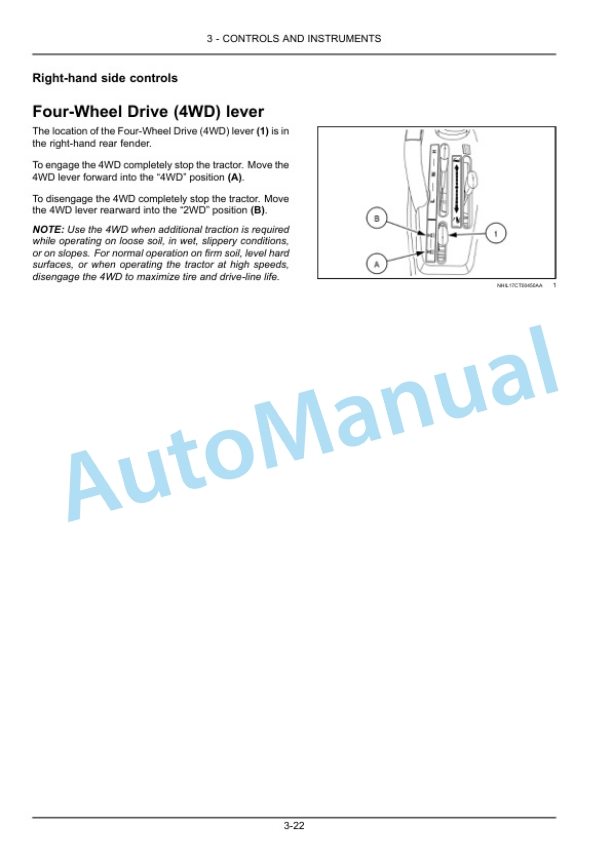
- 3.5.1. FourWheel Drive (4WD) lever
- 3.5.2. Transmission range lever
- 3.5.3. Threepoint hitch lever
- 3.6. Rearward controls
- 3.6.1. Drop rate control valve
- 3.6.2. Midmount mower deck height adjustment knob
- 3.6.3. Differential lock pedal
- 3.6.4. Rear remote control valve Optional
- 3.7. Exterior controls
- 3.7.1. Hood release latch
- 3.7.2. Beacon socket
- 3.7.3. Trailer 7Pole Electric Socket
- 3.7.4. Tool box
- 4. OPERATING INSTRUCTIONS
- 4.1. Commissioning the unit
- 4.1.1. Engine Runningin Procedure
- 4.1.2. Safety rules Diesel fuel
- 4.1.3. General specification Biodiesel fuels
- 4.1.4. Refueling the tractor
- 4.2. Starting the unit
- 4.2.1. Starting the engine
- 4.2.2. Cold starting aids
- 4.2.3. Starting the tractor with jumper cables
- 4.3. Stopping the unit
- 4.3.1. Stopping the engine
- 4.3.2. Stopping the unit Brakes
- 4.3.3. Emergency stopping
- 4.4. Moving the unit
- 4.4.1. Steering Operation
- 4.4.2. Hydrostatic Transmission (HST) Operation
- 4.4.3. Transmission operation at low ambient temperatures
- 4.5. Parking the unit
- 4.5.1. Park brake Operation
- 5. TRANSPORT OPERATIONS
- 5.1. Road transport
- 5.1.1. Road transport Overview
- 5.2. Shipping transport
- 5.2.1. Carrying the tractor on a transporter
- 5.3. Recovery transport
- 5.3.1. Towing the tractor
- 6. WORKING OPERATIONS
- 6.1. General information
- 6.1.1. External lighting Operating
- 6.1.2. Roll Over Protective Structure (ROPS) Fold up/down
- 6.1.3. Ballasting the tractor
- 6.1.4. Tractor ballasting weights
- 6.1.5. Operator presence system
- 6.1.6. Rear threepoint hitch Operation
- 6.1.7. Rear threepoint hitch Overview
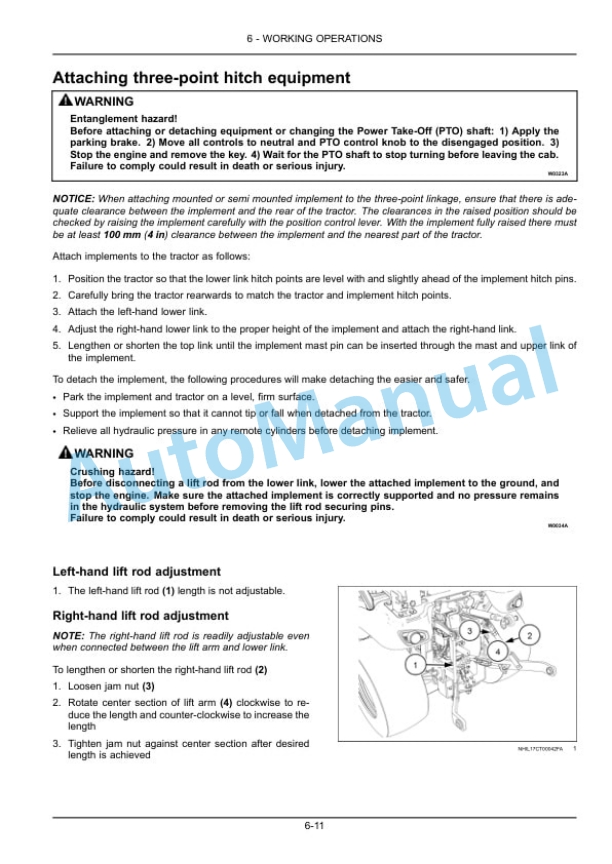
- 6.1.8. Attaching threepoint hitch equipment
- 6.1.9. Drawbar Operation
- 6.1.10. Power TakeOff (PTO) Operation
- 7. MAINTENANCE
- 7.1. General information
- 7.1.1. Safety rules
- 7.1.2. Engine cooling system Basic instructions
- 7.1.3. Engine side panel remove and install
- 7.1.4. Battery location and service
- 7.1.5. Battery disconnect switch
- 7.1.6. Tractor jacking points
- 7.1.7. Consumables
- 7.2. Maintenance planning
- 7.2.1. Maintenance chart
- 7.3. Every 8 hours or daily
- 7.3.1. Engine lubrication system Check
- 7.3.2. Engine cooling system Check
- 7.3.3. Hydrostatic transmission Check
- 7.3.4. Radiator screen cleaning
- 7.4. After the first 50 hours of operation
- 7.4.1. Engine Change fluid
- 7.4.2. Fuel filters Replace
- 7.4.3. Prefilter Replace
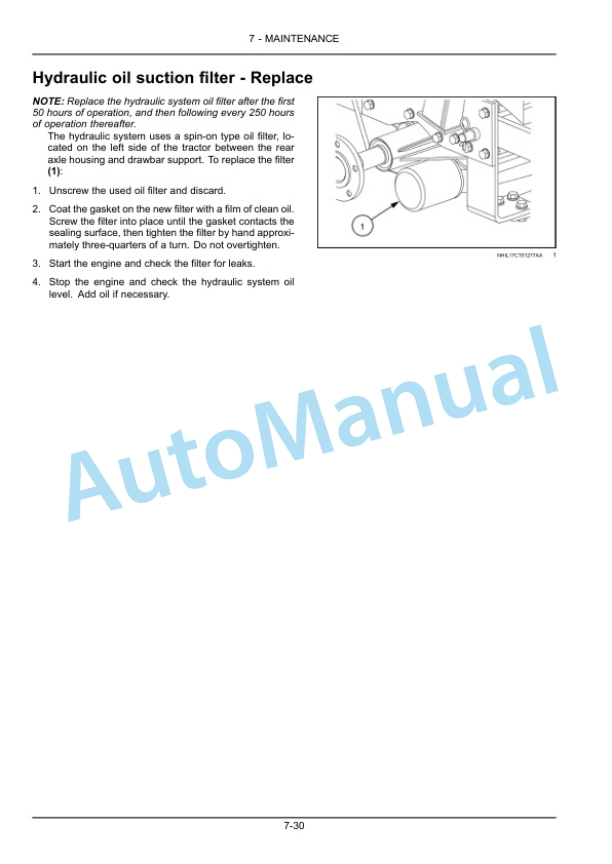
- 7.4.4. Hydraulic oil suction filter Replace
- 7.4.5. Hydrostatic Transmission (HST) oil filter Replace
- 7.4.6. Roll Over Protective Structure (ROPS) frame Check
- 7.5. Every 50 hours
- 7.5.1. Hydrostatic transmission Check
- 7.5.2. Mechanical service brakes Check
- 7.5.3. Hydrostatic transmission (HST) neutral adjustment Check
- 7.5.4. Belt Check
- 7.5.5. Tire pressure Check
- 7.5.6. Front axle differential fluid level Check
- 7.5.7. Air cleaner Cleaning
- 7.6. Every 250 hours
- 7.6.1. Engine Change fluid
- 7.6.2. Hydraulic oil suction filter Replace
- 7.6.3. Oil filter Replace
- 7.6.4. Roll Over Protective Structure (ROPS) frame Check
- 7.6.5. Wheel hardware Check
- 7.6.6. Front wheels toein Check
- 7.6.7. Air cleaner Replace
- 7.7. Every 500 hours
- 7.7.1. Front axle differential fluid Change
- 7.7.2. Hydrostatic transmission Check
- 7.7.3. Fuel filters Replace
- 7.7.4. Prefilter Replace
- 7.8. Every 1000 hours
- 7.8.1. Engine valve clearance Check and adjust
- 7.9. Every two years
- 7.9.1. Engine cooling system Drain fluid And flush
- 7.10. General maintenance
- 7.10.1. Fuel injection system Bleed
- 7.10.2. Belt Adjust
- 7.10.3. Battery Test
- 7.10.4. Headlight Replace
- 7.10.5. Turn signal and hazard bulb Replace
- 7.11. Fuse and relay locations
- 7.11.1. Fuses Check
- 7.11.2. Main fuse Check
- 7.12. Storage
- 7.12.1. Preparation for storage
- 7.12.2. Removal from storage
- 8. TROUBLESHOOTING
- 8.1. Symptom(s)
- 8.1.1. Engine Troubleshooting
- 8.1.2. Mechanical service brakes Troubleshooting
- 8.1.3. Rear threepoint hitch Troubleshooting
- 8.1.4. Steering Troubleshooting
- 8.1.5. Hydrostatic transmission Troubleshooting
- 8.1.6. Electrical system Troubleshooting
- 9. SPECIFICATIONS
- 9.1. Tractor general specifications
- 9.2. Tractor dimensions
- 10. FORMS AND DECLARATIONS
- 10.1. Predelivery report Dealers copy
- 10.2. Predelivery report Owners copy


There are no reviews yet.