Komatsu MX45 Operation and Maintenance Manual 054-107
$30.00
- Type Of Manual: Operation and Maintenance Manual
- Manual ID: 054-107
- Format: PDF
- Size: 7.2MB
- Number of Pages: 259
Description
- 1. MAIN MENU
- 2. Cover
- 3. Foreword
- 3.1. Your Machine Serial Numbers and Dealer
- 3.2. Safety Information
- 3.2.1. Signal Words
- 3.2.2. Example of Safety Message Using Signal Word
- 3.2.3. Other Signal Words
- 3.2.4. Safety Labels
- 3.2.5. Example of Safety Label Using Words
- 3.2.6. Example of Safety Label Using Pictogram
- 3.3. Introduction
- 3.3.1. Directions of Machine
- 3.4. Product Information
- 3.4.1. Machine Serial Number Plate and Its Location
- 3.4.2. Engine Serial Number Plate and Its Location
- 3.4.3. Emission Control Information Label and Its Location
- 3.4.4. Service Meter Location
- 3.5. Contents
- 4. Safety
- 4.1. Safety Labels
- 4.1.1. Location of Safety Labels
- 4.1.2. Safety Labels
- 4.2. Safety Information
- 4.2.1. Safety Rules
- 4.2.2. If Abnormalities Are Found
- 4.2.3. Working Wear and Personal Protective Items
- 4.2.4. Fire Extinguisher and First Aid Kit
- 4.2.5. Safety Equipment
- 4.2.6. Keep Machine Clean
- 4.2.7. Keep Operators Compartment Clean
- 4.2.8. Leaving Operators Seat with Lock
- 4.2.9. Handrails and Steps
- 4.2.10. Mounting and Dismounting
- 4.2.11. No Persons on Attachments
- 4.2.12. Do Not Get Caught in Articulated Portion
- 4.2.13. Burn Prevention
- 4.2.14. Fire Prevention and Explosion Prevention
- 4.2.15. Action if Fire Occurs
- 4.2.16. Windshield Washer Fluid
- 4.2.17. Falling Objects, Flying Objects and Intruding Objects Prevention
- 4.2.18. Attachment Installation
- 4.2.19. Attachment Combinations
- 4.2.20. Cab Window Glasses
- 4.2.21. Unauthorized Modifications
- 4.2.22. Safety at Jobsite
- 4.2.23. Working on Loose Ground
- 4.2.24. Distance to High Voltage Cables
- 4.2.25. Ensure Good Visibility
- 4.2.26. Ventilation for Enclosed Area
- 4.2.27. Signalmans Signal and Signs
- 4.2.28. Emergency Exit from Operators Cab
- 4.2.29. Asbestos Dust Hazard Prevention
- 4.3. Safe Machine Operation
- 4.3.1. Starting Engine
- 4.3.2. Operation
- 4.3.3. Transportation
- 4.3.4. Battery
- 4.3.5. Towing
- 4.3.6. Lifting Objects with Bucket
- 4.4. Safe Maintenance Information
- 4.4.1. Warning Tag
- 4.4.2. Keep Work Place Clean and Tidy
- 4.4.3. Appoint Leader When Working with Others
- 4.4.4. Stop Engine Before Carrying Out Maintenance
- 4.4.5. Two Workers for Maintenance When Engine is Running
- 4.4.6. Proper Tools
- 4.4.7. Personnel
- 4.4.8. Attachments
- 4.4.9. Work Under the Machine
- 4.4.10. Noise
- 4.4.11. When Using Hammer
- 4.4.12. Welding Works
- 4.4.13. Removing Battery Terminals
- 4.4.14. Safety First When Using HighPressure Grease to Adjust Track Tension
- 4.4.15. Do Not Disassemble Recoil Springs
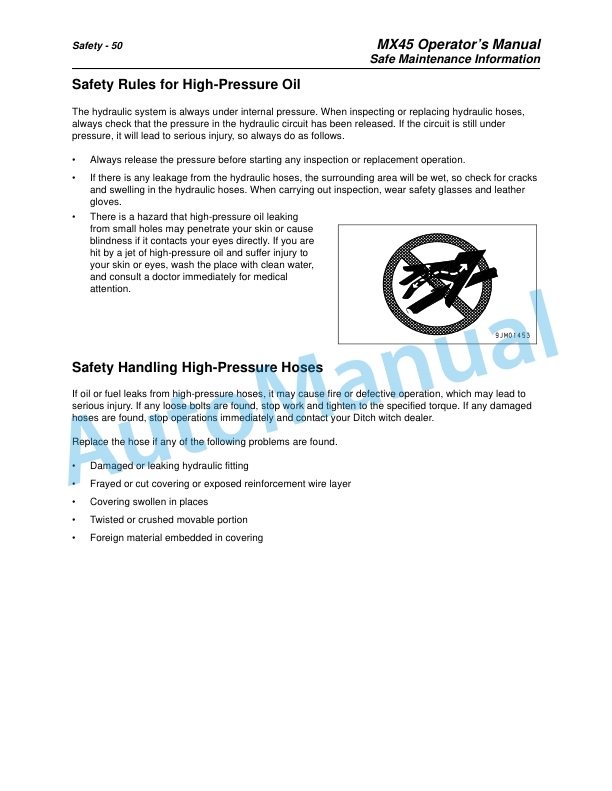
- 4.4.16. Safety Rules for HighPressure Oil
- 4.4.17. Safety Handling HighPressure Hoses
- 4.4.18. Waste Materials
- 4.4.19. Air Conditioner Maintenance
- 4.4.20. Compressed Air
- 4.4.21. Periodic Replacement of Safety Critical Parts
- 5. Operation
- 5.1. Machine View Illustrations
- 5.1.1. Overall Machine View
- 5.1.2. Controls and Gauges
- 5.2. Detailed Controls and Gauges
- 5.2.1. Monitoring System
- 5.2.2. Switches
- 5.2.3. Control Levers and Pedals
- 5.2.4. Windshield
- 5.2.5. Sliding Door
- 5.2.6. Sliding Window
- 5.2.7. Rear Window
- 5.2.8. Emergency Escape Hammer
- 5.2.9. Auxiliary Electric Power
- 5.2.10. Operators Manual Storage
- 5.2.11. Tool Box
- 5.2.12. Grease Pump Holder
- 5.2.13. Ashtray
- 5.3. Machine Operations and Controls
- 5.3.1. Before Starting Engine
- 5.3.2. Starting Engine
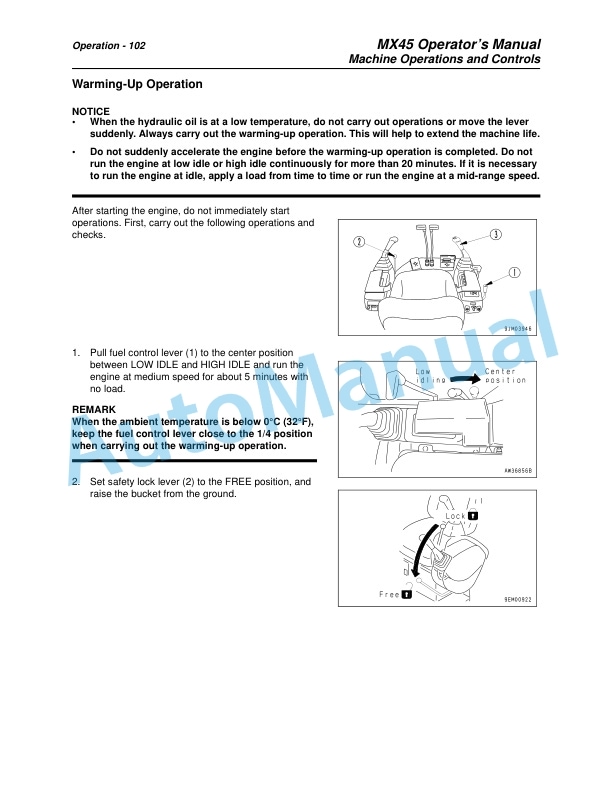
- 5.3.3. After Starting Engine
- 5.3.4. Stopping the Engine
- 5.3.5. Check After Shutting Off Engine
- 5.3.6. Machine Operation
- 5.3.7. Steering the Machine
- 5.3.8. Swinging
- 5.3.9. Backhoe Controls and Operations
- 5.3.10. Prohibited Operations
- 5.3.11. General Operation Information
- 5.3.12. Traveling on Slopes
- 5.3.13. Escape from Mud
- 5.3.14. Recommended Applications
- 5.3.15. Bucket Replacement
- 5.3.16. Parking Machine
- 5.3.17. Machine Inspection After Daily Work
- 5.3.18. Locking
- 5.3.19. Rubber Tracks and TurfFriendly Tracks
- 5.4. Transportation
- 5.4.1. Transportation Procedure
- 5.4.2. Loading and Unloading with Trailer
- 5.4.3. Lifting Machine
- 5.5. Cold Weather Operation
- 5.5.1. Cold Weather Operation Information
- 5.5.2. Cab Heater in Cold Weather
- 5.5.3. After Daily Work Completion
- 5.5.4. After Cold Weather Season
- 5.6. LongTerm Storage
- 5.6.1. Before Storage
- 5.6.2. During Storage
- 5.6.3. After Storage
- 5.7. Troubles and Actions
- 5.7.1. Running Out of Fuel
- 5.7.2. Phenomena That Are Not Failures
- 5.7.3. Towing the Machine
- 5.7.4. Severe Job Conditions
- 5.7.5. Discharged Battery
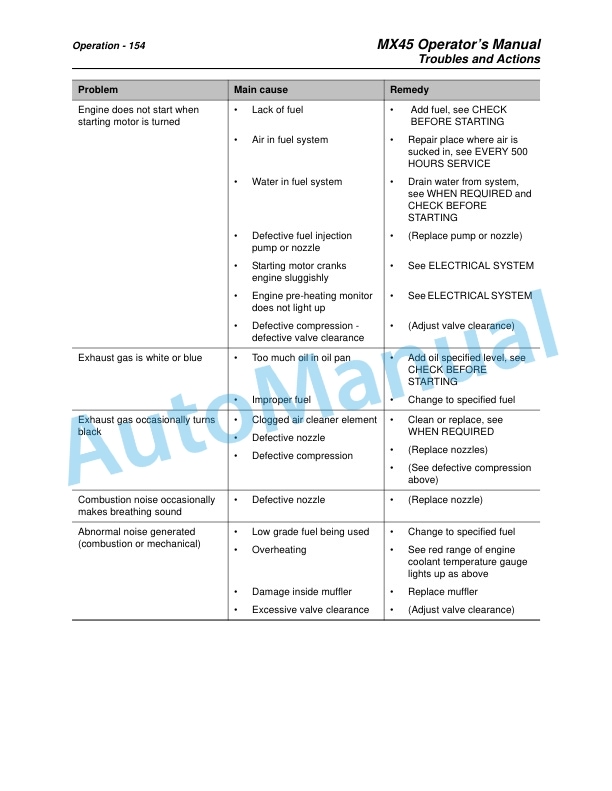
- 5.7.6. Other Trouble
- 6. Maintenance
- 6.1. Maintenance Information
- 6.2. Lubricants, Coolant, and Filters
- 6.2.1. Handling Oil, Fuel, and Coolant
- 6.2.2. Electric System Maintenance
- 6.3. Lubricants, Fuel, and Coolant Specifications
- 6.3.1. Proper Selection
- 6.4. Tightening Torque Specifications
- 6.4.1. Tightening Torque List
- 6.5. Maintenance Schedule
- 6.5.1. Maintenance Interval for Hydraulic Breaker
- 6.6. Maintenance Procedure
- 6.6.1. Initial 250 Hour Maintenance (Only After the First 250 Hours)
- 6.6.2. When Required
- 6.6.2.1. Check, Clean, and Replace Air Cleaner Element
- 6.6.2.2. Clean Inside of Cooling System
- 6.6.2.3. Clean Water Separator Element
- 6.6.2.4. Drain Water and Sediment from Fuel Tank
- 6.6.2.5. Check and Tighten Track Shoe Bolts
- 6.6.2.6. Check and Adjust Track Tension
- 6.6.2.7. Check Rubber Tracks or TurfFriendly Tracks
- 6.6.2.8. Check and Adjust Rubber Track Tension
- 6.6.2.9. Replace Bucket Teeth
- 6.6.2.10. Check Window Washer Fluid Level, Add Fluid
- 6.6.2.11. Check, Clean and Lubricate Cab Slide Door Rail and Roller
- 6.6.2.12. Bleeding Air from Hydraulic System
- 6.6.3. Check Before Starting
- 6.6.4. Every 100 Hours Maintenance
- 6.6.4.1. Lubricating
- 6.6.5. Every 250 Hours Maintenance
- 6.6.5.1. Replace Engine Oil in Engine Oil Pan
- 6.6.5.2. Replace Hydraulic Filter Element
- 6.6.5.3. Check and Adjust Cooling Fan Belt Tension
- 6.6.5.4. Check Level of Battery Electrolyte
- 6.6.6. Every 500 Hours Maintenance
- 6.6.6.1. Replace Engine Oil Filter Cartridge
- 6.6.6.2. Replace Fuel Filter Element
- 6.6.6.3. Check Oil Level in Final Drive Case, Add Oil
- 6.6.6.4. Lubricating
- 6.6.6.5. Clean and Inspect Radiator Fins and Oil Cooler Fins
- 6.6.7. Every 1000 Hours Maintenance
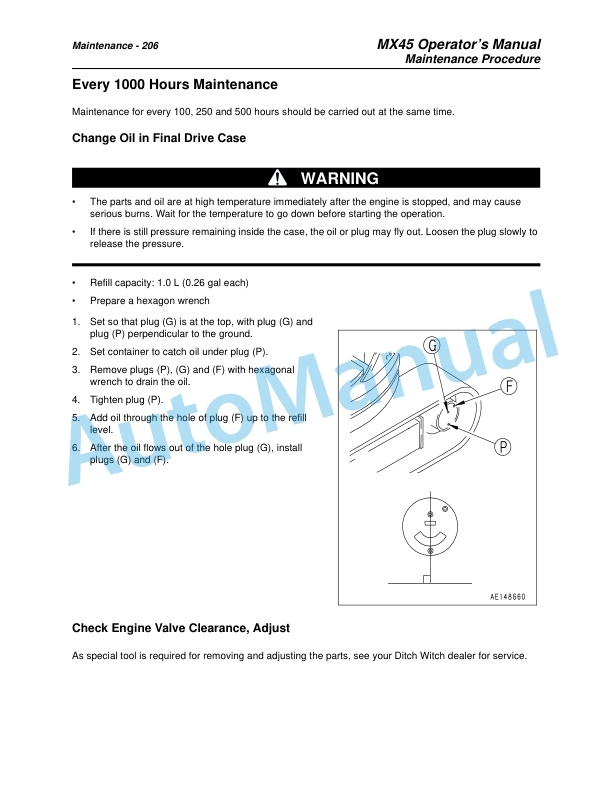
- 6.6.7.1. Change Oil in Final Drive Case
- 6.6.7.2. Check Engine Valve Clearance, Adjust
- 6.6.8. Every 2000 Hours Maintenance
- 6.6.8.1. Change Oil in Hydraulic Tank, Clean Strainer
- 6.6.8.2. Check Alternator, Starting Motor
- 7. Specifications
- 8. Attachments and Options
- 8.1. General Information
- 8.1.1. Safety First
- 8.1.2. Attachment Installation
- 8.2. Bucket with Hook
- 8.2.1. Hook Condition
- 8.2.2. Prohibited Operations
- 8.3. Air Conditioner
- 8.3.1. Control Panel and Components
- 8.3.2. Air Conditioner Controls
- 8.3.3. Air Conditioner Maintenance
- 8.4. Defroster Controls
- 8.4.1. Control Panel
- 8.5. Machine Ready for Attachment
- 8.5.1. Locations
- 8.5.2. Hydraulic Circuit
- 8.5.3. Attachment Operation
- 8.5.4. LongTerm Storage
- 8.6. Changing Machine Control Pattern
- 8.6.1. Control Pattern Change Procedure
- 8.6.2. Machine Control Patterns
- 8.7. Telescopic Arm
- 8.7.1. Extension and Retraction of Arm
- 8.7.2. Precautions in Use
- 8.7.3. Maintenance Procedure
- 8.7.4. Specifications
- 8.8. Power Angle, Power Tilt Blade
- 8.8.1. Blade Control Lever
- 8.8.2. Every 100 Hours Service
- 8.8.3. Every 500 Hours Service
- 8.8.4. Specifications
- 8.9. Attachment Guide
- 8.9.1. Attachment Combinations
- 8.10. Recommended Attachment Operations
- 8.10.1. Hydraulic Breaker
- 9. Support
- 9.1. Procedure
- 9.2. Resources
- 9.2.1. Publications
- 9.2.2. Ditch Witch Training
- 10. Warranty




Reviews
There are no reviews yet.