
Description
-
Model List:
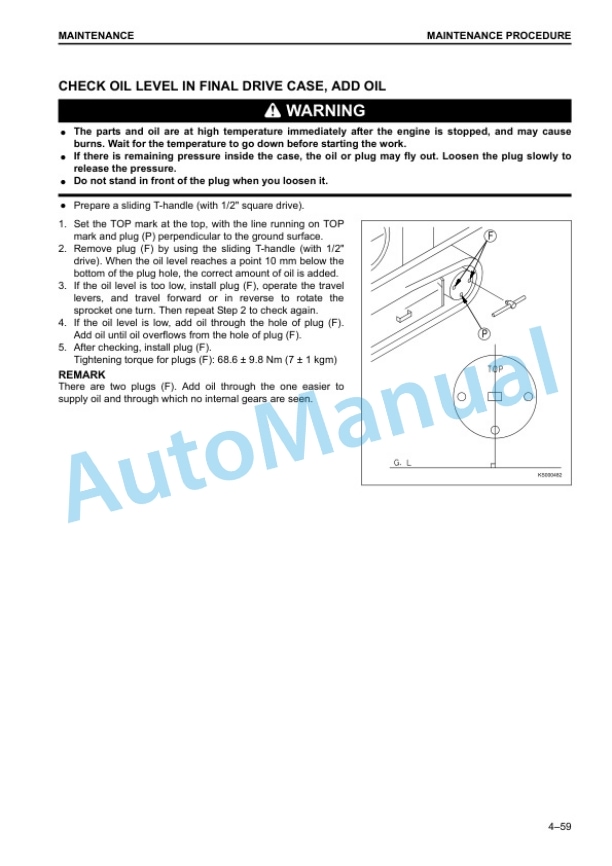
- PC490-10 Demolition Base Spec PC490LC-10 Demolition Base Spec Hydraulic Excavator
- PC490LC-10 Demolition Base Spec PC490LC-10 Demolition Base Spec Hydraulic Excavator
- PC490-10 Demolition Base Spec PC490LC-10 Demolition Base Spec Hydraulic Excavator
- 1. FOREWORD
- 1.1. FOREWORD
- 1.2. SAFETY INFORMATION
- 1.3. NOISE (PC49010, PC490LC10)
- 1.4. vibration levels
- 1.5. INTRODUCTION
- 1.6. PRODUCT INFORMATION
- 1.6.1. PRODUCT IDENTIFICATION NUMBER (PIN) / MACHINE SERIAL NO. PLATE
- 1.6.2. EPA regulations, engine number plate
- 1.6.3. Service meter location
- 1.6.4. Your machine serial numbers and distributor
- 1.6.5. SERIAL PLATE
- 1.7. declaration of conformity
- 1.8. Contents
- 2. SAFETY
- 2.1. Safety
- 2.2. SAFETY LABELS
- 2.2.1. LOCATION OF SAFETY LABELS
- 2.2.2. SAFETY LABELS
- 2.3. General precautions common to operation and maintenance
- 2.3.1. Precautions before starting operation
- 2.3.2. Preparations for safe operation
- 2.3.3. Fire prevention
- 2.3.4. Precautions when getting on or off machine
- 2.4. Precautions for operation and maintenance
- 2.4.1. DO NOT GET CAUGHT IN WORK EQUIPMENT
- 2.4.2. Precautions related to protective structures
- 2.4.3. Protection against falling, flying, or intruding objects
- 2.4.4. ACTIONS IN THE EVENT OF DAMAGE TO SAFETY STRUCTURES
- 2.4.5. UNAUthorised modification
- 2.4.6. Precautions related to attachments and options
- 2.4.7. PRECAUTIONS RELATED TO CAB GLASS
- 2.4.8. PRECAUTIONS WHEN RUNNING ENGINE INSIDE BUILDING
- 2.5. Precautions for operation and maintenance
- 2.5.1. Precautions for jobsite
- 2.6. SAFETY MACHINE OPERATION
- 2.6.1. Starting engine
- 2.6.2. When operating
- 2.6.3. TRANSPORTATION
- 2.6.4. Towing
- 2.6.5. Safety rules for lifting operations
- 2.7. Precautions for maintenance
- 2.7.1. Precautions before starting inspection and maintenance
- 2.7.2. Precautions for inspection and maintenance
- 3. OPERATION
- 3.1. General view
- 3.1.1. General view of machine
- 3.1.2. General view of cab
- 3.1.3. GENERAL VIEW OF CONTROLS AND GAUGES
- 3.2. Explanation of components
- 3.2.1. Machine monitor
- 3.2.2. SWitches
- 3.2.3. CONTROL LEVERS AND PEDALS
- 3.2.4. ROOF WINDOW
- 3.2.5. Opening and closing cab front window
- 3.2.6. EMERGENCY ESCAPE HAMMER
- 3.2.7. Door lock
- 3.2.8. Cab door hinge
- 3.2.9. Opening and closing engine hood
- 3.2.10. LOCK AND UNLOCK ENGINE HOOD
- 3.2.11. CAPS AND COVERS WITH LOCK
- 3.2.12. Drink box
- 3.2.13. Magazine box
- 3.2.14. Cup holder
- 3.2.15. Ashtray
- 3.2.16. HANDLING AIR CONDITIONER
- 3.2.17. HANDLING RADIO
- 3.2.18. SPACE FOR RADIO CASSETTE
- 3.2.19. AUXILIARY ELECTRIC POWER
- 3.2.20. Fuse
- 3.2.21. Fusible link
- 3.2.22. TOOL BOX
- 3.2.23. Grease pump holder
- 3.2.24. Fire extinguisher
- 3.2.25. BATTERY DISCONNECT SWITCH
- 3.2.26. System operating lamp
- 3.2.27. HANDLING KDPF
- 3.2.28. HANDLING KCCV
- 3.2.29. Handling machines equipped with KOMTRAX
- 3.3. Machine operations and controls
- 3.3.1. CHECKS AND ADJUSTMENT BEFORE STARTING ENGINE
- 3.3.2. STARTING ENGINE
- 3.3.3. OPERATIONS AND CHECKS AFTER STARTING ENGINE
- 3.3.4. STOPPING ENGINE
- 3.3.5. MACHINE OPERATION
- 3.3.6. Steering machine
- 3.3.7. SWINGING MACHINE
- 3.3.8. WORK EQUIPMENT CONTROLS AND OPERATIONS
- 3.3.9. WORKING MODE
- 3.3.10. Prohibited operations
- 3.3.11. RULES FOR OPERATION
- 3.3.12. Travelling on slopes
- 3.3.13. Escape from mud
- 3.3.14. RECOMMENDED APPLICATIONS
- 3.3.15. REPLACING AND INVERTING BUCKET
- 3.3.16. When parking machine
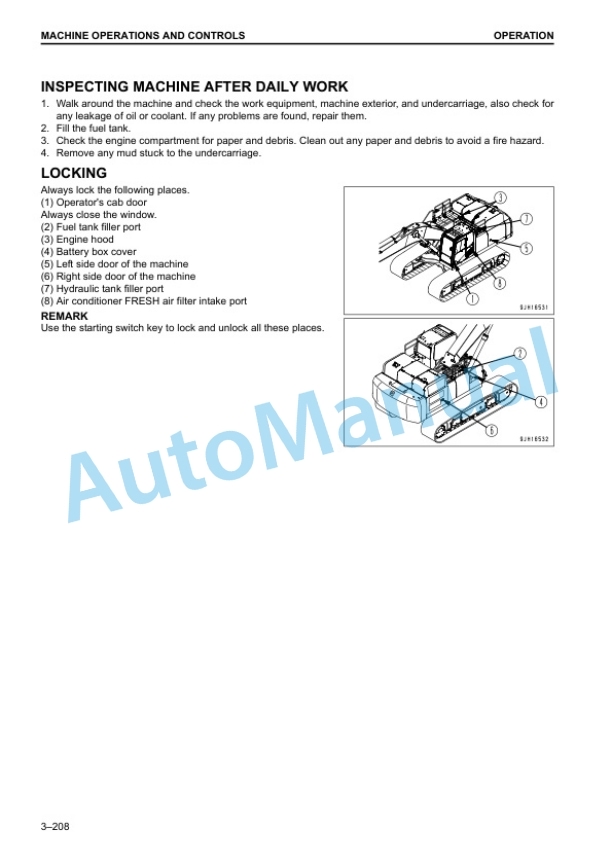
- 3.3.17. Inspecting machine after daily work
- 3.3.18. LOCKING
- 3.4. TRANSPORTATION
- 3.4.1. Transportation procedure
- 3.4.2. Loading and unloading with trailer
- 3.5. COLD WEATHER OPERATION
- 3.5.1. COLD WEATHER OPERATION INFORMATION
- 3.5.2. AFTER DAILY WORK COMPLETION
- 3.5.3. After cold weather season
- 3.6. Longterm storage
- 3.6.1. Before storage
- 3.6.2. During storage
- 3.6.3. After storage
- 3.6.4. Starting machine after longterm storage
- 3.7. TROUBLES AND ACTIONS
- 3.7.1. RUNNING OUT OF FUEL
- 3.7.2. Phenomena that are not failures
- 3.7.3. TOWING MACHINE
- 3.7.4. Lightweight towing hole
- 3.7.5. Severe job condition
- 3.7.6. DISCHARGED BATTERY
- 3.7.7. OTHER TROUBLE
- 4. MAINTENANCE
- 4.1. Rules for maintenance
- 4.1.1. Service Meter Reading
- 4.1.2. Komatsu Genuine Replacement Parts
- 4.1.3. Komatsu Genuine Lubricants
- 4.1.4. Always use clean washer fluid
- 4.1.5. Fresh and Clean Lubricants
- 4.1.6. Check drained oil and used filter
- 4.1.7. Fuel strainer
- 4.1.8. Welding instructions
- 4.1.9. Do not drop things inside machine
- 4.1.10. Dusty work sites
- 4.1.11. Avoid mixing oil
- 4.1.12. Locking inspection covers
- 4.1.13. BLEEDING AIR FROM HYDRAULIC CIRCUIT
- 4.1.14. Precautions when installing hydraulic hoses
- 4.1.15. Checks after inspection and maintenance
- 4.1.16. Fuel and lubricants to match the ambient temperature
- 4.2. Outline of service
- 4.2.1. Handling oil, fuel, coolant, and performing oil clinic
- 4.2.2. HANDLING ELECTRICAL COMPONENTS
- 4.3. Standard tightening torque for bolts and nuts
- 4.3.1. Tightening torque list
- 4.4. MAINTENANCE SCHEDULE
- 4.4.1. Maintenance schedule table
- 4.4.2. MAINTENANCE INTERVAL FOR HYDRAULIC BREAKER
- 4.5. Maintenance procedure
- 4.5.1. WHEN REQUIRED
- 4.5.2. CHECKS BEFORE STARTING
- 4.5.3. Every 50 hours maintenance
- 4.5.4. Every 250 hours maintenance
- 4.5.5. Every 500 hours maintenance
- 4.5.6. Every 1000 hours maintenance
- 4.5.7. Every 2000 hours maintenance
- 4.5.8. Every 4000 hours maintenance
- 4.5.9. EVERY 4500 HOURS MAINTENANCE
- 4.5.10. Every 5000 hours maintenance
- 4.5.11. EVERY 8000 HOURS MAINTENANCE
- 4.5.12. EVERY 9000 HOURS MAINTENANCE
- 4.6. END OF SERVICE LIFE
- 5. SPECIFICATIONS
- 5.1. SPECIFICATIONS
- 5.1.1. EXPLANATION OF LIFT CAPAICTY CHART (6.7M BOOM)
- 5.1.2. EXPLANATION OF LIFT CAPACITY CHART (7.1M BOOM)
- 6. ATTACHMENTS AND OPTIONS
- 6.1. GENERAL PRECAUTIONS FOR SAFETY
- 6.1.1. PRECAUTIONS WHEN SELECTING
- 6.1.2. Read the operation and maintenance manual thoroughly
- 6.1.3. PRECAUTIONS WHEN REMOVING OR INSTALLING
- 6.1.4. PRECAUTIONS WHEN USING
- 6.2. Handling quick coupler
- 6.3. AUTOMATIC GREASE SYSTEM
- 6.3.1. CHECK AUTOGREASING SYSTEM
- 6.4. Bucket with hook
- 6.4.1. HOOK CONDITION
- 6.4.2. Prohibited operations
- 6.5. Machine ready for installation of attachment
- 6.5.1. EXPLANATION OF COMPONENTS
- 6.5.2. HYDRAULIC CIRCUIT
- 6.5.3. REMOVAL AND INSTALLATION OF ATTACHMENT
- 6.5.4. ATTACHMENT OPERATIONS
- 6.5.5. Longterm storage
- 6.5.6. SPECIFICATIONS
- 6.6. ATTACHMENTS AND OPTIONS
- 6.6.1. Attachment combinations
- 6.6.2. TRACK SHOES SELECTION
- 6.7. RECOMMENDED ATTACHMENT OPERATIONS
- 6.7.1. HYDRAULIC BREAKER
- 7. Replacement parts
- 7.1. SAFETY CRITICAL PARTS
- 7.1.1. SAFETY CRITICAL PARTS LIST
- 7.2. Consumable parts
- 7.2.1. Consumable parts list
- 7.3. RECOMMENDED FUEL, COOLANT, AND LUBRICANT
- 7.3.1. Lubrication chart
- 7.3.2. FUEL, COOLANT, AND LUBRICANTS TO MATCH THE AMBIENT TEMPERATURE
- 7.3.3. RECOMMENDED BRANDS AND QUALITY FOR PRODUCTS OTHER THAN KOMATSU GENUINE OIL
- 8. INDEX






There are no reviews yet.