

Description
-
Model List:
- PC750-6 Hydraulic Excavator
- PC750LC-6 Hydraulic Excavator
- PC750SE-6 Hydraulic Excavator
- 1. MAIN MENU
- 2. COVER
- 3. INTRODUCTION
- 3.1. Foreword
- 3.2. Safety information
- 3.3. Introduction
- 3.4. Location of plates, table to enter serial No. and distributor
- 3.5. Contents
- 4. SAFETY
- 4.1. General precautions
- 4.2. Precautions during operation
- 4.2.1. Before starting engine
- 4.2.2. After starting engine
- 4.2.3. Transportation
- 4.2.4. Battery
- 4.2.5. Towing
- 4.2.6. Lifting operations
- 4.3. Precautions for maintenance
- 4.3.1. Before carrying out maintenance
- 4.3.2. During maintenance
- 4.4. Position for attaching safety labels
- 5. OPERATION
- 5.1. General view
- 5.1.1. General view of machine
- 5.1.2. General view of controls and gauges
- 5.2. Explanation of components
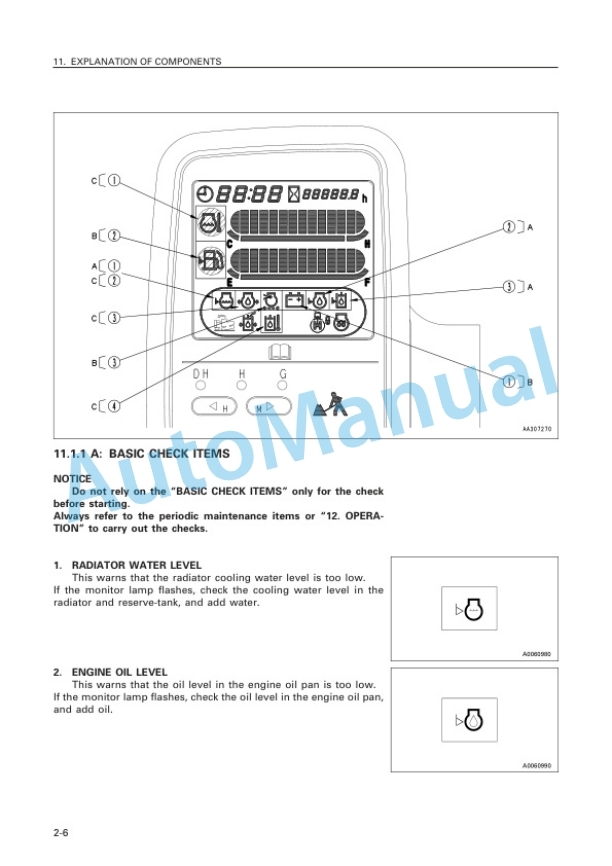
- 5.2.1. Machine monitor
- 5.2.2. Switches
- 5.2.3. Control levers, pedals
- 5.2.4. Ceiling window
- 5.2.5. Front window
- 5.2.6. Door lock
- 5.2.7. Cap, cover with lock
- 5.2.8. Hot and cool box
- 5.2.9. Luggage box
- 5.2.10. Ashtray
- 5.2.11. Handling air conditioner
- 5.2.12. Car radio
- 5.2.13. Power supply socket
- 5.2.14. Fuse
- 5.2.15. Fusible link
- 5.2.16. Controllers
- 5.2.17. Tool holder (cloth bag)
- 5.2.18. Handling grease pump
- 5.2.19. Handling accumulator
- 5.3. Operation
- 5.3.1. Check before starting engine
- 5.3.2. Starting engine
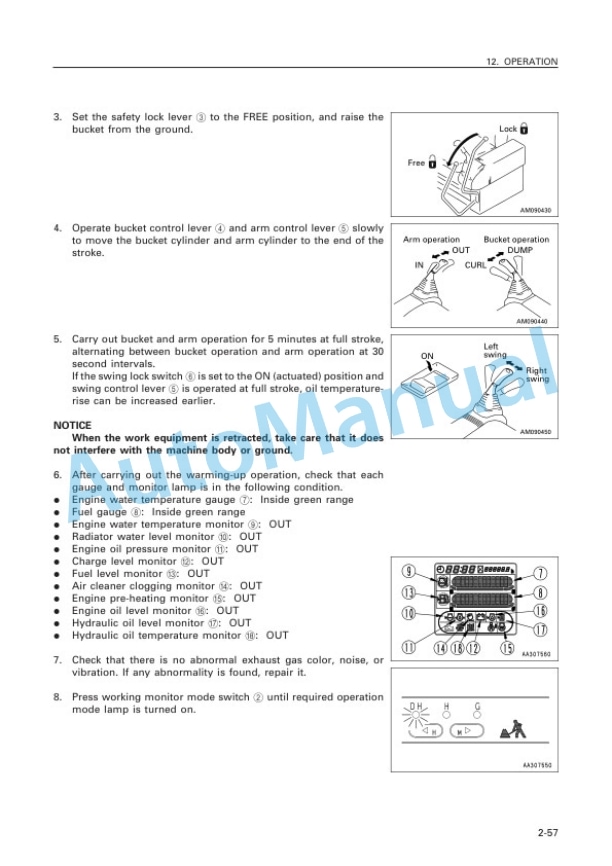
- 5.3.3. Operations and checks after starting engine
- 5.3.4. Moving machine off
- 5.3.5. Steering machine
- 5.3.6. Stopping machine
- 5.3.7. Swinging
- 5.3.8. Operation of work equipment
- 5.3.9. Handling working mode
- 5.3.10. Prohibitions for operation
- 5.3.11. Precautions for operation
- 5.3.12. Precautions when traveling up or down hills
- 5.3.13. How to escape from mud
- 5.3.14. Work possible using hydraulic excavator
- 5.3.15. Replacement of bucket
- 5.3.16. Parking machine
- 5.3.17. Check after finishing work
- 5.3.18. Stopping engine
- 5.3.19. Check after stopping engine
- 5.3.20. Locking
- 5.4. Transportation
- 5.4.1. Loading, unloading work
- 5.4.2. Precautions for loading
- 5.4.3. Precautions for transportation
- 5.4.4. Transportation posture
- 5.4.5. Procedure for increasing or reducing track frame gauge
- 5.5. Cold weather operation
- 5.5.1. Precautions for low temperature
- 5.5.2. Precautions after completion of work
- 5.5.3. After cold weather
- 5.6. Longterm storage
- 5.6.1. Before storage
- 5.6.2. During storage
- 5.6.3. After storage
- 5.6.4. Starting machine after longterm storage
- 5.7. Troubleshooting
- 5.7.1. Phenomena that are not failures
- 5.7.2. Method of towing machine
- 5.7.3. Precautions on particular jobsites
- 5.7.4. If battery is discharged
- 5.7.5. Other trouble
- 6. MAINTENANCE
- 6.1. Guides to maintenance
- 6.2. Outlines of service
- 6.2.1. Outline of oil, fuel, coolant
- 6.2.2. Outline of electric system
- 6.2.3. Outline of hydraulic system
- 6.2.4. Releasing pressure
- 6.2.5. Bleeding air from circuit
- 6.3. Wear parts list
- 6.4. Use of fuel, coolant and lubricants according to ambient temperature
- 6.5. Standard tightening torques for bolts and nuts
- 6.5.1. Introduction of necessary tools
- 6.5.2. Torque list
- 6.6. Periodic replacement of safety critical parts
- 6.7. Maintenance schedule chart
- 6.7.1. Maintenance schedule chart
- 6.8. Service Procedure
- 6.8.1. Initial 100 hours service
- 6.8.2. Initial 250 hours service
- 6.8.3. When required
- 6.8.4. Check before starting
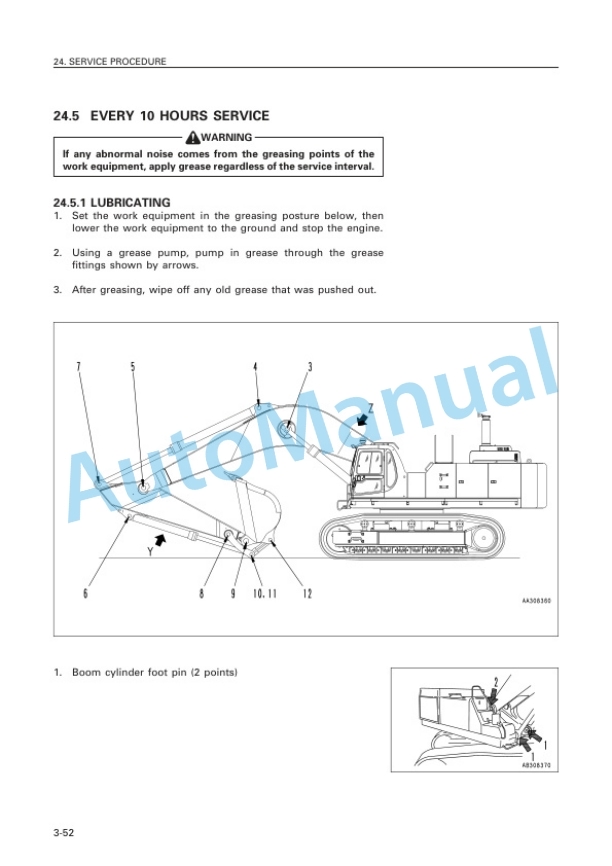
- 6.8.5. Every 10 hours service
- 6.8.6. Every 100 hours service
- 6.8.7. Every 250 hours service
- 6.8.8. Every 500 hours service
- 6.8.9. Every 1000 hours service
- 6.8.10. Every 2000 hours service
- 6.8.11. Every 4000 hours service
- 7. SPECIFICATIONS
- 7.1. Specifications
- 8. OPTIONS, ATTACHMENTS
- 8.1. General precautions
- 8.1.1. Precautions related to safety
- 8.1.2. Precautions when installing attachments
- 8.2. Using seat belt
- 8.2.1. Seat belt
- 8.3. Introduction of optional parts, attachments
- 8.3.1. Combinations of work equipment
- 8.3.2. Selection of track shoes







There are no reviews yet.