
Description
-
Model List:
- E40
- E40-20
- E40B
- E45
- E45-20
- E45B
- E50
- E50-20
- E50B
- 1. Electric Forklift TruckE40, E45, E50E4020, E4520, E5020
- 1.1. Table of content
- 1.2. Introduction
- 1.2.1. Introduction
- 1.2.2. General information
- 1.2.3. Conformity marking
- 1.2.4. Declaration that reflects the content of the declaration of conformity
- 1.2.5. Intended use
- 1.2.6. Hazard assessment
- 1.2.7. Improper use
- 1.2.8. Symbols used
- 1.2.9. Disposing of components and batteries
- 1.2.10. Description of use and climatic conditions
- 1.2.11. Technical description
- 1.3. Safety
- 1.3.1. Residual risks
- 1.3.2. Noise level
- 1.3.3. Frequency characteristics for vibrations imparted to the human body
- 1.3.4. Stability
- 1.3.5. In the case of tipover
- 1.3.6. Operating company
- 1.3.7. Drivers
- 1.3.8. Competent person
- 1.3.9. Regulations
- 1.3.10. Handling consumables
- 1.3.11. Fitting attachments
- 1.3.12. Emergency exit from drivers cab with windows
- 1.3.13. Manually lowering the forks
- 1.4. Overview
- 1.4.1. General view
- 1.4.2. Controller and display unit
- 1.4.3. Summary diagram of labels
- 1.4.4. Display unit
- 1.4.5. Switch panel
- 1.5. Operation
- 1.5.1. Service plan before initial commissioning
- 1.5.2. Instructions for runningin
- 1.5.3. Preshift checks
- 1.5.4. Daily inspection items
- 1.5.5. Mounting.dismounting
- 1.5.6. Seat belt status and performance checks
- 1.5.6.1. Checking condition and performance
- 1.5.6.2. Adjusting the drivers armrest
- 1.5.6.3. Adjusting the seat and seat belt (comfort)
- 1.5.6.4. Seat belt monitoring and alarm function
- 1.5.7. Operating the horn
- 1.5.8. Adjusting the steering column
- 1.5.9. Setting the display unit
- 1.5.10. Emergency off switch
- 1.5.11. Switching the truck on and off
- 1.5.12. Using the RFID Keypad (China only)
- 1.5.12.1. RFID Keypad installation position
- 1.5.12.2. RFID Keypad
- 1.5.13. Driving (dual pedal operation)
- 1.5.13.1. Driving
- 1.5.13.2. Forward travel
- 1.5.13.3. Reverse travel
- 1.5.13.4. Changing the drive direction
- 1.5.13.5. Starting on a slope
- 1.5.14. Driving (single pedal operation)
- 1.5.14.1. Driving
- 1.5.14.2. Forward travel
- 1.5.14.3. Reverse travel
- 1.5.14.4. Changing the drive direction
- 1.5.14.5. Forward travel E4020.E4520.E5020
- 1.5.14.6. Reverse travel E4020.E4520.E5020
- 1.5.14.7. Changing the drive direction E4020.E4520.E5020
- 1.5.14.8. Starting on a slope
- 1.5.15. Steering system
- 1.5.16. Brake system
- 1.5.16.1. Brake system information
- 1.5.16.2. Foot brake.emergency brake
- 1.5.16.3. Electronic regenerative braking
- 1.5.16.4. Electronic parking brake
- 1.5.16.5. Manually releasing the electronic parking brake
- 1.5.17. Battery cover Open Closed
- 1.5.18. Checking battery charging status
- 1.5.19. Connecting the rechargeable battery to an external charger
- 1.5.20. Lifting devices and attachments
- 1.5.20.1. Operating the centralised joystick for the lift mast
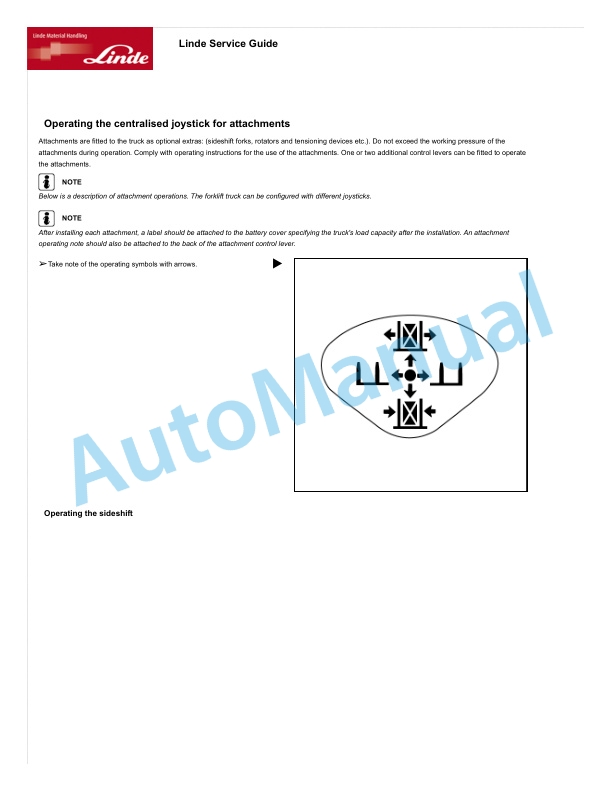
- 1.5.20.2. Operating the centralised joystick for attachments
- 1.5.20.3. Lift mast singlelever operation
- 1.5.20.4. Singlelever operation of attachments
- 1.5.20.5. Operating the joystick for the lift mast_E4020.E4520.E5020
- 1.5.20.6. Operating the joystick for attachments_E4020.E4520.E5020
- 1.5.21. Transporting loads
- 1.5.21.1. Load centre distance and load capacity
- 1.5.21.2. Adjusting the fork spacing
- 1.5.21.3. Picking up a load
- 1.5.21.4. Loading
- 1.5.21.5. Driving with a load
- 1.5.21.6. Unloading
- 1.5.21.7. Tow coupling
- 1.5.21.8. Leaving the truck temporarily
- 1.5.21.9. Before exiting the truck
- 1.5.22. Truck transport
- 1.5.22.1. Dismantling.installing the lift mast
- 1.5.22.2. Regulations for removing the mast and towing
- 1.5.22.3. Driving without a lift mast
- 1.5.22.4. Use a truck or flatbed trailer to carry the forklift truck
- 1.5.22.5. Lifting the truck with a crane
- 1.5.22.6. Description of lifting points
- 1.5.23. Truck storage
- 1.5.23.1. Taking the truck out of operation
- 1.5.24. Disposal of old trucks
- 1.6. Maintenance
- 1.6.1. Safety information for inspection and maintenance work
- 1.6.2. Inspection and maintenance data
- 1.6.3. Recommended fuels and oils
- 1.6.4. Regular maintenance
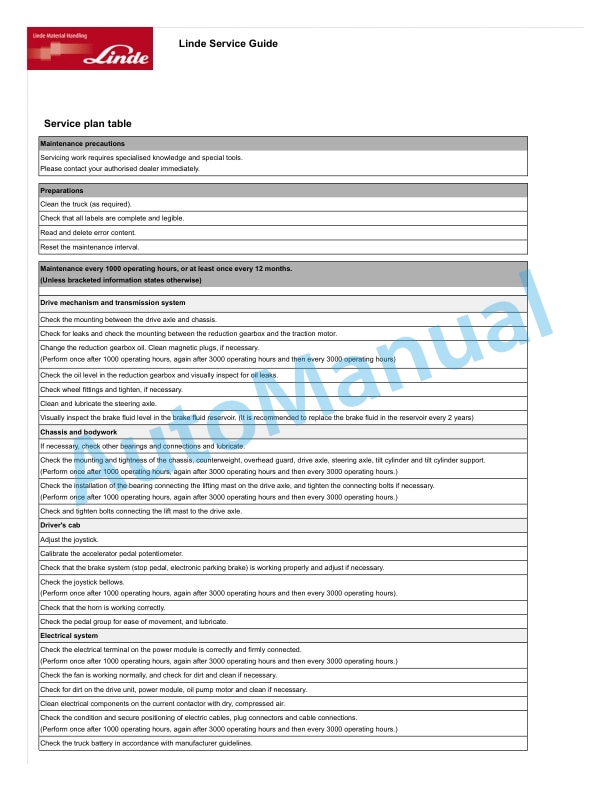
- 1.6.5. Service plan table
- 1.6.6. Cleaning the truck
- 1.6.7. Drive mechanism and transmission system
- 1.6.7.1. Checking the oil level of the reduction gearbox
- 1.6.7.2. Changing the reduction gearbox oil
- 1.6.7.3. Checking the reduction gearbox for leaks
- 1.6.7.4. Checking for leaks and checking the mounting between the reduction gearbox and the drive motor
- 1.6.7.5. Checking the fastening between the drive axle and chassis
- 1.6.7.6. Checking the brake fluid level in the brake fluid reservoir
- 1.6.7.7. Replacing the brake fluid in the brake fluid reservoir
- 1.6.7.8. Checking the wheels
- 1.6.7.9. Checking the condition of the antistatic belt
- 1.6.7.10. Tighten the wheel nuts
- 1.6.7.11. Changing wheels
- 1.6.7.12. Lubricating the steering axle
- 1.6.8. Chassis and bodywork
- 1.6.8.1. Checking other bearings and connections and lubricating
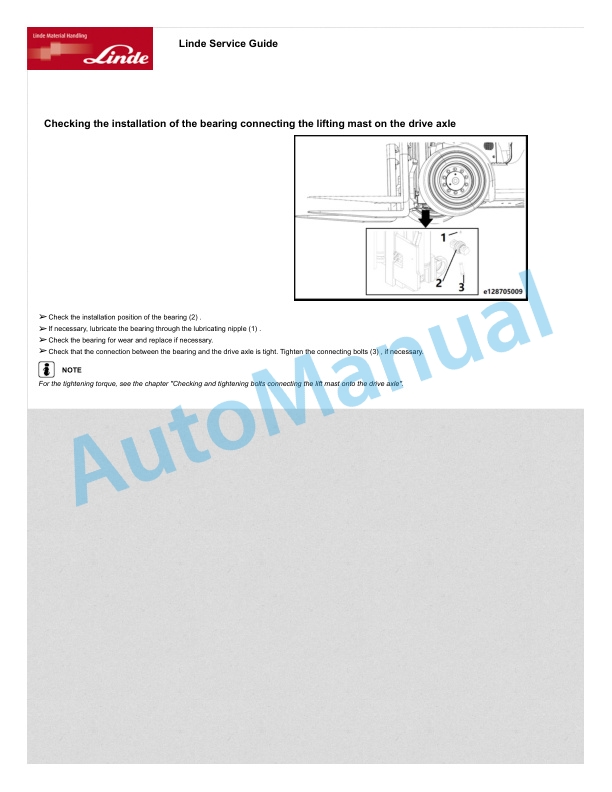
- 1.6.8.2. Checking the installation of the bearing connecting the lifting mast on the drive axle
- 1.6.8.3. Checking and tightening bolts connecting the lift mast onto the drive axle
- 1.6.9. Drivers cab
- 1.6.9.1. Checking seat belt condition and correct operation
- 1.6.9.2. Checking the brake system
- 1.6.9.3. Checking the horn is working normally
- 1.6.9.4. Checking the joystick bellows
- 1.6.9.5. Adjust joysticks
- 1.6.9.6. Calibrating the accelerator pedal potentiometer
- 1.6.9.7. Checking the pedal group for ease of movement and lubricating as required
- 1.6.9.8. Checking the battery cover locking devices
- 1.6.10. Electrics.electronics
- 1.6.10.1. Checking the power module for dirt and cleaning if necessary
- 1.6.10.2. Checking the main contactor
- 1.6.10.3. Checking the operation of the fan and cleaning, if necessary
- 1.6.10.4. Checking electric cables
- 1.6.10.5. Fuses
- 1.6.10.6. Fuse box
- 1.6.10.7. Leadacid battery discharge
- 1.6.10.8. Changing the battery
- 1.6.10.9. Replacing the battery using a suspension arrangement
- 1.6.10.10. Inspecting and maintaining the lithiumion battery
- 1.6.11. Hydraulic system
- 1.6.11.1. Checking the hydraulic system for leaks
- 1.6.11.2. Checking the hydraulic oil level
- 1.6.11.3. Changing the hydraulic oil
- 1.6.11.4. Checking the breather filter is working normally
- 1.6.11.5. Replacing the breather filter, high pressure filter and suction filter
- 1.6.12. Lifting system
- 1.6.12.1. Checking the fork arms and the fork arm quick release apparatus
- 1.6.12.2. Checking the working condition and installation of the lift mast, lifting chains and lift cylinder
- 1.6.12.3. Lubricating the lift mast and chains with chain spray
- 1.6.12.4. Adjusting the length of the lifting chains and lubricating using chain spray
- 1.6.13. Special equipment
- 1.6.13.1. Checking the preload of the double hoses (if equipped with attachments)
- 1.6.13.2. Cleaning and lubricating the sideshift forks and checking connections
- 1.7. Technical datasheet
- 1.7.1. Dimensions overview
- 1.7.2. Technical datasheet
- 1.7.3. Technical datasheet load centre of gravity distance 600
- 1.7.4. Ecodesign requirements for electric motors and variable speed drives


There are no reviews yet.