
Description
-
Model List:
- L14
- L14AP
- L16
- L16AP
- L28AP
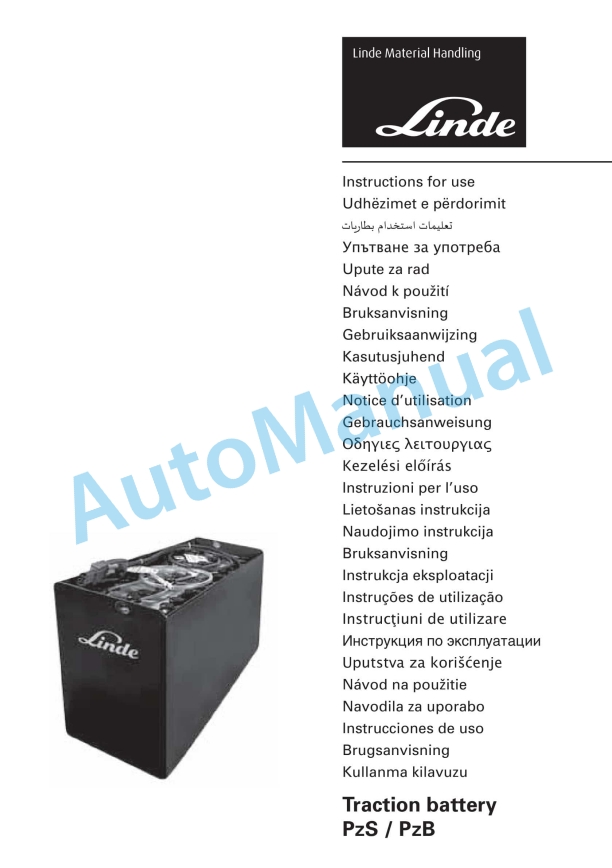
- 1. EnerSys.Hawker Batteries
- 2. MIDAC Batteries
- 3. Pallet stackers372_L14, 372_L14AP, 372_L16, 372_L16AP
- 3.1. Table of content
- 3.2. Introduction
- 3.2.1. Your truck
- 3.2.2. Impermissible use
- 3.2.3. Description of use and climatic conditions
- 3.2.4. Specific use of the equipment
- 3.2.5. Symbols used
- 3.2.6. Legal requirements for placing on the market
- 3.2.7. Technical description
- 3.3. Safety
- 3.3.1. Residual risks
- 3.3.2. Stability
- 3.3.3. Operation of industrial trucks in plant area
- 3.3.4. Competent person
- 3.3.5. Safety regulations
- 3.3.6. Driving regulations
- 3.3.7. Handling consumables
- 3.3.8. Periodic general checks on the trucks
- 3.4. General views
- 3.4.1. Labels
- 3.4.2. Identification label
- 3.4.3. General view, L14L16
- 3.4.4. General view, L14 APL16 AP
- 3.4.5. L14L16 . L14APL16AP controls
- 3.4.6. Hour meter.Battery discharge indicator combination (ILDB)
- 3.5.1. Checks before first use
- 3.5.2. Daily checks before use
- 3.5.3. Checking the working environment
- 3.5.4. General information on batteries
- 3.5.5. Using the charger
- 3.5.6. Adjusting the onboard charger
- 3.5.7. Driving, L14L16, without platform
- 3.5.7.1. Operating instructions
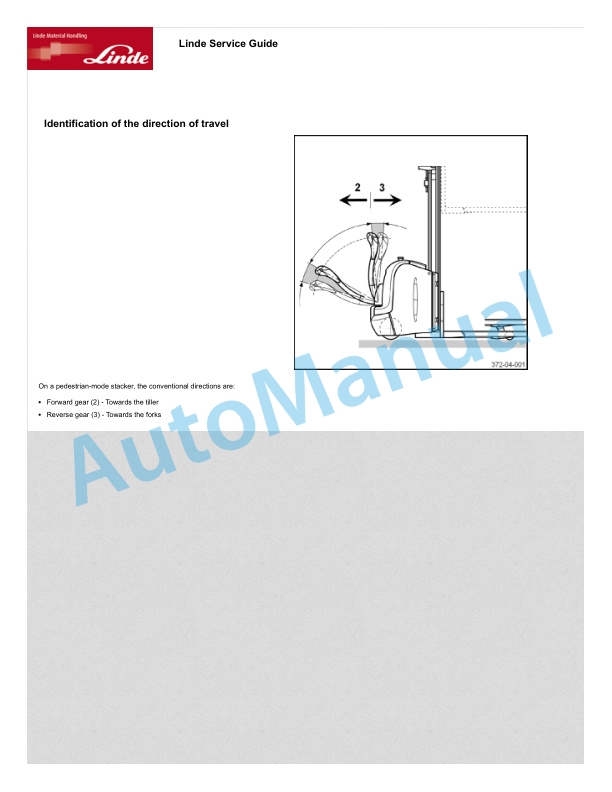
- 3.5.7.2. Identification of the direction of travel
- 3.5.7.3. Startup
- 3.5.7.4. Forward travel.reverse travel
- 3.5.7.5. Reversing direction of travel
- 3.5.7.6. Steering
- 3.5.7.7. Safety reverser
- 3.5.7.8. Emergency stop button
- 3.5.7.9. Use of the truck on a slope
- 3.5.8. Driving, L14APL16AP, with platform
- 3.5.8.1. Operating instructions
- 3.5.8.2. Identification of the direction of travel
- 3.5.8.3. Startup
- 3.5.8.4. Pedestrian driving
- 3.5.8.5. Rideon driving
- 3.5.8.6. Forward travel.reverse travel
- 3.5.8.7. Reversing direction of travel
- 3.5.8.8. Steering
- 3.5.8.9. Emergency stop button
- 3.5.8.10. Using the truck on a slope
- 3.5.9. Braking system, horn
- 3.5.10. Cold store usage (optional)
- 3.5.11. Use of the mast
- 3.5.12. Reading the capacity rating plate
- 3.5.13. Working with loads
- 3.5.14. Slinging, lifting and towing the mast
- 3.5.15. Storage of truck
- 3.6. Maintenance
- 3.6.1. General information
- 3.6.2. Calendar of testing and maintenance operations
- 3.6.3. Technical inspection and maintenance characteristics
- 3.6.4. Recommended lubricants
- 3.6.5. Maintenance plan as required
- 3.6.5.1. Cleaning the truck
- 3.6.5.2. Cleaning the battery and its compartment
- 3.6.5.3. Opening the front hood (L14L16 without platform)
- 3.6.5.4. Removing flexible hood providing access to the tiller joint (L14L16 without platform)
- 3.6.5.5. Opening the front hood (L14L16 with platform)
- 3.6.5.6. Battery for side removal
- 3.6.5.7. Battery with vertical access
- 3.6.5.8. Opening the sideaccess battery cover
- 3.6.5.9. Opening the verticalaccess battery cover
- 3.6.5.10. Checking the fuses
- 3.6.6. Inspection and maintenance overview
- 3.6.6.1. h Service plan
- 3.6.6.2. hour service plan
- 3.6.6.3. hour service plan
- 3.6.7. Traction motor
- 3.6.7.1. Cleaning the traction motor cooling fins
- 3.6.8. Steering . braking . wheels
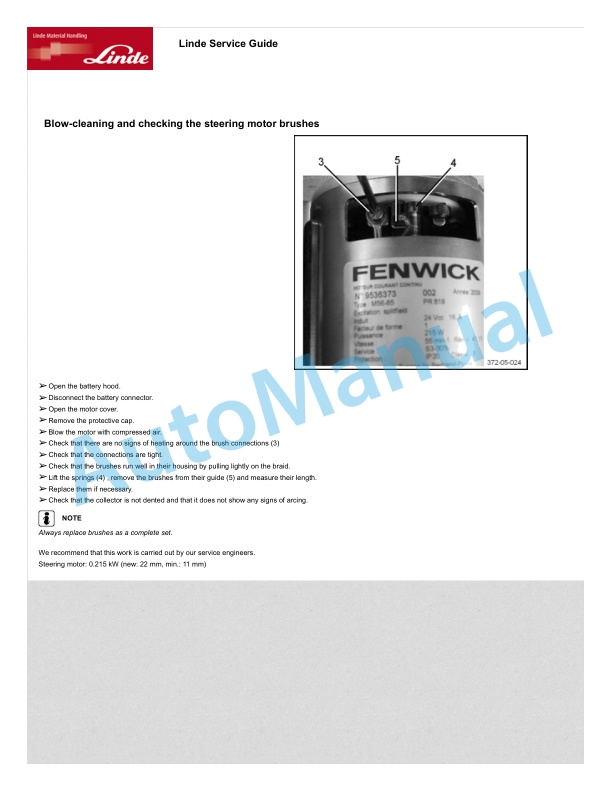
- 3.6.8.1. Blowcleaning and checking the steering motor brushes
- 3.6.8.2. Cleaning the pinion gear of the steering geared motor
- 3.6.8.3. Checking the condition and tightness of wheels
- 3.6.8.4. Adjusting the height of the stabiliser wheel
- 3.6.8.5. Checking and adjusting (if necessary) the air gap on the electromagnetic brake
- 3.6.9. Electrical equipment
- 3.6.9.1. Cleaning and blowing the electrical panel
- 3.6.9.2. Checking the tightness of power cables
- 3.6.9.3. Checking the electrolyte level and topping up with water
- 3.6.9.4. Checking the condition of cables, terminals and battery connector
- 3.6.9.5. Spring condition and lubrication of the locking handle for the sideaccess battery cover
- 3.6.9.6. Checking the onboard charger
- 3.6.10. Hydraulic circuits
- 3.6.10.1. Blowcleaning and checking the pump motor brushes
- 3.6.10.2. Checking the hydraulic system for leaks
- 3.6.10.3. Hydraulic oil level check
- 3.6.10.4. Draining the hydraulic oil
- 3.6.10.5. Replacing the pressure filter
- 3.6.11. Lift mast
- 3.6.11.1. Specific mast maintenance
- 3.6.12. Lifting system
- 3.6.12.1. Checking and adjusting the initial lift guide shoes
- 3.6.12.2. Checking the various joints
- 3.6.12.3. Checking the side stop fixings in the battery compartment
- 3.7. Technical datasheet
- 3.7.1. L14.L16 datasheet
- 3.7.2. L14AP.L16AP datasheet
- 3.7.3. Noise emission values
- 3.7.4. Vibration characteristic values for bodily vibrations
- 3.8. Diagrams
- 3.8.1. Circuit diagrams
- 3.8.1.1. Power
- 3.8.1.2. L14L16 control with Initial Lift
- 3.8.1.3. L14L16 control without Initial Lift
- 3.8.1.4. L14L16 AP control with initial lift
- 3.8.1.5. L14L16 AP control without Initial Lift
- 3.8.2. Hydraulics diagrams
- 3.8.2.1. Proportional control . Without Initial Lift (from number W4X 372A00001)
- 3.8.2.2. Proportional control . Initial Lift (from number W4X 372A00001)
- 3.8.2.3. Proportional control . Without Initial Lift . Booster option (from number W4X 372A00001)
- 3.8.2.4. Proportional control . With Initial Lift . Booster Option (from number W4X 372A00001)
- 4. TAB Batteries


There are no reviews yet.