
Description
-
Model List:
- E25 EX
- E30 EX
- E35 EX
- 1. Electric forklift truckE25 . 30 . 35 Ex
- 1.1. Table of content
- 1.2. Introduction
- 1.2.1. Your industrial truck
- 1.2.2. Intended use
- 1.2.3. Impermissible use
- 1.2.4. Basic information on explosion protection
- 1.2.5. Description of use and climatic conditions
- 1.2.6. Symbols used
- 1.2.7. Technical description
- 1.2.8. Receiving the industrial truck
- 1.2.9. Legal requirements for marketing
- 1.2.10. Disposing of components and batteries
- 1.3. Safety
- 1.3.1. Safety guidelines
- 1.3.2. Residual risks
- 1.3.3. Stability
- 1.3.4. In the case of tipover
- 1.3.5. Handling consumables
- 1.3.6. Qualified person
- 1.3.7. Periodic safety inspection
- 1.3.8. Fitting attachments
- 1.3.9. Emergency exit with attached rear window
- 1.3.10. Emergency lowering
- 1.3.11. Towing
- 1.4. Overview
- 1.4.1. Labelling
- 1.4.1.1. Position of nameplate
- 1.4.1.2. Nameplate
- 1.4.1.3. Truck numbers and identification plates
- 1.4.1.4. Truck configuration
- 1.4.2. Truck overview
- 1.4.3. Truck view rear
- 1.4.4. Operating devices
- 1.4.5. Display unit
- 1.4.6. Switch panel
- 1.5. Operation
- 1.5.1. Service plan before initial commissioning
- 1.5.2. Instructions for runningin
- 1.5.3. Preshift checks
- 1.5.4. Checking the tyres
- 1.5.5. Regular maintenance
- 1.5.6. Drivers compartment
- 1.5.6.1. Entering and exiting the truck
- 1.5.6.2. Minimum distance between head and overhead guard
- 1.5.6.3. Adjusting the drivers seat
- 1.5.6.4. Adjusting the drivers seat armrest
- 1.5.6.5. Adjusting the steering column
- 1.5.6.6. Seat belt
- 1.5.6.7. Horn
- 1.5.6.8. Lighting
- 1.5.6.9. Windscreen wipers
- 1.5.6.10. Heating system
- 1.5.6.11. Overhead guard with optimised visibility
- 1.5.7. Operation
- 1.5.7.1. Switching the truck on and off
- 1.5.7.2. Access system connect (LFM)
- 1.5.7.3. Emergency off switch
- 1.5.7.4. Driving (singlepedal operation)
- 1.5.7.5. Driving (dualpedal operation)
- 1.5.7.6. Briefly leaving the truck
- 1.5.7.7. Adjusting the time
- 1.5.7.8. Steering system
- 1.5.7.9. Brake system
- 1.5.7.10. Turn indicators
- 1.5.7.11. Joystick Central lever operation
- 1.5.7.12. Joystick Single lever operation
- 1.5.7.13. Depressurisation
- 1.5.7.14. Driving speed reduction via a switch
- 1.5.8. Working with a load
- 1.5.8.1. Load capacity diagram
- 1.5.8.2. Adjusting the fork arm distance
- 1.5.8.3. Picking up a load
- 1.5.8.4. Determining visibility conditions when driving with a load
- 1.5.8.5. Driving under load
- 1.5.8.6. Setting down loads
- 1.5.8.7. Mast positioning
- 1.5.8.8. Lift height limitation
- 1.5.8.9. Steering angle display
- 1.5.8.10. Towing device
- 1.5.9. Leaving the truck
- 1.5.10. Drive batteries
- 1.5.10.1. Checking the battery charge status
- 1.5.10.2. Battery hoodOpening Closing
- 1.5.10.3. Charging the battery
- 1.5.10.4. Battery chargers
- 1.5.10.5. Replacing the battery
- 1.5.11. Loading.transporting
- 1.5.11.1. Removing.attaching the lift mast
- 1.5.11.2. Driving without the lift mast
- 1.5.11.3. Transporting the truck using a lorry or flatbed trailer
- 1.5.11.4. Crane loading
- 1.6. Maintenance
- 1.6.1. Safety information regarding servicing work
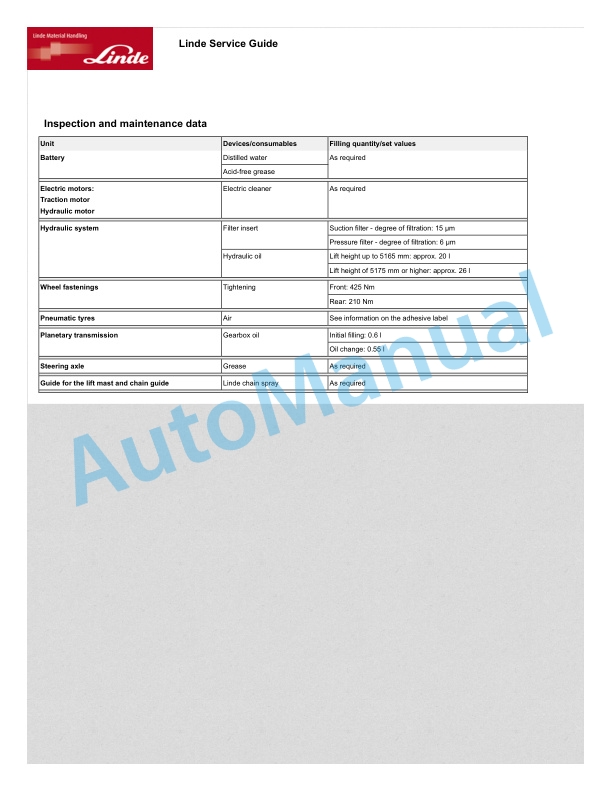
- 1.6.2. Inspection and maintenance data
- 1.6.3. Recommendations for consumables
- 1.6.4. Service plan
- 1.6.5. Additional service plan for explosion protection
- 1.6.6. Gearbox
- 1.6.6.1. Planetary transmissionChecking the oil level
- 1.6.6.2. Checking the planetary transmission for leak tightness
- 1.6.7. Chassis, bodywork and fittings
- 1.6.7.1. Cleaning the industrial truck
- 1.6.7.2. Checking and lubricating the bearing points and joints
- 1.6.7.3. Battery door and battery hoodLubricating the bolts, hinges and interlocks
- 1.6.7.4. Battery door and battery hoodChecking and adjusting the interlocks
- 1.6.7.5. Battery compartment Checking the battery side stop
- 1.6.7.6. Checking the condition and function of the seat belt
- 1.6.7.7. Filling up the washer system.water tank
- 1.6.8. Chassis frame
- 1.6.8.1. Information on antistatic tyres
- 1.6.8.2. Checking the leak resistance
- 1.6.8.3. Checking the wheels for damage, foreign objects and wear
- 1.6.8.4. Wheel change
- 1.6.8.5. Tightening the wheel fastenings
- 1.6.8.6. Checking the tyre pressure
- 1.6.8.7. Lubricating the steering axle
- 1.6.9. Operating devices
- 1.6.9.1. Checking the brake system for correct function
- 1.6.9.2. Checking and lubricating the pedal group and linkage
- 1.6.9.3. Checking the horn for correct function
- 1.6.10. Electrics.electronics
- 1.6.10.1. Checking the pressuretight housing
- 1.6.10.2. Checking the main contactor
- 1.6.10.3. Tightening the connections of the power electronics
- 1.6.10.4. Checking the condition of the drive battery
- 1.6.10.5. Checking the cables and the plugs on the drive battery
- 1.6.10.6. Checking the heat sinks on the power modules for contamination and cleaning the heat sinks
- 1.6.11. Hydraulics
- 1.6.11.1. Hydraulic systemChecking the oil level
- 1.6.11.2. Hydraulic systemChecking for leak tightness
- 1.6.11.3. Checking that the bleeder valve on the hydraulic tank is functioning correctly
- 1.6.11.4. Hose linesChecking the preload
- 1.6.12. Load lift system
- 1.6.12.1. Working on the lift mast and at the front of the truck
- 1.6.12.2. Checking the condition of the lift mast
- 1.6.12.3. Cleaning and spraying the lift mast chain
- 1.6.12.4. Lift mast adjusting the chain
- 1.6.12.5. Checking the load fork
- 1.6.12.6. Checking and lubricating the fork prong positioner (special equipment)
- 1.6.13. Selfhelp
- 1.6.13.1. Fuses
- 1.6.13.2. Diagnostic connector
- 1.6.13.3. Malfunctions during operation
- 1.6.13.4. Malfunctions, causes and remedies Hydraulic system
- 1.6.14. Shutting down
- 1.6.14.1. Decommissioning the industrial truck
- 1.6.14.2. Disposal of old trucks
- 1.7. Technical data
- 1.7.1. Overview of dimensions
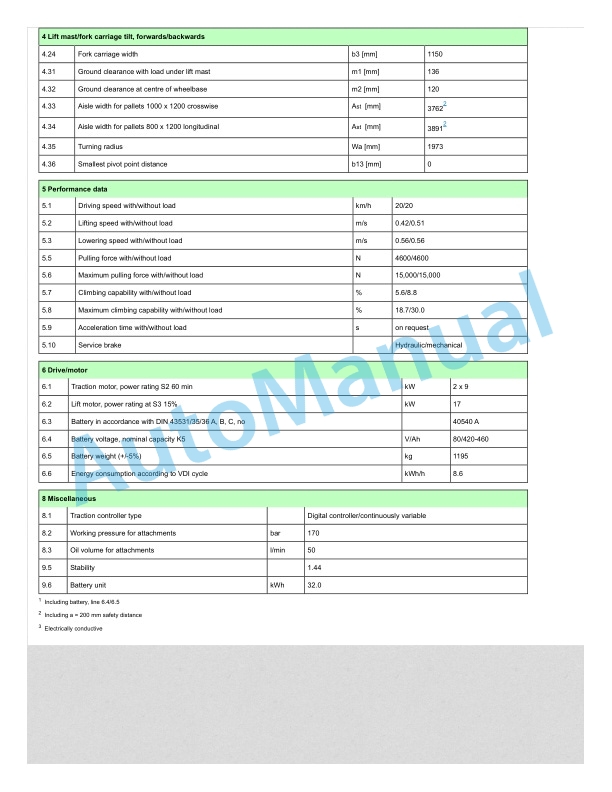
- 1.7.2. E 25.500 Ex type sheet, as at 08.2012
- 1.7.3. E 25.500 L Ex type sheet, as at 08.2012
- 1.7.4. E 30.500 Ex type sheet, as at 08.2012
- 1.7.5. E 30.500 L Ex type sheet, as at 08.2012
- 1.7.6. E 35.500 L Ex type sheet, as at 08.2012
- 1.7.7. Lift mast data
- 1.7.8. Tyre variants and rim sizes
- 1.7.9. Additional capacity rating plate for attachments
- 1.7.10. Noise emission values
- 1.7.11. Vibration characteristics for bodily vibrations
- 2. Leadacid battery charger 24V . 48V . 80V


There are no reviews yet.