
Description
-
Model List:
- V15
- V15HP
- V15P
- 1. series Vertical Order PickerModel V15 North America
- 1.1. Table of content
- 1.2. Introduction
- 1.2.1. Scope
- 1.2.2. Obligations of the Equipment Owner
- 1.2.3. Operator Responsibilities
- 1.2.4. Proper use
- 1.2.5. Hazard messages
- 1.3. Safety
- 1.3.1. Before Operation
- 1.3.2. Operator Daily Checklist
- 1.3.3. Operating Position
- 1.3.4. Pedestrians
- 1.3.5. Travel
- 1.3.6. Raising and Lowering the Operator Compartment
- 1.3.7. Avoiding Falls and Tipovers
- 1.3.8. Parking
- 1.3.9. Battery Safety
- 1.3.10. Safety During Maintenance
- 1.3.10.1. Personnel Qualifications
- 1.3.10.2. Hazardous Substances
- 1.3.11. Operator Warning Decals
- 1.3.11.1. Data plate
- 1.3.11.2. Voltage decal
- 1.3.11.3. Operator warning decal
- 1.3.11.4. Trained operator warning decal
- 1.3.11.5. Never stand or walk under forks warning decal
- 1.3.11.6. Do not lift personnel warning decal
- 1.3.11.7. Crushed fingers warning decal
- 1.3.11.8. Back up alarm warning decal
- 1.3.11.9. Platform surface warning decal
- 1.4. Overview
- 1.4.1. Technical Description
- 1.4.2. Truck Components
- 1.4.3. Controls
- 1.4.4. Display Unit
- 1.4.5. Definition of directions
- 1.4.6. Decal and Data Plate Location
- 1.4.7. Data Plate
- 1.5. Operation
- 1.5.1. Unloading and Preparing a New Truck for Operation
- 1.5.2. Safety Harness
- 1.5.3. Console Height Adjustment (optional equipment)
- 1.5.4. Operating the Display Unit
- 1.5.5. Turning the Truck On and Off
- 1.5.6. Driving
- 1.5.7. Mechanical Aisle Guidance (optional equipment)
- 1.5.8. Inductive Guidance (optional equipment)
- 1.5.9. Braking
- 1.5.10. Steering
- 1.5.11. Horn
- 1.5.12. Pallet Clamp
- 1.5.13. Raising and Lowering the Operator Compartment
- 1.5.14. Lift Limit Function (optional equipment)
- 1.5.15. Manual Lowering of Operator Compartment
- 1.5.16. Lights and BackUp Alarm
- 1.5.17. Fan (optional equipment)
- 1.5.18. Changing the Battery
- 1.5.19. Connecting the Battery to an External Charger
- 1.5.20. Towing the Truck
- 1.5.21. Securing the Truck for Transport
- 1.5.22. Hoisting the Truck
- 1.5.23. Long term storage
- 1.6. Maintenance
- 1.6.1. Personnel Qualifications
- 1.6.2. Cleaning
- 1.6.2.1. Cleaning the Truck
- 1.6.2.2. Cleaning the Lift Chains
- 1.6.3. Operator Inspection and Maintenance
- 1.6.3.1. Daily Inspection Overview
- 1.6.3.2. Daily Inspection Checklist
- 1.6.3.3. Check for fluid leakage
- 1.6.3.4. Check overhead guard
- 1.6.3.5. Check hydraulic cylinders
- 1.6.3.6. Check lift chains
- 1.6.3.7. Check fork carriage
- 1.6.3.8. Check battery retention
- 1.6.3.9. Check battery connector
- 1.6.3.10. Check hydraulic oil level
- 1.6.3.11. Check Drive Wheel and Fasteners
- 1.6.3.12. Check all wheels for debris
- 1.6.3.13. Antistatic strap (optional equipment)
- 1.6.3.14. Check decal condition
- 1.6.3.15. Operational checks
- 1.6.4. Routine Lubrication and Inspection
- 1.6.4.1. Routine Lubrication and Inspection Intervals
- 1.6.4.2. Hydraulic Tank Pressure Valve Test
- 1.6.4.3. Checking Gear Oil Level
- 1.6.4.4. Lubricate Steering Gear
- 1.6.4.5. Testing and Cleaning the Fans
- 1.6.5. Scheduled Maintenance
- 1.6.5.1. General Maintenance Information
- 1.6.5.2. Scheduled Maintenance Chart
- 1.6.6. Fluids and Lubricants
- 1.6.6.1. Capacities
- 1.6.6.2. Fluid and Lubricant Specifications
- 1.6.7. Troubleshooting
- 1.6.7.1. Fuses
- 1.7. Specifications
- 1.7.1. Specifications
- 1.7.2. Mast Heights
- 2. Highlevel order pickerV15
- 2.1. Table of content
- 2.2. Introduction
- 2.2.1. Introduction
- 2.2.2. Intended use
- 2.2.3. Improper use
- 2.2.4. Extra information
- 2.2.5. Description of use
- 2.2.6. Symbols used
- 2.3. Safety
- 2.3.1. Safety guidelines
- 2.3.2. Stability
- 2.3.3. Residual risks
- 2.3.4. Use of lubricants
- 2.3.5. Handling consumables
- 2.3.6. Regulations
- 2.3.7. Periodic general checks on trucks
- 2.4. Views
- 2.4.1. Description of truck
- 2.4.2. View of the truck
- 2.4.3. Display unit
- 2.4.4. View of main components
- 2.4.5. Safety protective devices
- 2.4.6. Safety devices and warning labels
- 2.4.7. Control panel
- 2.4.8. Identification plates
- 2.4.9. Label (only for CE)
- 2.4.10. Drive directions
- 2.5. Operation
- 2.5.1. General commissioning
- 2.5.1.1. Test run
- 2.5.1.2. Transporting and loading
- 2.5.1.3. Display
- 2.5.1.4. Supporting block
- 2.5.1.5. Pallet clamping device
- 2.5.2. Daily commissioning
- 2.5.2.1. Preshift checklist
- 2.5.3. Safety protective devices
- 2.5.3.1. Checking the safety protective devices
- 2.5.3.2. Using the safety rope
- 2.5.3.3. Using the safety rope
- 2.5.3.4. Using the selfretracting device
- 2.5.4. Operating the truck
- 2.5.4.1. Operating instructions
- 2.5.4.2. Switching the truck on and off
- 2.5.4.3. Fleet management system
- 2.5.4.4. Fleet management system (LFM Go.LKU10, option)
- 2.5.4.5. Inductive Guidance (IZF)
- 2.5.5. Driving
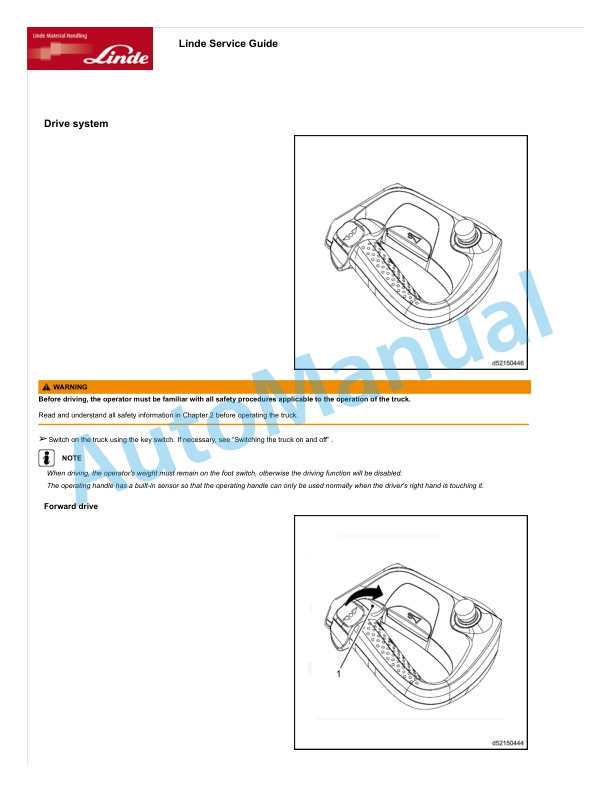
- 2.5.5.1. Drive system
- 2.5.5.2. Braking
- 2.5.5.3. Steering
- 2.5.5.4. Horn
- 2.5.6. Picking
- 2.5.6.1. Picking up and setting down loads
- 2.5.6.2. Picking
- 2.5.6.3. Load diagram
- 2.5.7. Parking
- 2.5.7.1. Parking and leaving the truck
- 2.5.7.2. Decommissioning
- 2.5.8. Emergency operation
- 2.5.8.1. Emergency operation
- 2.5.8.2. Emergency lowering valve
- 2.6. Maintenance
- 2.6.1. Safety information for inspection and maintenance work
- 2.6.2. Cleaning
- 2.6.2.1. Cleaning the truck
- 2.6.3. Inspection and maintenance work tables
- 2.6.3.1. Regular maintenance
- 2.6.3.2. Service plan Every 1000 hours or every 6 months
- 2.6.3.3. Service plan Every 3000 hours or every 18 months
- 2.6.3.4. Lubrication plan
- 2.6.3.5. Lubricants
- 2.6.3.6. Inspection and maintenance data
- 2.6.4. Safety protective devices
- 2.6.4.1. Maintenance methods for safety protective devices
- 2.6.5. Transmission system
- 2.6.5.1. Checking the gearbox for leaks
- 2.6.5.2. Changing the gearbox oil
- 2.6.5.3. Lubricating the steering bearing
- 2.6.5.4. Checking the parking brake gap
- 2.6.6. Steering axle and wheels
- 2.6.6.1. Checking the drive wheels
- 2.6.6.2. Checking the load wheels
- 2.6.6.3. Checking the condition of the antistatic belt
- 2.6.7. Chassis
- 2.6.7.1. Checking the overhead guard
- 2.6.7.2. Checking the pallet clamping device
- 2.6.8. Control system
- 2.6.8.1. Checking the brake system
- 2.6.8.2. Checking the horn
- 2.6.9. Electrical system
- 2.6.9.1. Checking electrical cables
- 2.6.9.2. Troubleshooting
- 2.6.9.3. Connecting the rechargeable battery to an external charger
- 2.6.9.4. Changing the battery
- 2.6.10. Hydraulic system
- 2.6.10.1. Checking the hydraulic system for leaks
- 2.6.10.2. Checking the breather filter is working normally
- 2.6.10.3. Checking the oil level in the oil tank
- 2.6.10.4. Changing the hydraulic oil
- 2.6.11. Lifting system
- 2.6.11.1. Lubricate the lift mast and chains with chain spray
- 2.6.11.2. Adjusting the length of the lift chains, and lubricating using chain spray
- 2.7. Technical data
- 2.7.1. Technical data


There are no reviews yet.