
Description
-
Model List:
- 3YM30, 3YM20, 2YM15 Marine Diesel Engine
- 1. History of Revision
- 2. FOREWORD
- 3. CONTENTS
- 4. FOR SAFETY
- 5. General
- 5.1. Exterior views
- 5.2. Specifications
- 5.3. Fuel oil, lubricating oil and cooling water
- 5.3.1. Fuel oil
- 5.3.2. Lubricating oil
- 5.3.3. Cooling water
- 5.4. Engine outline
- 5.5. Piping diagrams
- 5.6. Exhaust gas emission regulation
- 5.6.1. Engine identification (EPA/ARB)
- 5.6.2. Exhaust gas emission standard (EPA/ARB)
- 5.6.3. Guarantee conditions for emission standard (EPA/ARB)
- 6. Inspection and adjustment
- 6.1. Periodic maintenance schedule
- 6.2. Periodic inspection and maintenance procedure
- 6.2.1. Check before starting
- 6.2.2. inspection after initial 50 hours or one month operation
- 6.2.3. Inspection every 50 hours or monthly
- 6.2.4. Inspection every 100 hours six months
- 6.2.5. Inspection every 150 hours or one year
- 6.2.6. Inspection every 250 hours or one year
- 6.2.7. Inspection every 1,000 hours or four years
- 6.3. Adjusting the no-load maximum or minimum speed
- 6.4. Sensor Inspection
- 6.4.1. Oil pressure switch
- 6.4.2. Thermo switch
- 6.5. Thermostat inspection
- 6.6. Adjusting operation
- 6.6.1. Preliminary precautions
- 6.6.2. Adjusting operation procedure
- 6.6.3. Check points and precautions during running
- 6.7. Long storage
- 7. Troubleshooting
- 7.1. Preparation before troubleshooting
- 7.2. Quick reference chart for troubleshooting
- 7.3. Troubleshooting (Concerning engine and fuel injection equipment)
- 7.4. Troubleshooting by measuring compression pressure
- 8. Disassembly and reassembly
- 8.1. Disassembly and reassembly precautions
- 8.2. Disassembly and reassembly tools
- 8.2.1. General hand tools
- 8.2.2. Special hand tools
- 8.2.3. Measuring instruments
- 8.2.4. Other material
- 8.3. Disassembly and reassembly
- 8.3.1. Disassembly
- 8.3.2. Reassembly
- 9. Inspection and servicing of basic engine parts
- 9.1. Cylinder block
- 9.1.1. Inspection of parts
- 9.1.2. Cleaning of oil holes
- 9.1.3. Color check procedure
- 9.1.4. Replacement of cap plugs
- 9.1.5. Cylinder bore measurement
- 9.2. Cylinder head
- 9.2.1. Inspecting the cylinder head
- 9.2.2. Valve seat correction procedure
- 9.2.3. Intake/exhaust valves, valve guides
- 9.2.4. Valve springs
- 9.2.5. Assembling the cylinder head
- 9.2.6. Measuring top clearance
- 9.2.7. Intake and exhaust rocker arms
- 9.2.8. Adjustment of valve clearance
- 9.3. Piston and piston pins
- 9.3.1. Piston
- 9.3.2. Piston pin
- 9.3.3. Piston rings
- 9.4. Connecting rod
- 9.4.1. Inspecting the connection rod
- 9.4.2. Crank pin metal
- 9.4.3. Piston pin bushing
- 9.4.4. Assembling piston and connecting rod
- 9.5. Crankshaft and main bearing
- 9.5.1. Crankshaft
- 9.5.2. Main bearing
- 9.6. Camshaft and tappets
- 9.6.1. Camshaft
- 9.6.2. Tappets
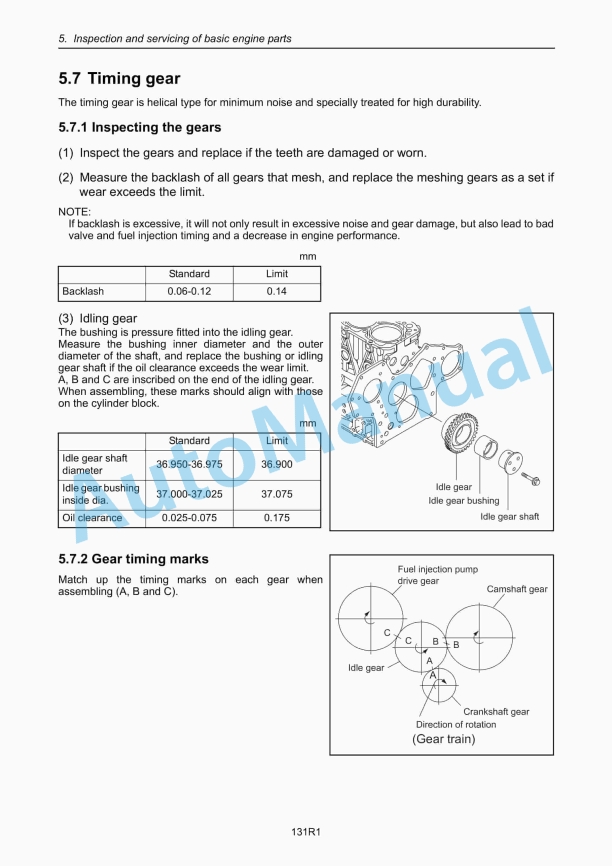
- 9.7. Timing gear
- 9.7.1. Inspecting the gears
- 9.7.2. Gear timing marks
- 9.8. Flywheel and housing
- 9.8.1. Position of top dead center and fuel injection timing
- 9.8.2. Damper disc
- 10. Fuel injection equipment
- 10.1. Fuel Injection pump/governor
- 10.1.1. Fuel system diagram
- 10.1.2. Fuel injection pump service data and adjustment
- 10.1.3. Fuel injection pump structure
- 10.1.4. Removing a fuel injection pump
- 10.1.5. Installing a fuel injection pump
- 10.1.6. Adjusting fuel injection timing
- 10.1.7. Troubleshooting of fuel injection pump
- 10.1.8. Major faults and troubleshooting
- 10.2. Fuel feed pump
- 10.2.1. Construction of fuel feed pump
- 10.2.2. Fuel feed pump specifications
- 10.2.3. Disassembly and reassembly of fuel feed pump
- 10.2.4. Fuel feed pump inspection
- 10.3. Fuel filter
- 10.3.1. Fuel filter specifications
- 10.3.2. Fuel filter inspection
- 10.4. Fuel tank
- 11. Intake and exhaust system
- 11.1. Intake system
- 11.1.1. Breather system (A reductor to intake air system of blowby gas)
- 11.1.2. Diaphragm assy inspection
- 11.2. Exhaust system
- 11.2.1. Construction
- 11.2.2. Mixing elbow inspection
- 12. Lubrication system
- 12.1. Lubrication system
- 12.2. Lube oil pump
- 12.2.1. Lube oil pump construction
- 12.2.2. Specifications of lube oil pump
- 12.2.3. Lube oil pump disassembly and reassembly
- 12.2.4. Lube oil pump inspection
- 12.2.5. Pressure control valve construction
- 12.3. Lube oil filter
- 12.3.1. Lube oil filter construction
- 12.3.2. Lube oil filter replacement
- 12.4. Rotary waste oil pump (Optional)
- 13. Cooling water system
- 13.1. Cooling water system
- 13.2. Seawater pump
- 13.2.1. Specifications of seawater pump
- 13.2.2. Seawater pump disassembly
- 13.2.3. Seawater pump Inspection
- 13.2.4. Seawater pump reassembly
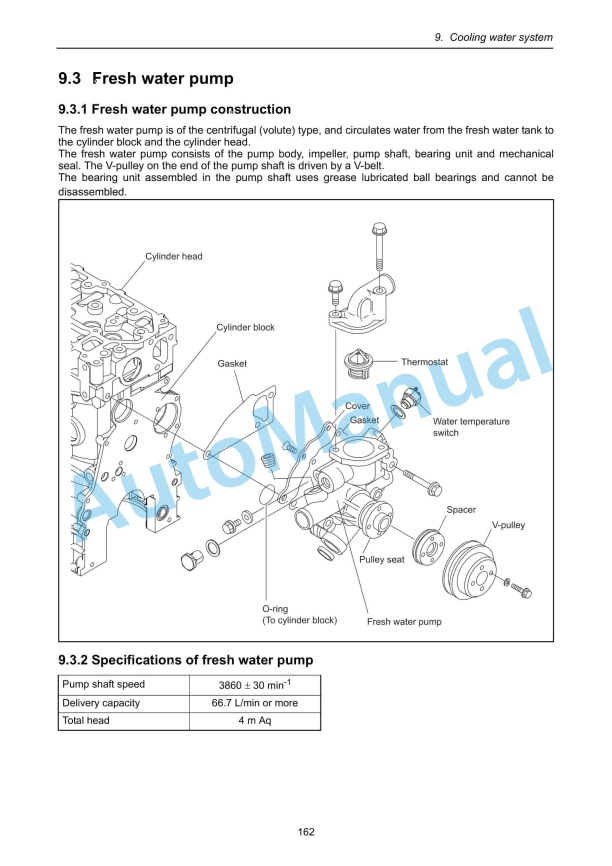
- 13.3. Fresh water pump
- 13.3.1. Fresh water pump construction
- 13.3.2. Specifications of fresh water pump
- 13.3.3. Fresh water pump disassembly
- 13.3.4. WFresh water pump inspection
- 13.4. Heat exchanger
- 13.4.1. Heat exchanger construction
- 13.4.2. Disassembly and reassembly of the heat exchanger
- 13.4.3. Heat exchanger inspection
- 13.5. Pressure cap and coolant recovery tank
- 13.5.1. Pressure cap construction
- 13.5.2. Pressure cap pressure control
- 13.5.3. Pressure cap inspection
- 13.5.4. Replacing filler neck
- 13.5.5. Function of the coolant recovery tank
- 13.5.6. Specifications of coolant recovery tank
- 13.5.7. Mounting the coolant recovery tank
- 13.5.8. Precautions on usage of the coolant recovery tank
- 13.6. Thermostat
- 13.6.1. Functioning of thermostat
- 13.6.2. Thermostat construction
- 13.6.3. Characteristics of thermostat
- 13.6.4. Thermostat inspection
- 13.6.5. Testing the thermostat
- 13.7. Bilge pump and bilge strainer (Optional)
- 13.7.1. Introduction
- 13.7.2. Description
- 13.7.3. Cautions
- 13.7.4. Assembly procedure
- 13.7.5. Cautions for assembling
- 13.7.6. Troubleshooting
- 14. Reduction and reversing gear
- 14.1. Specifications
- 15. Remote control (Optional)
- 15.1. Remote control system
- 15.1.1. Construction of remote control system
- 15.1.2. Remote control device components
- 15.2. Remote control installation
- 15.3. Remote control inspection
- 15.4. Remote control adjustment
- 16. Electrical system
- 16.1. Electrical system
- 16.1.1. Wiring diagram
- 16.2. Battery
- 16.3. Starting motor
- 16.3.1. Specifications
- 16.3.2. Characteristics
- 16.3.3. Structure
- 16.3.4. Wiring diameter of a starting motor
- 16.4. Alternator standard, 12V/60A
- 16.4.1. Specifications
- 16.4.2. Structure
- 16.4.3. Wiring diagram
- 16.4.4. Standard output characteristics
- 16.4.5. Inspection
- 16.5. Alternator 12V/80A (Optional)
- 16.5.1. Specifications
- 16.5.2. Structure
- 16.5.3. Wiring diagram
- 16.5.4. Standard output characteristics
- 16.6. Instrument panel
- 16.6.1. B-type instrument panel (Optional)
- 16.7. Warning devices
- 16.7.1. Oil pressure alarm
- 16.7.2. Cooling water temperature alarm
- 16.8. Glow plug
- 16.9. Electric engine stopping device
- 17. Service standards
- 17.1. Engine tuning
- 17.2. Engine body
- 17.2.1. Cylinder head
- 17.2.2. Camshaft and gear train
- 17.2.3. Cylinder block
- 17.3. Lubricating oil system (Trochoid pump)
- 18. Tightening torque for bolts and nuts
- 18.1. Main bolt and nut
- 18.2. Standard bolts and nuts (without lube oil)
- 19. Colophon
- 20. Back cover


,%202GM(F)(L),%203GM(D)(F)(L),%203HM(F)(L)%20Engine%20Service%20Manual&url=https://pdfrepairmanual.com/docs/yanmar-1gm10l-2gmfl-3gmdfl-3hmfl-engine-service-manual/&media=https://pdfrepairmanual.com/wp-content/uploads/2026/01/yanmar-1gm10l-2gmfl-3gmdfl-3hmfl-engine-service-manual-1.jpg)


,%202GM20(F)(C),%203GM30(F)(C),%203HM35(F)(C)%20Marine%20Diesel%20Engine%20Service%20Manual&url=https://pdfrepairmanual.com/docs/yanmar-1gm10c-2gm20fc-3gm30fc-3hm35fc-marine-diesel-engine-service-manual/&media=https://pdfrepairmanual.com/wp-content/uploads/2026/01/yanmar-1gm10c-2gm20fc-3gm30fc-3hm35fc-marine-diesel-engine-service-manual-1.jpg)

,%202GM20(F)(C),%203GM30(F)(C),%203HM35(F)(C)%20Engine%20Service%20Manual&url=https://pdfrepairmanual.com/docs/yanmar-1gm10c-2gm20fc-3gm30fc-3hm35fc-engine-service-manual/&media=https://pdfrepairmanual.com/wp-content/uploads/2026/01/yanmar-1gm10c-2gm20fc-3gm30fc-3hm35fc-engine-service-manual-1.jpg)
There are no reviews yet.