
Description
-
Model List:
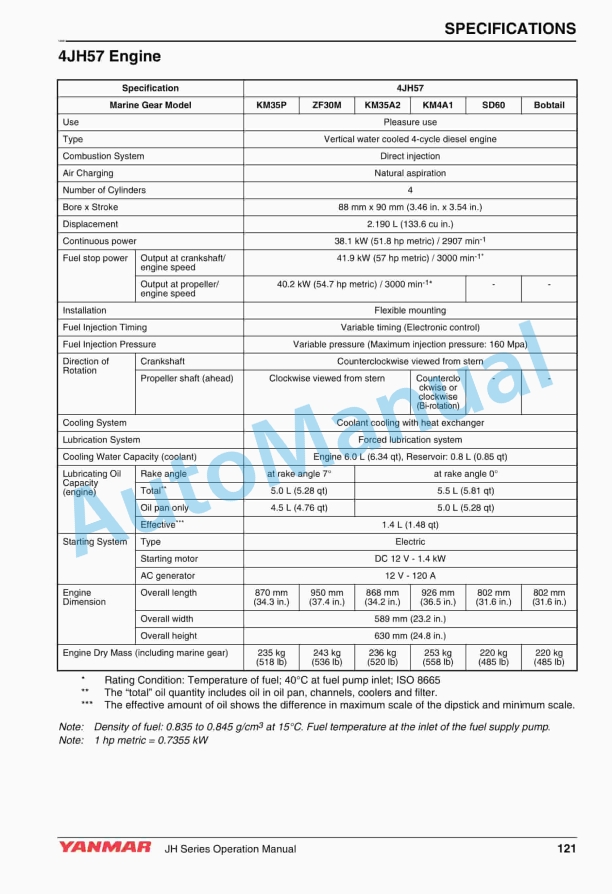
- 4JH45, 4JH57, 4JH80, 4JH110 Marine Engine
- 1. Table of Contents
- 2. Introduction
- 2.1. Record of Ownership
- 2.2. Safety Precautions
- 2.2.1. General Information
- 2.2.2. Before You Operate
- 2.2.3. During Operation and Maintenance
- 2.3. Location of Safety Decals
- 3. Product Overview
- 3.1. YANMAR 4JH COMMON RAIL SERIES FEATURES AND APPLICATIONS
- 3.1.1. New Engine Break-In
- 3.2. Component Identification
- 3.2.1. Right Side (Viewed from Flywheel) – 4JH45/4JH57
- 3.2.2. Left Side (Viewed from Flywheel) – 4JH45/4JH57
- 3.2.3. Right Side (Viewed from Flywheel) – 4JH80/4JH110
- 3.2.4. Left Side (Viewed from Flywheel) – 4JH80/4JH110
- 3.3. Nameplates
- 3.4. Function of Major Components
- 3.5. ELECTRONIC CONTROL SYSTEM
- 3.6. Main Electronic Control Components and Features
- 3.7. Control Equipment
- 3.7.1. Instrument Panel (Optional)
- 3.7.1.1. Equipment and Functions
- 3.7.1.2. Indicators and Alarms (Optional)
- 3.7.1.3. Selecting the fuel tank level gauge (Usually set at boat builder)
- 3.7.1.4. Selection of the display setting
- 3.7.2. Accessory power output
- 3.7.3. Single-Lever Remote Control Handle
- 3.8. Vessel Control System (VC10)
- 3.8.1. Display
- 3.8.1.1. Display Function
- 3.8.1.2. Emergency Stop Switch
- 4. Before You Operate
- 4.1. Introduction
- 4.2. Safety Precautions
- 4.3. Diesel Fuel
- 4.3.1. Diesel Fuel Specifications
- 4.3.1.1. Biodiesel Fuels
- 4.3.1.2. Additional Technical Fuel Requirements
- 4.3.1.3. Fuel Tank (Optional)
- 4.3.2. Filling the Fuel Tank
- 4.3.2.1. Before filling fuel tank for the first time
- 4.3.2.2. To fill the fuel tank
- 4.3.3. Bleeding the Fuel System
- 4.3.3.1. Bleeding the pre-filter
- 4.3.4. Priming the Fuel System
- 4.3.4.1. Bleeding the fuel filter
- 4.4. Engine Oil
- 4.4.1. Engine Oil Specifications
- 4.4.1.1. Service Categories
- 4.4.1.2. Handling Engine Oil
- 4.4.2. Engine Oil Viscosity
- 4.4.3. Checking the Engine Oil
- 4.4.4. Adding Engine Oil
- 4.5. Marine Gear or Sail Drive Oil
- 4.5.1. Marine Gear Oil Specifications
- 4.5.2. Sail Drive Oil Specifications
- 4.5.3. Checking Marine Gear Oil
- 4.5.4. Adding Marine Gear Oil
- 4.5.5. Checking and Adding Sail Drive Oil
- 4.6. Engine Coolant
- 4.6.1. Engine Coolant Specifications
- 4.6.2. Coolant (Closed Cooling System)
- 4.6.3. Checking and Adding Coolant
- 4.6.3.1. H45, 4JH57
- 4.6.3.2. H80, 4JH110
- 5. Engine Operation
- 5.1. Introduction
- 5.2. Safety Precautions
- 5.3. OPERATION (B25,C35-Type instrument panel)
- 5.3.1. Starting the Engine
- 5.3.2. If the Engine Fails to Start
- 5.3.2.1. Air Bleeding the Fuel System After Starting Failure
- 5.3.3. Starting at Low Temperatures
- 5.3.4. After the Engine has Started
- 5.4. Remote Control Handle Operation
- 5.4.1. Acceleration and Deceleration
- 5.4.2. Shifting the Engine
- 5.4.3. Switching to Trolling (KMH4A Only)
- 5.5. Cautions During Operation
- 5.6. Shutting Down the Engine
- 5.6.1. Normal Shutdown
- 5.6.2. Emergency Shutdown
- 5.6.3. Emergency Stop Switch (option usually equipped near the instrument panel)
- 5.7. Checking the Engine After Operation
- 5.8. OPERATION (VC10 VESSEL CONTROL SYSTEM)
- 5.8.1. Starting the Engine
- 5.8.2. Station Protect
- 5.8.3. Sys on by ID, Start by ID
- 5.8.4. Owner ID Change
- 5.8.5. If the Engine Fails to Start
- 5.8.5.1. Air Bleeding the Fuel System After Starting Failure
- 5.8.6. Starting at Low Temperatures
- 5.8.7. After the Engine has Started
- 5.9. Warm Up Mode (Shift Disconnect)
- 5.10. Throttle and Shift Control
- 5.10.1. Neutral
- 5.10.2. Forward
- 5.10.3. Reverse
- 5.10.4. Forward (Reverse) to Reverse (Forward)
- 5.11. Engine Speed Limit Mode
- 5.12. Cautions During Operation
- 5.13. Shut-Down the Engine (Stopping)
- 5.13.1. Normal Stopping
- 5.13.2. Emergency Stop
- 5.13.2.1. Electric Emergency Stop
- 5.14. Control the Backup Panel
- 5.15. Checking the Engine After Operation
- 6. Periodic Maintenance
- 6.1. Introduction
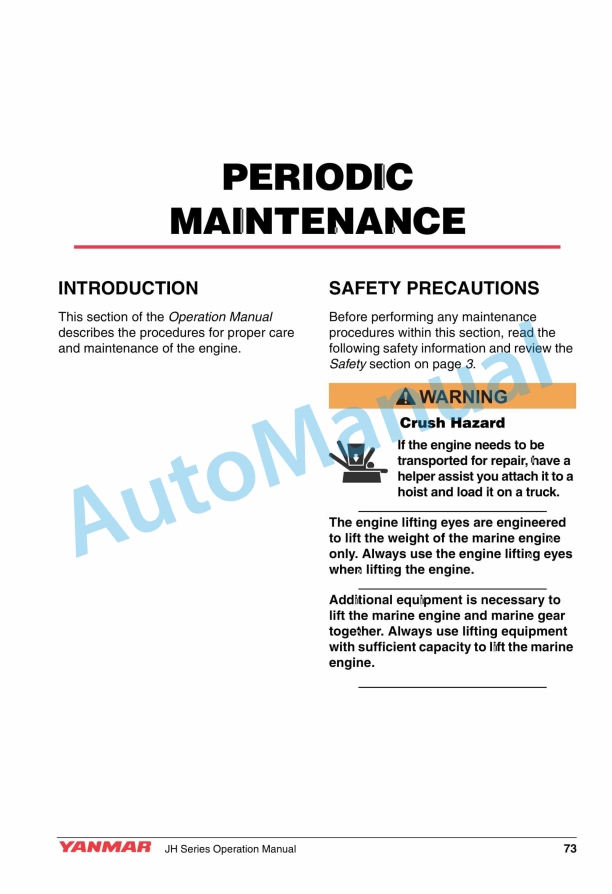
- 6.2. Safety Precautions
- 6.3. Precautions
- 6.3.1. The Importance of Periodic Maintenance
- 6.3.2. Performing Periodic Maintenance
- 6.3.3. The Importance of Daily Checks
- 6.3.4. Keep a Log of Engine Hours and Daily Checks
- 6.3.5. Yanmar Replacement Parts
- 6.3.6. Tools Required
- 6.3.7. Ask Your Authorized Yanmar Marine Dealer or Distributor for Help
- 6.3.7.1. Main Bolts and Nuts
- 6.4. EPA Maintenance Requirements
- 6.4.1. EPA Requirements for USA and Other Applicable Countries
- 6.4.2. EPA Requirements
- 6.4.3. Installation of Exhaust Sampling Port
- 6.5. Periodic Maintenance Schedule
- 6.5.1. Inspection and Maintenance of EPA Emission-Related Parts for CI Marine Engines
- 6.6. Periodic Maintenance Procedures
- 6.6.1. Daily Checks
- 6.6.1.1. Visual Checks
- 6.6.1.2. Check Diesel Fuel, Engine Oil and Engine Coolant Levels
- 6.6.1.3. Checking and Refilling Marine Gear Oil
- 6.6.1.4. Checking the Battery Electrolyte Level
- 6.6.1.5. Checking the Alternator Belt
- 6.6.1.6. Checking the Remote Control Handle
- 6.6.1.7. Checking the Alarm Indicators
- 6.6.1.8. Preparing Fuel, Oil and Coolant in Reserve
- 6.6.2. After Initial 50 Hours of Operation
- 6.6.2.1. Draining the Fuel Tank
- 6.6.2.2. Changing the Engine Oil and Replacing the Engine Oil Filter Element
- 6.6.2.3. Changing the Marine Gear Oil and Replacing the Marine Gear Oil Filter (If Equipped)
- 6.6.2.4. Checking and Adjusting the Alternator V-ribbed belt Tension
- 6.6.2.5. Inspecting and Adjusting Intake/Exhaust Valve Clearance
- 6.6.2.6. Checking and Adjusting Remote Control Cables
- 6.6.2.7. Adjusting Propeller Shaft Alignment
- 6.6.3. Every 50 Hours of Operation
- 6.6.3.1. Draining Fuel Filter/Water Separator
- 6.6.3.2. Checking the Battery Electrolyte Level (Serviceable Batteries Only)
- 6.6.4. Every 250 Hours of Operation
- 6.6.4.1. Draining the Fuel Tank
- 6.6.4.2. Replacing the Fuel Filter Element
- 6.6.4.3. Changing the Engine Oil and Replacing the Engine Oil Filter Element
- 6.6.4.4. Changing the Marine Gear Oil and Replacing the Marine Gear Oil Filter Element (if equipped)
- 6.6.4.5. Checking or Replacing Seawater Pump Impeller
- 6.6.4.6. Changing the Coolant
- 6.6.4.7. Cleaning the Intake Silencer (Air Cleaner) Element
- 6.6.4.8. Cleaning the Exhaust/Water Mixing Elbow
- 6.6.4.9. Wash the Turbocharger blower (If Equipped)
- 6.6.4.10. Adjusting the Alternator V-ribbed belt Tension
- 6.6.4.11. Checking the Wiring Connectors
- 6.6.4.12. Tightening All Major Nuts and Bolts
- 6.6.5. Every 500 Hours of Operation
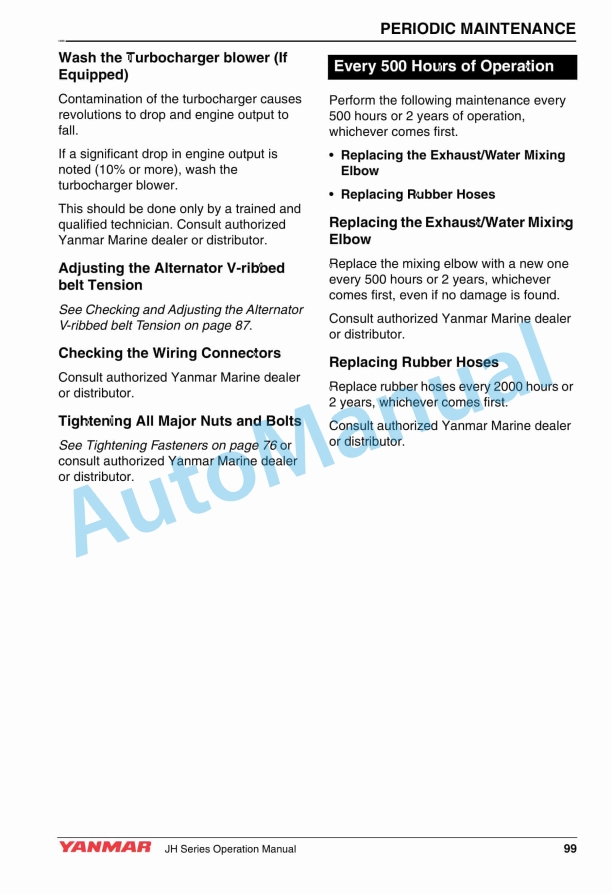
- 6.6.5.1. Replacing the Exhaust/Water Mixing Elbow
- 6.6.5.2. Replacing Rubber Hoses
- 6.6.6. Every 1000 Hours of Operation
- 6.6.6.1. Replacing the Seawater Pump Impeller
- 6.6.6.2. Cleaning and Checking the Seawater Passages
- 6.6.6.3. Checking Diaphragm Assembly (4JH45/4JH57 Only)
- 6.6.6.4. Replacing the Alternator V-ribbed belt
- 6.6.6.5. Adjusting Intake/Exhaust Valve Clearance
- 6.6.6.6. Checking the Remote Control Cable Operation
- 6.6.6.7. Adjusting the Propeller Shaft Alignment
- 7. Troubleshooting
- 7.1. Safety Precautions
- 7.2. Troubleshooting After Starting
- 7.3. Troubleshooting Information
- 7.4. Troubleshooting Chart
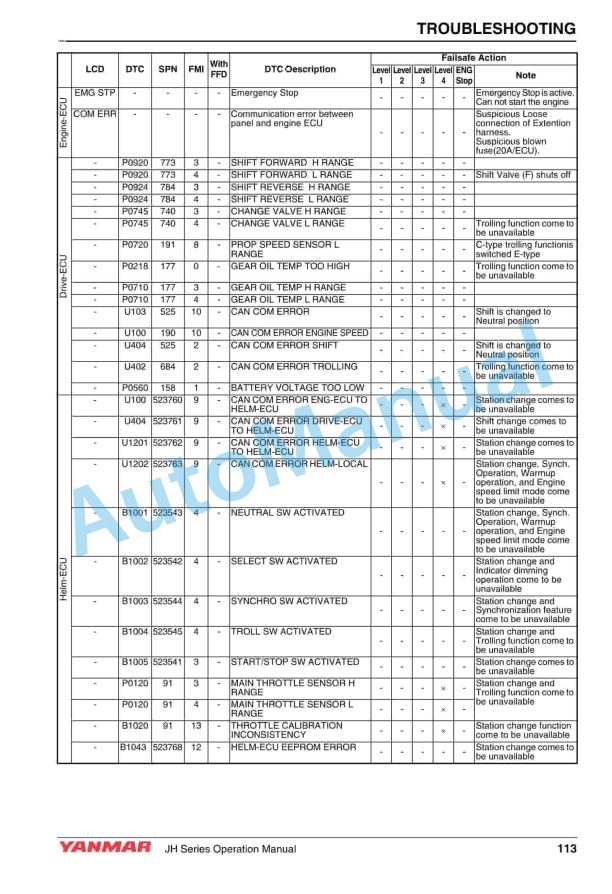
- 7.5. Failsafe Diagnosis Functional Specification Chart
- 8. Long-Term Storage
- 8.1. Prepare Engine for Long-Term Storage
- 8.2. Drain Seawater Cooling System
- 8.3. Returning the Engine to Service
- 9. Specifications
- 9.1. Principal Engine Specifications
- 9.1.1. H45 Engine
- 9.1.2. H57 Engine
- 9.1.3. H45, 4JH57 Marine Gear or Sail Drive
- 9.1.4. H80 Engine
- 9.1.5. H110 Engine
- 9.1.6. H80, 4JH110 Marine Gear or Sail Drive
- 10. System Diagrams
- 10.1. Piping Diagrams
- 10.2. Wiring Diagrams
- 11. EPA Warranty USA Only
- 11.1. Yanmar Co., Ltd. Limited Emission Control System Warranty – USA Only
- 11.1.1. Your Warranty Rights and Obligations
- 11.1.2. Warranty Period
- 11.1.3. Warranty Coverage
- 11.1.4. Exclusions
- 11.1.5. Owners Responsibility
- 11.1.6. Customer Assistance
- 11.1.7. Maintenance Log


There are no reviews yet.