
Description
-
Model List:
- L48N, L70N, L100N Industrial Engine
- 1. Table of Contents
- 2. Introduction
- 3. Yanmar Warranties
- 3.1. Yanmar Limited Warranty
- 3.1.1. What is Covered by this Warranty
- 3.1.2. How Long is the Warranty Period
- 3.1.3. What the Engine Owner Must Do
- 3.1.4. To Locate an Authorized Yanmar Industrial Engine Dealer or Distributor
- 3.1.5. What Yanmar Will Do
- 3.1.6. What is Not Covered by this Warranty
- 3.1.7. Warranty Limitations
- 3.1.8. Warranty Modifications
- 3.1.9. Questions
- 3.1.10. Retail Purchaser Registration
- 3.2. Warranty
- 3.2.1. Warranty Coverage
- 3.2.2. Exclusions
- 3.2.3. Owners Warranty Responsibilities
- 3.3. Safety Statements
- 3.4. Before You Begin Servicing
- 3.5. Safety Precautions
- 4. General Service Information
- 4.1. Component Identification
- 4.2. Location of Labels
- 4.3. Specifications
- 4.3.1. Description of Model Number
- 4.3.2. Engine Speed Specifications
- 4.3.3. General Engine Specifications
- 4.4. Function of Major Engine Components
- 4.5. Diesel Fuel
- 4.5.1. Diesel Fuel Specifications
- 4.5.1.1. Additional Technical Fuel Requirements
- 4.5.1.2. Bio-Diesel Fuels
- 4.5.2. Filling the Fuel Tank
- 4.5.3. Priming the Fuel System
- 4.5.3.1. Gravity-Fed Fuel System
- 4.5.3.2. Electric Pump Pressurized Fuel System
- 4.6. Engine Oil
- 4.6.1. Engine Oil Specifications
- 4.6.1.1. Service Categories
- 4.6.1.2. Definitions
- 4.6.1.3. Additional Technical Engine oil Requirements
- 4.6.2. Engine Oil Viscosity
- 4.6.3. Engine Oil Capacity (Typical)
- 4.6.4. Checking Engine Oil
- 4.6.5. Adding Engine Oil
- 4.7. Abbreviations and Symbols
- 4.7.1. Abbreviations
- 4.7.2. Symbols
- 4.8. Unit Conversions
- 4.8.1. Unit Prefixes
- 4.8.2. Units of Length
- 4.8.3. Units of Volume
- 4.8.4. Units of Mass
- 4.8.5. Units of Force
- 4.8.6. Units of Torque
- 4.8.7. Units of Pressure
- 4.8.8. Units of Power
- 4.8.9. Units of Temperature
- 4.9. Tightening Torques for Standard Bolts and Nuts
- 4.10. Tightening Torques for Special Bolts and Nuts
- 5. Periodic Maintenance
- 5.1. Before You Begin Servicing
- 5.1.1. Introduction
- 5.1.2. The Importance of Periodic Maintenance
- 5.1.3. Performing Periodic Maintenance
- 5.1.4. The Importance of Daily Checks
- 5.1.5. Keep a Log of Engine Hours and Daily Checks
- 5.1.6. Yanmar Replacement Parts
- 5.1.7. Tools Required
- 5.1.8. Tightening Fasteners
- 5.2. Periodic Maintenance Schedule
- 5.3. Periodic Maintenance Procedures
- 5.3.1. Daily, Before Operation
- 5.3.1.1. Check Battery (If Equipped)
- 5.3.1.2. Check Battery Indicator (If Equipped)
- 5.3.1.3. Check Engine Oil Level
- 5.3.1.4. Check for Engine Oil Leakage
- 5.3.1.5. Check Engine Speed Control
- 5.3.1.6. Check Spark Arrester (If Equipped)
- 5.3.1.7. Check Fuel Level
- 5.3.1.8. Check for Fuel Leakage
- 5.3.2. Daily, After Operation
- 5.3.2.1. Check for Engine Oil Leakage
- 5.3.2.2. Check for Fuel Leakage
- 5.3.3. After Initial 50 Hours of Operation
- 5.3.3.1. Replace Engine Oil
- 5.3.3.2. Clean / Inspect Engine Oil Filter
- 5.3.4. Every 50 Hours of Operation
- 5.3.4.1. Clean Inlet Fuel Screen
- 5.3.5. Every 200 Hours of Operation
- 5.3.5.1. Clean Air Cleaner Element
- 5.3.5.2. Replace Engine Oil and Clean / Inspect Engine Oil Filter
- 5.3.5.3. Check and Adjust Engine Speed Control
- 5.3.5.4. Drain the Fuel Tank and Replace Outlet Fuel Filter
- 5.3.6. Every 500 Hours of Operation
- 5.3.6.1. Adjust Intake and Exhaust Valve Clearance
- 5.3.6.2. Replace Outlet Fuel Filter
- 5.3.6.3. Inspect, Clean and Test Fuel Injection Nozzle, if required
- 5.3.7. Every 1000 Hours of Operation
- 5.3.7.1. Check Compression
- 5.3.8. Every 2000 Hours of Operation
- 5.3.8.1. Check and Replace Fuel Hoses
- 5.4. Before You Begin Servicing
- 5.5. Introduction
- 5.6. Specifications
- 5.6.1. Cylinder Head Assembly
- 5.6.1.1. Valve Clearance
- 5.6.1.2. Cylinder Head
- 5.6.1.3. Intake / Exhaust Valve Seat
- 5.6.1.4. Intake / Exhaust Valves, Guides and Seals
- 5.6.1.5. Push Rod
- 5.6.1.6. Valve Spring
- 5.6.1.7. Rocker Arm and Shaft
- 5.6.2. Crankshaft, Balancer Shaft, Piston and Connecting Rod
- 5.6.2.1. Crankshaft
- 5.6.2.2. Balancer Shaft
- 5.6.2.3. Piston Ring
- 5.6.2.4. Connecting Rod
- 5.6.3. Camshaft and Tappet
- 5.6.3.1. Camshaft
- 5.6.4. Cylinder Block and Crankcase Cover
- 5.6.4.1. Cylinder Block
- 5.6.4.2. Crankcase Cover
- 5.6.5. Oil Pump (Trochoid Pump)
- 5.6.6. Special Torque Specifications
- 5.7. Special Service Tools
- 5.8. Measuring Instruments
- 5.9. Cylinder Head
- 5.9.1. Removal of Cylinder Head
- 5.9.1.1. L48N Models
- 5.9.1.2. L70N and L100N Models
- 5.9.1.3. All Models
- 5.9.2. Disassembly of Cylinder Head
- 5.9.3. Inspection of Cylinder Head Components
- 5.9.3.1. Valve Face and Valve Seat
- 5.9.3.2. Valves and Valve Guides
- 5.9.3.3. Valve Springs
- 5.9.3.4. Rocker Arms and Push Rods
- 5.9.3.5. Cylinder Head Distortion
- 5.9.4. Reassembly of Cylinder Head
- 5.9.4.1. Reassembly of Intake / Exhaust Valves
- 5.9.5. Installation of Cylinder Head
- 5.9.6. Calculating Cylinder Head Gasket Thickness
- 5.9.7. Checking Actual Piston TDC (Top Dead Center)
- 5.9.8. Measuring and Adjusting Valve Clearance
- 5.9.9. Removal of Engine
- 5.9.10. Disassembly of Engine
- 5.9.11. Inspection of Engine Components
- 5.9.11.1. Piston, Piston Rings and Wrist Pin
- 5.9.11.2. Connecting Rod
- 5.9.11.3. Crankshaft, Main Bearing and Flywheel
- 5.9.11.4. Crankshaft
- 5.9.11.5. Bearings
- 5.9.11.6. Camshaft and Tappet
- 5.9.11.7. Balancer Shaft
- 5.9.11.8. Timing Gears
- 5.9.11.9. Cylinder Bore
- 5.9.11.10. Honing and Boring
- 5.9.11.11. Inspection and Service of Engine Oil Pump
- 5.9.12. Reassembly of Engine
- 5.9.12.1. Replacement of Throttle Shaft Seal – L48N Models
- 5.9.12.2. Replacement of Throttle Shaft Seal – L70N and L100N Models
- 5.9.12.3. Replacement of Crankshaft Seals
- 5.9.12.4. Reassembly of Piston, Piston Rings and Connection Rod
- 5.9.12.5. Installation of Crankshaft
- 5.9.12.6. Installation of Piston and Connecting Rod
- 5.9.12.7. Installation of Camshaft and Balancer Shaft
- 5.9.12.8. Installation of Crankcase Cover
- 5.9.12.9. Final Engine Assembly
- 5.9.13. Installation of Engine
- 6. Fuel System
- 6.1. Before You Begin Servicing
- 6.2. Introduction
- 6.3. Specifications
- 6.3.1. Test and Adjustment Specifications
- 6.3.2. Special Torque Specifications
- 6.4. Special Service Tools
- 6.5. Measuring Instruments
- 6.6. Fuel System Operation
- 6.6.1. Fuel Injection Pump
- 6.6.2. Fuel Injector
- 6.7. Fuel System Diagram
- 6.8. Fuel System Components
- 6.9. Checking and Adjusting Fuel Injection Timing
- 6.9.1. Checking Fuel Injection Timing
- 6.9.2. Adjusting Fuel Injection Timing
- 6.10. Fuel Injection Pump
- 6.10.1. Removal of Fuel Injection Pump
- 6.10.2. Installation of Fuel Injection Pump
- 6.10.3. Replacement and/or Adjustment of the Fuel Limiter
- 6.11. Fuel Injector
- 6.11.1. Removal of Fuel Injector
- 6.11.2. Testing of Fuel Injector
- 6.11.3. Disassembly and Inspection of Fuel Injector
- 6.11.4. Adjusting Fuel Injector Pressure
- 6.11.5. Reassembly of Fuel Injector
- 6.11.6. Installation of the Fuel Injector
- 6.12. Speed Control Device
- 6.12.1. Variable Speed Type
- 6.12.2. Remote Control Type
- 6.12.3. Variable Speed Friction Plate Type
- 6.12.4. Constant Speed Type
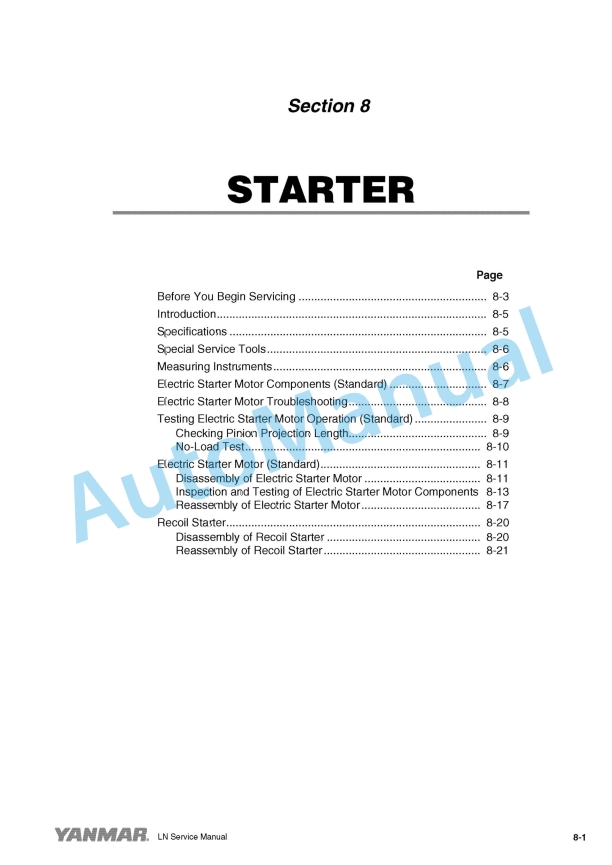
- 7. Starter
- 7.1. Before You Begin Servicing
- 7.2. Introduction
- 7.3. Specifications
- 7.4. Special Service Tools
- 7.5. Measuring Instruments
- 7.6. Electric Starter Motor Components (Standard)
- 7.7. Electric Starter Motor Troubleshooting
- 7.8. Testing Electric Starter Motor Operation (Standard)
- 7.8.1. Checking Pinion Projection Length
- 7.8.2. No-Load Test
- 7.9. Electric Starter Motor (Standard)
- 7.9.1. Disassembly of Electric Starter Motor
- 7.9.2. Inspection and Testing of Electric Starter Motor Components
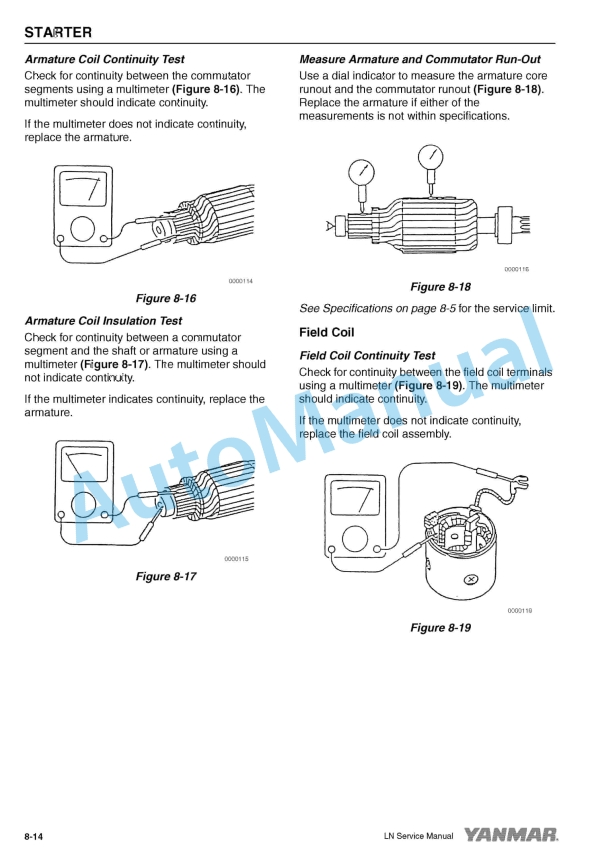
- 7.9.2.1. Armature
- 7.9.2.2. Field Coil
- 7.9.2.3. Brush Holder
- 7.9.2.4. Solenoid Switch
- 7.9.3. Reassembly of Electric Starter Motor
- 7.10. Recoil Starter
- 7.10.1. Disassembly of Recoil Starter
- 7.10.1.1. L48N and L70N
- 7.10.2. Reassembly of Recoil Starter
- 8. Charging System
- 8.1. Before You Begin Servicing
- 8.2. Introduction
- 8.3. Specifications
- 8.3.1. General Specifications
- 8.3.2. Unregulated Output Test Specifications
- 8.3.3. Regulated Output Test Specifications
- 8.3.4. Special Torque Specifications
- 8.4. Special Service Tools
- 8.5. Measuring Instruments
- 8.6. Charging System Operation
- 8.7. Charging System Wiring Diagrams
- 8.7.1. V – 3 A and 12 V – 15 A System
- 8.7.2. V – 1.7 A System
- 8.7.3. V – 1 A System
- 8.7.4. V – 3 A and 12 V – 15 A with Intake Air Heater and Timer
- 8.8. Charging System Components
- 8.9. Testing of Charging System and Components
- 8.9.1. Testing Regulated Output
- 8.9.2. Testing Unregulated Output
- 8.9.3. Testing Stator Coil Continuity
- 8.9.4. Testing Stator Coil Short-to-Ground
- 8.9.5. Testing of Regulator / Rectifier
- 8.9.5.1. Regulator Number RS5112
- 8.9.5.2. Regulator Number RS2190
- 8.9.6. Testing of Rectifier
- 8.9.6.1. ZR2117 (Half-Wave Rectifier)
- 8.9.6.2. ZR2120 (Full-Wave Rectifier)
- 8.9.7. Removal of Stator
- 8.9.8. Installation of Stator
- 9. Electric Wiring
- 9.1. Electric Wiring Precautions
- 9.2. Electrical Wire Resistance
- 9.3. Battery Cable Resistance (If Equipped)
- 9.4. Electrical Wire Sizes – Voltage Drop
- 9.5. Conversion of AWG to European Standards
- 10. Troubleshooting
- 10.1. Before You Begin Servicing
- 10.2. Introduction
- 10.3. Specifications
- 10.3.1. Cylinder Compression Pressure
- 10.4. Measuring Instruments
- 10.5. Troubleshooting By Measuring Compression Pressure
- 10.5.1. Measuring Compression Pressure
- 10.5.2. Low Compression Troubleshooting Chart
- 10.6. Troubleshooting Quick Reference Charts
- 10.7. Troubleshooting Charts
- 11. BACK COVER

,%202GM(F)(L),%203GM(D)(F)(L),%203HM(F)(L)%20Marine%20Diesel%20Engine%20Service%20Manual&url=https://pdfrepairmanual.com/docs/yanmar-1gm10l-2gmfl-3gmdfl-3hmfl-marine-diesel-engine-service-manual/&media=https://pdfrepairmanual.com/wp-content/uploads/2026/01/yanmar-1gm10l-2gmfl-3gmdfl-3hmfl-marine-diesel-engine-service-manual-1.jpg)


There are no reviews yet.