Komatsu PC240LC-10 Hydraulic Excavator Operation and Maintenance Manual CEAM025104
$30.00
- Type Of Manual: Operation and Maintenance Manual
- Manual ID: CEAM025104
- Format: PDF
- Size: 28.1MB
- Number of Pages: 401
Description
-
Model List:
- PC240LC-10 Hydraulic Excavator
- 1. OPERATION AND MAINTENANCE MANUAL, PC240LC10
- 1.1. Contents
- 1.2. INTRODUCTION
- 1.2.1. Foreword
- 1.2.2. Safety Alert Symbol and Signal Words
- 1.2.3. Basic Machine Introduction
- 1.2.4. Product Information
- 1.3. SAFETY
- 1.3.1. Safety Labels
- 1.3.1.1. Location of Safety Labels
- 1.3.2. General Precautions Common to Operation and Maintenance
- 1.3.2.1. Precautions Before Starting Operation
- 1.3.2.2. Preparations for Safe Operation
- 1.3.2.3. Fire and Explosion Prevention
- 1.3.2.4. Precautions When Getting On or Off the Machine
- 1.3.2.5. Precautions for Cab and Working Around Machine
- 1.3.3. Operation Precautions
- 1.3.3.1. Precautions at Jobsite
- 1.3.3.2. Precautions in Starting Engine
- 1.3.3.3. Precautions During Operation
- 1.3.3.4. Transportation Safety
- 1.3.3.5. Lifting Objects With Bucket
- 1.3.4. Maintenance Precautions
- 1.3.4.1. Precautions Before Inspection and Maintenance
- 1.3.4.2. Precautions During Inspection and Maintenance
- 1.4. OPERATION
- 1.4.1. Visual Overview of Machine
- 1.4.1.1. General Machine View
- 1.4.1.2. General View of Cab
- 1.4.1.3. Controls and Gauges
- 1.4.1.4. Machine Monitor Overview
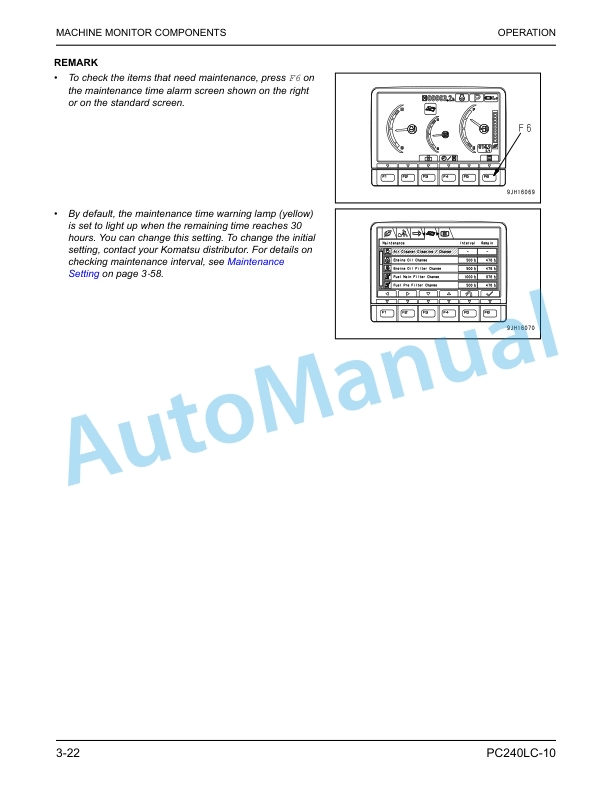
- 1.4.2. Machine Monitor Components
- 1.4.2.1. Basic Operation of Machine Monitor
- 1.4.2.2. Warning Lamps
- 1.4.2.3. Pilot Display
- 1.4.2.4. Gauge and Meter Display
- 1.4.2.5. Monitor Switches
- 1.4.2.6. User Menu
- 1.4.3. Operator Cab Switches
- 1.4.4. Control Levers and Pedals
- 1.4.5. Air Conditioner Operations
- 1.4.5.1. Air Conditioner Control Switches and Sensor
- 1.4.5.2. Using A/C in Auto Mode
- 1.4.5.3. Using A/C in Manual Mode
- 1.4.5.4. Blowing Cold Air to Face, Warm Air to Feet
- 1.4.5.5. Using Defrost Mode
- 1.4.6. Radio Operations
- 1.4.6.1. Radio Buttons and Display
- 1.4.6.2. Radio Setting and Adjusting
- 1.4.7. Auxiliary Electric Power
- 1.4.8. Fuses
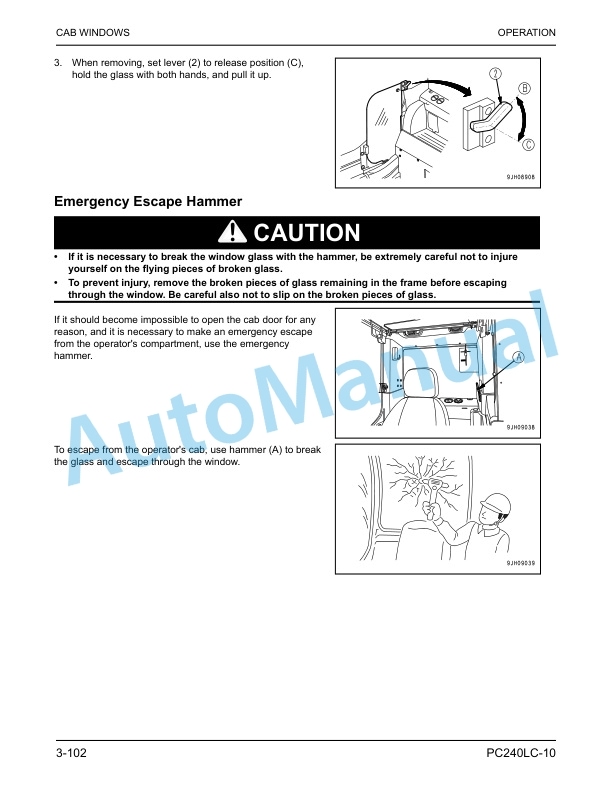
- 1.4.9. Cab Windows
- 1.4.9.1. Opening and Closing Roof Window
- 1.4.9.2. Opening and Closing Windshield
- 1.4.10. Cab Door
- 1.4.11. Containers and Fire Extinguisher
- 1.4.12. Engine Hood
- 1.4.12.1. Opening Engine Hood
- 1.4.12.2. Closing Engine Hood
- 1.4.13. Caps and Covers with Lock
- 1.4.13.1. Open and Close Caps with Locks
- 1.4.13.2. Open and Close Covers with Locks
- 1.4.13.3. Lock and Unlock Engine Hood
- 1.4.13.4. Lock and Unlock the Cab Door
- 1.4.14. Battery Disconnect Switch
- 1.4.15. System Operating Lamp
- 1.4.16. Komatsu Diesel Particulate Filter (KDPF)
- 1.4.16.1. Manual Stationary Regeneration Procedure
- 1.4.16.2. KDPF Regeneration Disable Procedure
- 1.4.16.3. Canceling KDPF Regeneration Disable
- 1.4.17. Komatsu Closed Crankcase Ventilation (KCCV)
- 1.4.18. KOMTRAX
- 1.4.19. Daily Checks and Preparations Before Starting Engine
- 1.4.19.1. WalkAround Checks
- 1.4.19.2. Drain Water and Sediment from Fuel Tank
- 1.4.19.3. Drain Water and Sediment in Water Separator
- 1.4.19.4. Check and Add to Oil Level in Hydraulic Tank
- 1.4.19.5. Check and Add to Coolant Level
- 1.4.19.6. Check and Add to Oil in Engine Pan
- 1.4.19.7. Check Electrical Wiring
- 1.4.19.8. Check and Add to Fuel Level
- 1.4.19.9. Check Working Lamp Switch
- 1.4.19.10. Check Horn Function
- 1.4.19.11. Preparing to Use Operators Cab
- 1.4.20. Starting the Engine
- 1.4.20.1. Manual Preheating When Starting Engine
- 1.4.20.2. Turbocharger Protection Function
- 1.4.21. Operations and Checks After Starting the Engine
- 1.4.21.1. Engine WarmUp
- 1.4.21.2. Hydraulic System WarmUp
- 1.4.22. Stopping the Engine
- 1.4.23. Moving and Steering Machine
- 1.4.23.1. Moving Machine Forward
- 1.4.23.2. Moving Machine in Reverse
- 1.4.23.3. Stopping the Machine
- 1.4.23.4. Steering the Machine
- 1.4.23.5. Swinging the Machine
- 1.4.24. Operating Work Equipment
- 1.4.25. Working Mode
- 1.4.25.1. Operating the Working Mode Selector Switch
- 1.4.26. Prohibited Operations
- 1.4.27. Rules for Traveling
- 1.4.27.1. Traveling on Slopes
- 1.4.28. Recommended Applications
- 1.4.29. Replacing and Inverting Bucket
- 1.4.29.1. Replacing the Bucket
- 1.4.29.2. Inverting the Bucket
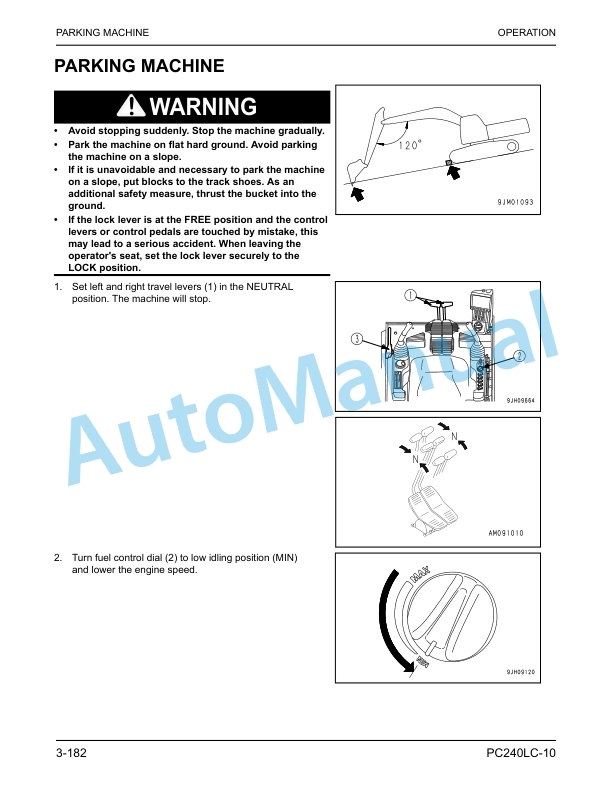
- 1.4.30. Parking Machine
- 1.4.31. After Finishing Work
- 1.4.31.1. Checks After Finishing Daily Work
- 1.4.31.2. Locking the Machine
- 1.4.32. Transporting the Machine
- 1.4.32.1. Loading and Unloading with Trailer
- 1.4.32.2. Lifting Machine
- 1.4.33. Cold Weather Operation
- 1.4.34. LongTerm Storage of Machine
- 1.4.35. Common Phenomena That are Not Failures
- 1.4.36. Towing Machine
- 1.4.37. Towing with Machine
- 1.4.38. Disconnect and Charge Battery
- 1.4.39. Jumper Cables to Start Engine
- 1.4.39.1. Attaching Jumper Cables to Machine
- 1.4.39.2. Start Engine with Jumper Cables Attached
- 1.4.39.3. Disconnect Jumper Cables from Machine
- 1.4.40. Troubleshooting Common Troubles and Actions to Take
- 1.4.40.1. Error List Screen
- 1.5. MAINTENANCE
- 1.5.1. Rules for Maintenance
- 1.5.2. Outline of Service
- 1.5.2.1. Handling Oil, Fuel, Coolant, and Performing Oil Clinic
- 1.5.2.2. Handling Electrical Components
- 1.5.3. Consumable Parts
- 1.5.4. Safety Critical Parts
- 1.5.5. Torque Specifications
- 1.5.6. Recommended Fuel, Coolant, and Lubricant
- 1.5.7. Hydraulic Breaker Maintenance Interval
- 1.5.8. Maintenance Schedule
- 1.5.8.1. Maintenance Schedule Table
- 1.5.9. Maintenance Procedures as Required
- 1.5.9.1. Air Cleaner Element Maintenance
- 1.5.9.2. Cooling System Cleaning
- 1.5.9.3. Track Shoe Bolts
- 1.5.9.4. Track Tension Inspection
- 1.5.9.5. Track Tension Increase
- 1.5.9.6. Track Tension Decrease
- 1.5.9.7. Vertical Pin Bucket Teeth Replacement
- 1.5.9.8. Horizontal Pin Bucket Teeth Replacement
- 1.5.9.9. Bucket Clearance Adjustment
- 1.5.9.10. Window Washer Fluid Level And Mixture Ratio
- 1.5.9.11. Air Conditioner Maintenance
- 1.5.9.12. Washable Cab Floor and Floor Mat
- 1.5.9.13. Setting Machine at Angle
- 1.5.9.14. Gas Spring Maintenance
- 1.5.9.15. Bleeding Air From Hydraulic System
- 1.5.9.16. Bleeding Air from Fuel Circuit
- 1.5.10. Maintenance for First 500 Hours
- 1.5.11. Maintenance Every 100 Hours
- 1.5.11.1. Lubrication Every 100 Hours
- 1.5.12. Maintenance Every 250 Hours
- 1.5.12.1. Battery Electrolyte Level Check
- 1.5.12.2. Air Conditioner Compressor Belt Check and Tension Adjustment
- 1.5.13. Maintenance Every 500 Hours
- 1.5.13.1. Lubrication Every 500 Hours
- 1.5.13.2. Engine Oil and Filter Cartridge Replacement
- 1.5.13.3. Fuel Prefilter Cartridge Replacement
- 1.5.13.4. Swing Pinion Grease Level
- 1.5.13.5. Radiator, Cooler, and Condenser Fins Maintenance
- 1.5.13.6. Recirculated Filter and Fresh Air Filter Maintenance
- 1.5.13.7. Hydraulic Tank Breather Element Replacement
- 1.5.13.8. Swing Machinery Case Oil Level
- 1.5.13.9. Final Drive Case Oil Level
- 1.5.14. Maintenance Every 1000 Hours
- 1.5.14.1. Hydraulic Oil Filter Element Replacement
- 1.5.14.2. Swing Machinery Case Oil Change
- 1.5.14.3. Damper Case Oil Level
- 1.5.14.4. Fuel Main Filter Cartridge Replacement
- 1.5.15. Maintenance Every 2000 Hours
- 1.5.15.1. Final Drive Case Oil Change
- 1.5.15.2. Hydraulic Tank Strainer Cleaning
- 1.5.15.3. Accumulator Nitrogen Gas Pressure
- 1.5.15.4. KCCV Filter Element Replacement
- 1.5.16. Maintenance Every 4000 Hours
- 1.5.16.1. Water Pump Check
- 1.5.16.2. Vibration Damper Check
- 1.5.16.3. Accumulator Replacement (Control Circuit)
- 1.5.16.4. High Pressure Mounting Checks
- 1.5.16.5. Fuel Spray Prevention Cap Check
- 1.5.17. Maintenance Every 4500 Hours
- 1.5.18. Maintenance Every 5000 Hours
- 1.5.18.1. Hydraulic Tank Oil Change
- 1.5.19. Maintenance Every 8000 Hours
- 1.6. SPECIFICATIONS
- 1.6.1. Specifications PC240LC10
- 1.7. OPTIONS, ATTACHMENTS
- 1.7.1. General Attachment Safety Precautions
- 1.7.2. Machine Options
- 1.7.2.1. Straight Travel Pedal
- 1.7.2.2. Machine Control Pattern
- 1.7.3. Machine Attachments
- 1.7.3.1. Explanation of Attachment Components
- 1.7.3.2. Hydraulic Circuit
- 1.7.3.3. Attachment Guide
- 1.7.3.4. Attachment Operations
- 1.8. Index











Reviews
There are no reviews yet.