
Description
-
Model List:
- BC 473 EB-3 Soil Compactor
- 1. Table of contents
- 2. Introduction
- 2.1. Foreword
- 2.2. Machine type plate and engine type plate
- 3. Technical data
- 3.1. Noise and vibration data
- 3.1.1. Noise data
- 3.1.2. Vibration data
- 4. Concerning your safety
- 4.1. General prerequisites
- 4.1.1. General
- 4.1.2. Explanation of signal words used
- 4.1.3. Personal protective equipment
- 4.1.4. Intended use
- 4.1.5. Improper use
- 4.2. Definition of responsible persons
- 4.2.1. Operating company
- 4.2.2. Expert / qualified person
- 4.2.3. Driver / operator
- 4.3. Fundamentals for safe operation
- 4.3.1. Remaining dangers, remaining risks
- 4.3.2. Regular safety inspections
- 4.3.3. Modifications and alterations to the machine
- 4.3.4. Damage, defects, misuse of safety devices
- 4.3.5. Roll Over Protective Structure (ROPS)
- 4.4. Handling fuels and lubricants
- 4.4.1. Preliminary remarks
- 4.4.2. Safety regulations and environmental protection regulations for handling diesel fuel
- 4.4.3. Safety regulations and environmental protection regulations for handling oil
- 4.4.4. Safety regulations and environmental protection regulations for handling hydraulic oil
- 4.4.5. Safety regulations and environmental protection regulations for handling coolants
- 4.4.6. Safety regulations and environmental protection regulations for handling battery acid
- 4.5. Load/transport the machine
- 4.6. Start up procedure
- 4.6.1. Prior to starting up
- 4.6.2. Starting the engine
- 4.6.3. Starting the engine with jump leads
- 4.6.4. Auxiliary heating
- 4.7. Driving the machine, working operation
- 4.7.1. Persons in the danger area
- 4.7.2. Driving the machine
- 4.7.3. Driving on gradients and slopes
- 4.7.4. Parking the machine
- 4.8. Refuelling
- 4.9. What to do in events of emergency
- 4.9.1. Actuating the emergency stop switch
- 4.9.2. Disconnecting the battery
- 4.9.3. Towing the machine
- 4.10. Maintenance work
- 4.10.1. Preliminary remarks
- 4.10.2. Work on hydraulic lines
- 4.10.3. Working on the engine
- 4.10.4. Maintenance work on electric components and battery
- 4.10.5. Working on the air conditioning
- 4.10.6. Cleaning work
- 4.10.7. After maintenance work
- 4.11. Repair
- 4.12. Signage
- 5. Indicators and control elements
- 5.1. Drivers stand
- 5.1.1. Instrument cluster
- 5.1.2. Starter switch
- 5.1.3. Travel pedal
- 5.1.4. Operating console
- 5.1.5. Console for dozer blade control
- 5.1.6. Console for tilt blade control
- 5.1.7. Steering lever console
- 5.2. Cabin
- 5.2.1. Control panel for heating / air conditioning system
- 5.2.2. Control console cabin
- 5.2.3. Hood control panel
- 5.2.4. Control panel for selfregulating air conditioning system
- 5.2.5. Control panel for auxiliary heating
- 5.2.6. Monitor for reversing camera
- 5.3. Outside of machine
- 5.3.1. Main battery switch
- 5.3.2. Reversing camera
- 5.3.3. Fire extinguisher
- 5.3.4. Tilt blade
- 6. Checks prior to start up
- 6.1. Notes on safety
- 6.2. Visual inspections and function tests
- 6.3. Checking the engine oil level
- 6.4. Checking the fuel level, topping up fuel
- 6.4.1. Checking the fuel level
- 6.4.2. Refuelling
- 6.5. Checking the hydraulic oil level
- 6.6. Checking the coolant level
- 6.7. Checking the oil level in the transfer case
- 6.8. Checking the compactor wheels
- 6.9. Check the grease supply in the central lubrication system
- 6.10. Lubricate the tilt blade
- 7. Operation
- 7.1. Setup the work place
- 7.1.1. Adjust the drivers seat
- 7.2. Electronic immobilizer
- 7.3. Starting the engine
- 7.4. Travel operation
- 7.4.1. Preliminary remarks and safety notes
- 7.4.2. Driving the machine
- 7.4.3. Applying the parking brake
- 7.4.4. Notes on travel operation
- 7.5. Operating the dozer blade
- 7.6. Operating the tilt blade
- 7.7. Parking the machine in secured condition
- 7.8. Heating / air conditioning
- 7.9. Selfregulating air conditioning system
- 7.9.1. Preliminary remarks
- 7.9.2. Buttons and displays
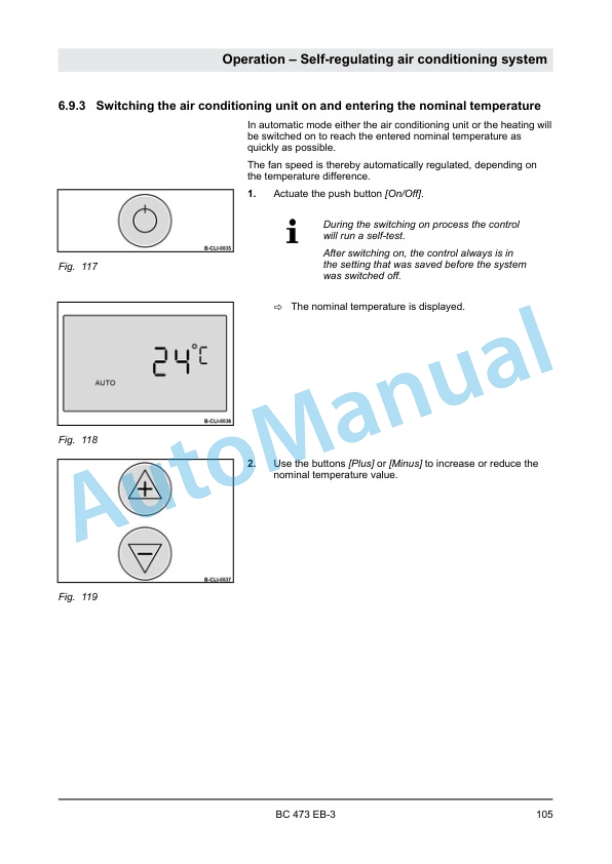
- 7.9.3. Switching the air conditioning unit on and entering the nominal temperature
- 7.9.4. Switching the temperature display between C and F
- 7.9.5. Setting the fan speed manually
- 7.9.6. Reducing the humidity (reheat function)
- 7.10. Operating the auxiliary heating
- 7.10.1. Setting time and weekday
- 7.10.2. Heating operation without preselection (ignition off)
- 7.10.3. Heating operation without preselection (ignition on)
- 7.10.4. Preselecting start of heating
- 7.11. Using the accessing aids
- 7.12. Emergency procedures
- 7.12.1. Actuating the emergency stop switch
- 7.12.2. Emergency exit
- 7.12.3. Disconnect the battery
- 8. Loading / transporting the machine
- 8.1. Loading the machine
- 8.2. Lashing the machine to the transport vehicle
- 8.3. Loading by crane
- 8.4. After transport
- 9. Maintenance
- 9.1. Preliminary remarks and safety notes
- 9.2. Preparations / concluding work
- 9.2.1. Overview of maintenance flaps and doors
- 9.2.2. Opening / closing the hood
- 9.2.3. Engaging / releasing the articulation lock
- 9.3. Fuels and lubricants
- 9.3.1. Engine oil
- 9.3.2. Fuel
- 9.3.3. Coolant
- 9.3.4. Hydraulic oil
- 9.3.5. Gear oil SAE 80W140
- 9.3.6. Lubrication grease
- 9.4. List of fuels and lubricants
- 9.5. Runningin instructions
- 9.5.1. General
- 9.5.2. After 50 operating hours
- 9.5.3. After 250 operating hours
- 9.5.4. After 500 operating hours
- 9.5.5. After 1000 operating hours
- 9.5.6. After 2000 operating hours
- 9.6. Maintenance Table
- 9.7. Every 500 operating hours
- 9.7.1. Changing engine oil and oil filter element
- 9.7.2. Replacing the fuel filter, bleeding the fuel system
- 9.7.3. Checking the ribbed Vbelt
- 9.7.4. Checking the antifreeze concentration and the condition of the coolant
- 9.7.5. Checking the hydraulic lines
- 9.7.6. Servicing the battery, checking the battery isolation
- 9.7.7. Checking the engine mounts
- 9.7.8. Servicing the air conditioning system
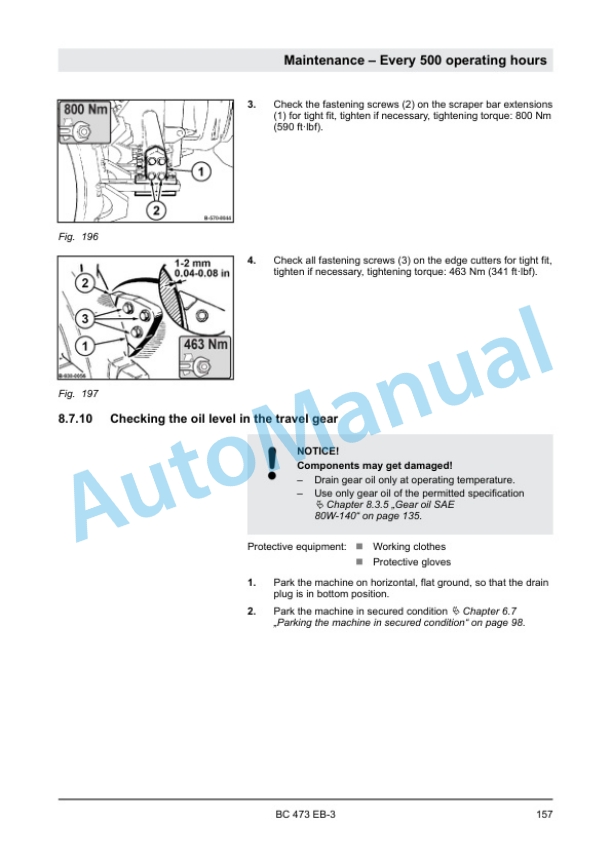
- 9.7.9. Checking the fastening of scrapers and edge cutters
- 9.7.10. Checking the oil level in the travel gear
- 9.7.11. Checking the central lubrication system
- 9.7.12. Changing fresh air filter and circulation air filter
- 9.8. Every 1000 operating hours
- 9.8.1. Checking, adjusting the valve clearance
- 9.8.2. Checking the crankcase ventilation valve
- 9.8.3. Replacing the hydraulic oil filter
- 9.8.4. Changing the oil in the travel gear
- 9.8.5. Checking the ROPS
- 9.8.6. Servicing the auxiliary heating
- 9.9. Every 2000 operating hours
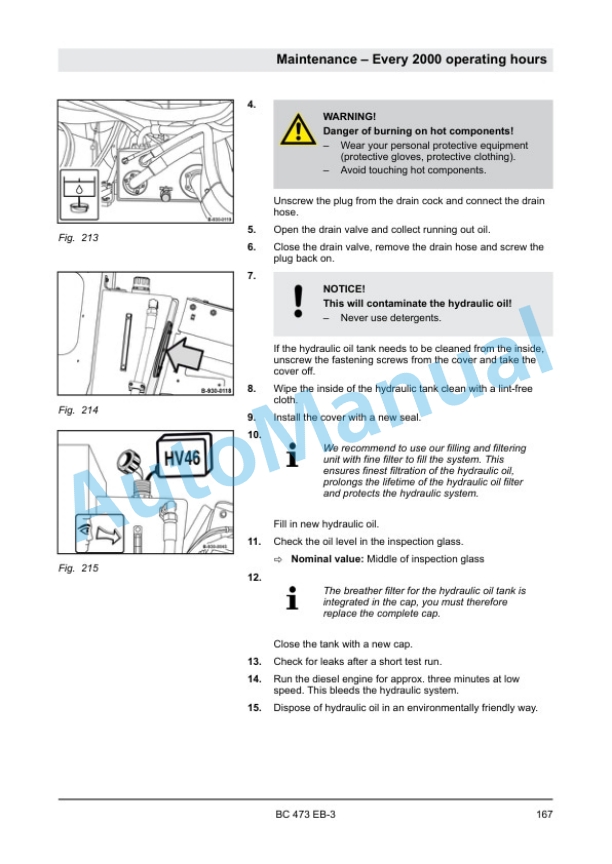
- 9.9.1. Changing the hydraulic oil
- 9.9.2. Changing the coolant
- 9.9.3. Changing oil and filter in the transfer case
- 9.9.4. Checking the condition of the oscillating articulated joint
- 9.10. Every 3000 operating hours
- 9.10.1. Replacing ribbed Vbelt and idler pulley
- 9.10.2. Checking the adjusting lever and the gate in the exhaust gas recirculation
- 9.10.3. Replacing the crankcase ventilation valve
- 9.11. As required
- 9.11.1. Checking, cleaning the water separator
- 9.11.2. Air filter maintenance
- 9.11.3. Cleaning the radiator module
- 9.11.4. Filling the provision tank for the windscreen washer system
- 9.11.5. Draining off dirty fluids from front and rear frame
- 9.11.6. Drain the fuel tank sludge
- 9.11.7. Check / adjust scrapers and edge cutters
- 9.11.8. Checking the dozer blade cutting edges
- 9.11.9. Replacing padfpoot caps
- 9.11.10. Weld on new pad foot caps
- 9.11.11. Measures prior to extended shutdown period
- 10. Troubleshooting
- 10.1. Preliminary remarks
- 10.2. Starting the engine with jump leads
- 10.3. Emergency operation of hood
- 10.4. Operating the engine emergency mode
- 10.5. Fuse assignment
- 10.5.1. Notes on safety
- 10.5.2. Central electrics
- 10.5.3. Main fuses
- 10.5.4. Control console cabin
- 10.6. Engine faults
- 11. Disposal
- 11.1. Final shutdown of machine
- 12. List of special tools


There are no reviews yet.