
Description
-
Model List:
- BW 226 BVC-5 Single Drum Roller
- 1. Table of contents
- 2. Introduction
- 2.1. Foreword
- 2.2. Machine type plate and engine type plate
- 3. Technical data
- 3.1. Noise and vibration data
- 3.1.1. Noise data
- 3.1.2. Vibration data
- 4. Concerning your safety
- 4.1. General prerequisites
- 4.1.1. General
- 4.1.2. Explanation of signal words used
- 4.1.3. Personal protective equipment
- 4.1.4. Intended use
- 4.1.5. Improper use
- 4.2. Definition of responsible persons
- 4.2.1. Operating company
- 4.2.2. Expert / qualified person
- 4.2.3. Driver / operator
- 4.3. Fundamentals for safe operation
- 4.3.1. Remaining dangers, remaining risks
- 4.3.2. Regular safety inspections
- 4.3.3. Modifications and alterations to the machine
- 4.3.4. Damage, defects, misuse of safety devices
- 4.3.5. Roll Over Protective Structure (ROPS)
- 4.4. Handling fuels and lubricants
- 4.4.1. Preliminary remarks
- 4.4.2. Safety regulations and environmental protection regulations for handling diesel fuel
- 4.4.3. Safety regulations and environmental protection regulations for handling oil
- 4.4.4. Safety regulations and environmental protection regulations for handling hydraulic oil
- 4.4.5. Safety regulations and environmental protection regulations for handling coolants
- 4.4.6. Safety regulations and environmental protection regulations for handling battery acid
- 4.5. Load/transport the machine
- 4.6. Startup procedure
- 4.6.1. Prior to starting up
- 4.6.2. Starting the engine
- 4.6.3. Starting the engine with jump leads
- 4.7. Driving the machine, working operation
- 4.7.1. Persons in the danger area
- 4.7.2. Driving the machine
- 4.7.3. Driving on gradients and slopes
- 4.7.4. Crossslope
- 4.7.5. Working with vibration
- 4.7.6. Parking the machine
- 4.8. Refuelling
- 4.9. Emergency procedures
- 4.9.1. Actuating the emergency stop switch
- 4.9.2. Disconnecting the battery
- 4.9.3. Towing the machine
- 4.10. Maintenance work
- 4.10.1. Preliminary remarks
- 4.10.2. Work on hydraulic lines
- 4.10.3. Working on the engine
- 4.10.4. Maintenance work on electric components and battery
- 4.10.5. Working on the air conditioning
- 4.10.6. Working on wheels and tyres
- 4.10.7. Cleaning work
- 4.10.8. After maintenance work
- 4.11. Repair
- 4.12. Stickers and signage
- 5. Indicators and control elements
- 5.1. Drivers stand
- 5.1.1. Instrument cluster
- 5.1.2. Operating console
- 5.1.3. Arm console
- 5.2. Cabin
- 5.2.1. Control panel, cabin
- 5.2.2. Heating / air conditioning
- 5.2.3. 12 V DIN socket
- 5.2.4. Monitor for reversing camera
- 5.2.5. Fire extinguisher
- 5.3. Engine compartment
- 5.3.1. Main battery switch
- 5.4. Outside of machine
- 5.4.1. Reversing camera
- 6. Checks prior to start up
- 6.1. Notes on safety
- 6.2. Visual inspections and function tests
- 6.3. Checking the engine oil level
- 6.4. Checking the fuel level, topping up fuel
- 6.4.1. Checking the fuel level
- 6.4.2. Refuelling
- 6.5. Checking the hydraulic oil level
- 6.6. Checking the coolant level
- 6.7. Checking wheels and tyres
- 7. Operation
- 7.1. Settingup the work place
- 7.1.1. Adjusting the drivers seat
- 7.1.2. Swivelling the drivers seat
- 7.1.3. Adjust the steering wheel
- 7.2. Electronic immobilizer
- 7.3. Starting the engine
- 7.4. Travel operation
- 7.4.1. Preliminary remarks and safety notes
- 7.4.2. Driving the machine
- 7.4.3. Applying the parking brake
- 7.4.4. Notes on travel operation
- 7.5. Working with vibration
- 7.5.1. Preliminary remarks and safety notes
- 7.5.2. Vibration in automatic operation
- 7.5.3. Vibration in manual mode
- 7.6. Measuring pass with BVC
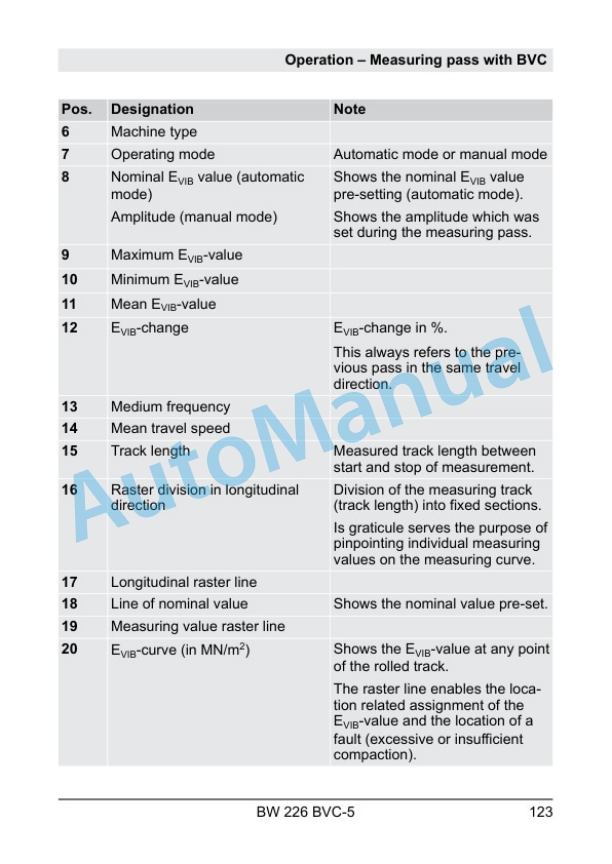
- 7.6.1. Line chart (EVIB) Automatic/manual operation
- 7.7. Parking the machine in secured condition
- 7.8. Operating the heating / air conditioning system
- 7.9. ECOSTOP
- 7.10. Emergency procedures
- 7.10.1. Actuating the emergency stop switch
- 7.10.2. Disconnecting the battery
- 7.10.3. Towing the machine
- 7.10.4. After towing
- 8. Loading / transporting the machine
- 8.1. Prepare for transport
- 8.2. Loading the machine
- 8.3. Lashing the machine to the transport vehicle
- 8.4. Loading by crane
- 8.5. After transport
- 9. Maintenance
- 9.1. Preliminary remarks and safety notes
- 9.2. Preparations / concluding work
- 9.2.1. Open and secure the engine hood
- 9.2.2. Engaging / releasing the articulation lock
- 9.3. Fuels and lubricants
- 9.3.1. Engine oil
- 9.3.2. Fuel
- 9.3.3. Coolant
- 9.3.4. Hydraulic oil
- 9.3.5. Gear oil SAE 75W90
- 9.3.6. Gear oil SAE 80W140
- 9.4. List of fuels and lubricants
- 9.5. Runningin instructions
- 9.5.1. General
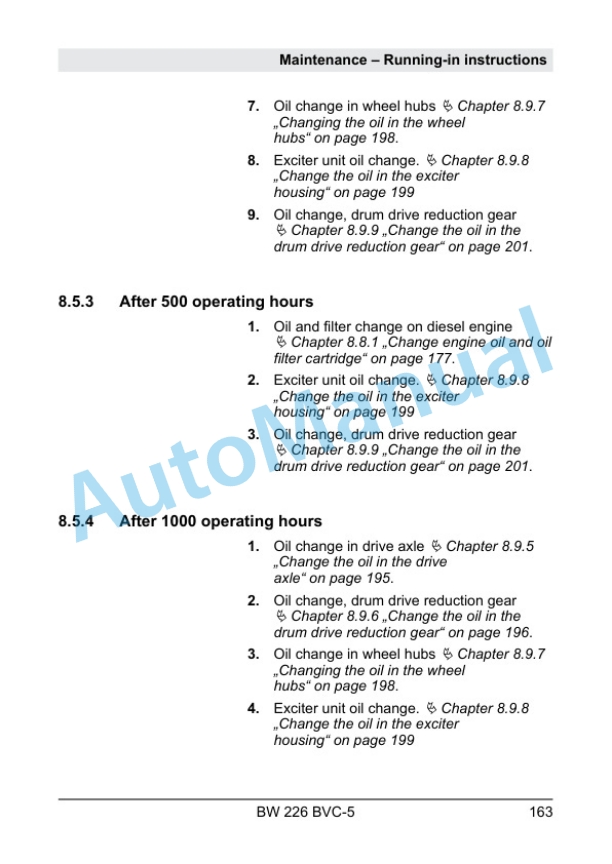
- 9.5.2. After 250 operating hours
- 9.5.3. After 500 operating hours
- 9.5.4. After 1000 operating hours
- 9.6. Maintenance Table
- 9.7. Every 250 operating hours
- 9.7.1. Cleaning the radiator module
- 9.7.2. Checking, tensioning the Vbelt for the generator system
- 9.7.3. Checking the oil level in the drive axle
- 9.7.4. Checking the oil level in the drive axle reduction gear
- 9.7.5. Checking the oil level in the wheel hubs
- 9.7.6. Checking the oil level in the exciter housing
- 9.7.7. Checking the oil level in the drum drive reduction gear
- 9.7.8. Changing the fresh air filter in the cabin
- 9.7.9. Check the parking brake
- 9.8. Every 500 operating hours
- 9.8.1. Change engine oil and oil filter cartridge
- 9.8.2. Replacing the fuel filter, bleeding the fuel system
- 9.8.3. Checking the antifreeze concentration and the condition of the coolant
- 9.8.4. Checking the hydraulic lines
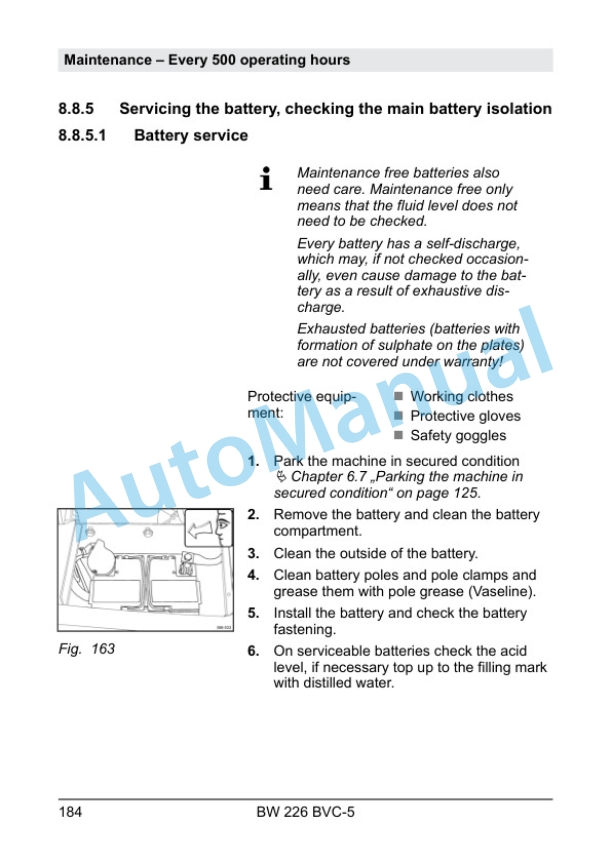
- 9.8.5. Servicing the battery, checking the main battery isolation
- 9.8.6. Servicing the air conditioning system
- 9.9. Every 1000 operating hours
- 9.9.1. Checking the ribbed Vbelt
- 9.9.2. Replacing the air conditioning compressor Vbelts
- 9.9.3. Checking the engine mounts
- 9.9.4. Replacing the hydraulic oil filter
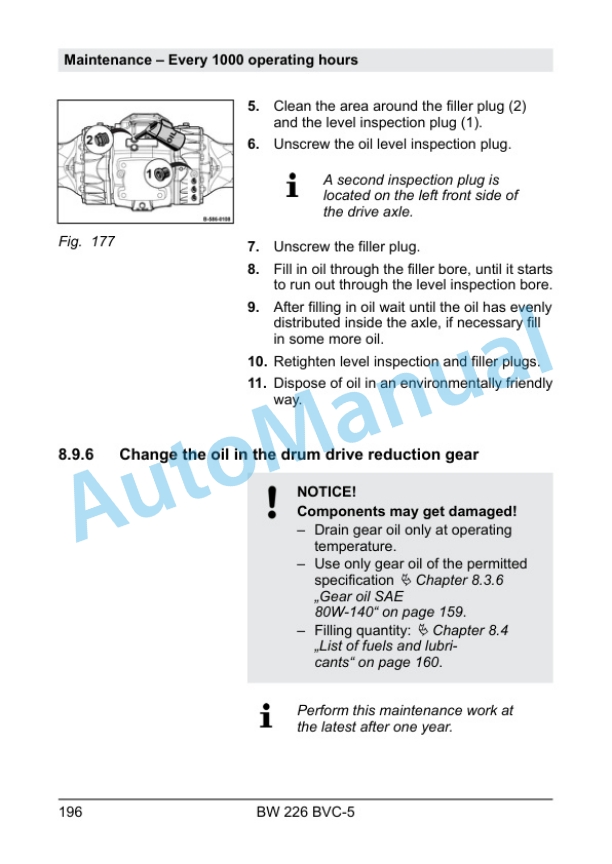
- 9.9.5. Change the oil in the drive axle
- 9.9.6. Change the oil in the drum drive reduction gear
- 9.9.7. Changing the oil in the wheel hubs
- 9.9.8. Change the oil in the exciter housing
- 9.9.9. Change the oil in the drum drive reduction gear
- 9.9.10. Retightening the fastening of the axle on the frame
- 9.9.11. Retightening the wheel nuts
- 9.9.12. Checking the ROPS
- 9.9.13. Checking the travel control
- 9.9.14. Cleaning the circulation air filter for the heating
- 9.10. Every 2000 operating hours
- 9.10.1. Adjusting the valve clearance
- 9.10.2. Changing the hydraulic oil
- 9.10.3. Changing the coolant
- 9.11. Every 4000 operating hours
- 9.11.1. Replace ribbed Vbelt and idler pulley
- 9.12. As required
- 9.12.1. Air filter maintenance
- 9.12.2. Checking, cleaning the water separator
- 9.12.3. Retightening the padfoot shell
- 9.12.4. Adjust the scrapers
- 9.12.5. Filling the windscreen washer tank
- 9.12.6. Replacing the paper roll in the printer
- 9.12.7. Replacing the printer ribbon in the printer
- 9.12.8. Drain the fuel tank sludge
- 9.12.9. Measures prior to extended shutdown period
- 10. Troubleshooting
- 10.1. Preliminary remarks
- 10.2. Starting the engine with jump leads
- 10.3. Fuse assignment
- 10.3.1. Notes on safety
- 10.3.2. Central electrics
- 10.3.3. Main fuses
- 10.3.4. Control console cabin
- 10.4. Engine malfunctions
- 11. Disposal
- 11.1. Final shutdown of machine
- 12. List of special tools


There are no reviews yet.