

Description
-
Model List:
- CK30-1 Compact Track Loader
- 1. INTRODUCTION
- 1.1. FOREWORD
- 1.2. SAFETY INFORMATION
- 1.3. APPROVED AND NON APPROVED USES
- 1.3.1. Approved
- 1.3.2. Non Approved
- 1.4. PRODUCT INFORMATION
- 1.4.1. Main Features
- 1.4.2. Break In Period
- 1.5. PRODUCT IDENTIFICATION
- 1.5.1. Machine Serial Number
- 1.5.2. Machine Identification Plate And Product Identification Number (Pin)
- 1.5.3. Engine Serial Number And Emission Plate
- 1.5.4. Travel Reduction Gear Serial Number
- 1.5.5. Cab Serial Number
- 1.6. SERIAL NUMBERS AND DISTRIBUTOR INFORMATION
- 1.6.1. Model CK301
- 1.7. TABLE OF CONTENTS
- 2. SAFETY
- 2.1. SAFETY LABELS
- 2.1.1. Example Of Safety Label Using Words
- 2.1.2. Example Of Safety Label Using Pictogram
- 2.2. SAFETY AND WARNING DECALS
- 2.2.1. Location Of The Safety Decals
- 2.2.2. Decals Defined
- 2.3. SAFETY RULES AND PRECAUTIONS
- 2.3.1. General Safety Rules
- 2.3.2. Safety Features
- 2.3.3. Personal Protective Equipment
- 2.3.4. Unauthorized Modifications
- 2.3.5. Leaving The Operators Seat
- 2.3.6. Mounting And Dismounting
- 2.3.7. Checking The Rearview Mirrors (If Installed)
- 2.3.8. Fire Prevention For Fuel And Oil
- 2.3.9. Preventing Burns
- 2.3.10. Asbestos Dust Hazard Precautions
- 2.3.11. Preventing Accidents Caused By Improper Operation Of The Work Equipment
- 2.3.12. Fire Extinguisher And First Aid Kit
- 2.3.13. Precautions Concerning The Cab Structure
- 2.3.14. Precautions When Using ROPS
- 2.3.15. Precautions Concerning The Equipment
- 2.4. PRECAUTIONS BEFORE STARTING THE ENGINE
- 2.4.1. Safety On The Work Site
- 2.4.2. Fire Prevention
- 2.4.3. Precautions To Be Taken For The Operators Cab
- 2.4.4. Room Ventilation
- 2.4.5. Precautions To Be Taken For The Lights (If Installed)
- 2.4.6. Cleaning The Windows And The Rearview Mirrors Checking The Windshield Wiper Blades
- 2.5. PRECAUTIONS TO BE TAKEN WHEN WORKING
- 2.5.1. Starting The Engine
- 2.5.2. Rules For Traveling In Reverse
- 2.5.3. Moving The Machine
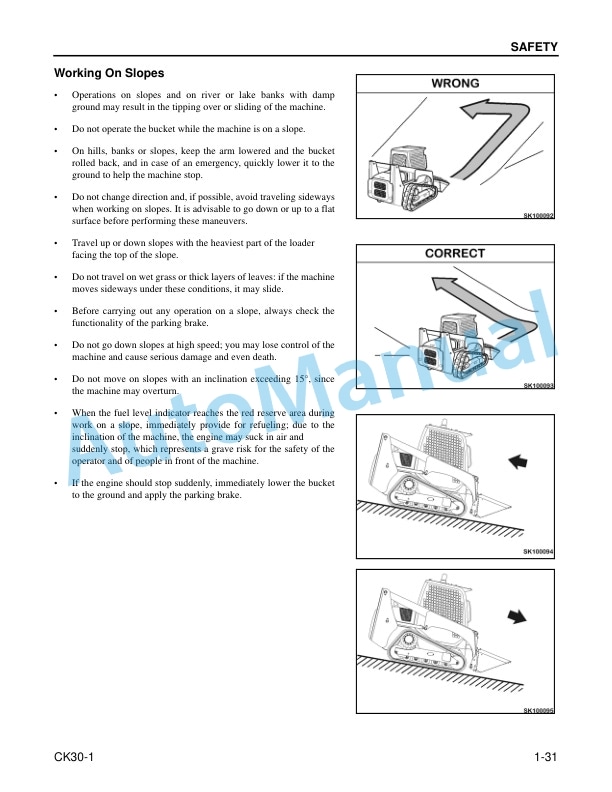
- 2.5.4. Working On Slopes
- 2.5.5. Preventing Electrocution
- 2.5.6. Visibility
- 2.5.7. Working On Icy Or Snowcovered Surfaces
- 2.5.8. Preventing Accidents Caused By The Improper Operation Of The Work Equipment
- 2.5.9. Working On Loose Ground
- 2.5.10. Parking The Machine
- 2.6. TRANSPORTING THE MACHINE
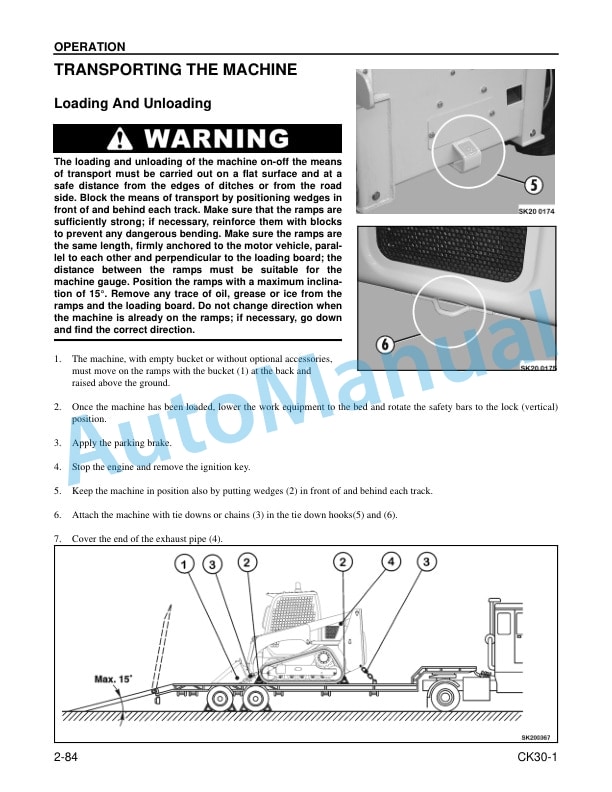
- 2.6.1. Loading And Unloading The Machine
- 2.6.2. The Route
- 2.7. BATTERY
- 2.7.1. Safety Precautions For Work On Batteries
- 2.7.2. Starting With Booster Cables
- 2.7.3. Precautions For Emergency Recovery
- 2.8. PRECAUTIONS DURING MAINTENANCE
- 2.8.1. Warning Tags
- 2.8.2. Tools
- 2.8.3. Personnel
- 2.8.4. Equipment Storage
- 2.8.5. Working Under The Machine
- 2.8.6. Keeping The Machine Clean
- 2.8.7. Engine Operation During Maintenance
- 2.8.8. Critical Parts
- 2.8.9. Stop The Engine Before Carrying Out Any Maintenance Operation Or Inspection
- 2.8.10. Rules For Refueling The Machine
- 2.8.11. Cooling System Precautions
- 2.8.12. Using Lamps
- 2.8.13. Precautions Concerning The Battery And Alternator
- 2.8.14. Precautions Concerning The Starter
- 2.8.15. Precautions Concerning High Pressure Hoses
- 2.8.16. Precautions For Working On High Pressure Systems
- 2.8.17. Precautions For Maintenance Work Involving High Temperatures And Pressures
- 2.8.18. Rotating Parts
- 2.8.19. Precautions To Be Taken When Using Highpressure Grease To Adjust The Rubber Track Tension
- 2.8.20. Do Not Remove The Shock Absorbing Spring From The Shock Absorber Unit
- 2.8.21. Hydraulic Accumulator
- 2.8.22. Disposal Of Waste Materials
- 2.8.23. Hydraulic Environmental Ester Synthetic (HEES) Oil
- 3. OPERATION
- 3.1. SAFETY LOCKS
- 3.1.1. Loader Arm Support
- 3.2. GENERAL VIEWS
- 3.2.1. Front View Of Machine
- 3.2.2. Rear View Of Machine
- 3.2.3. Inside View Of Cab
- 3.3. INSTRUMENTS AND CONTROLS
- 3.3.1. Instruments
- 3.3.2. Indicator Lights
- 3.3.3. Switches And Push Buttons
- 3.3.4. Electrical Accessories
- 3.3.5. Machine Controls
- 3.3.6. ISO Pattern Control System
- 3.3.7. Optional Pattern Control System
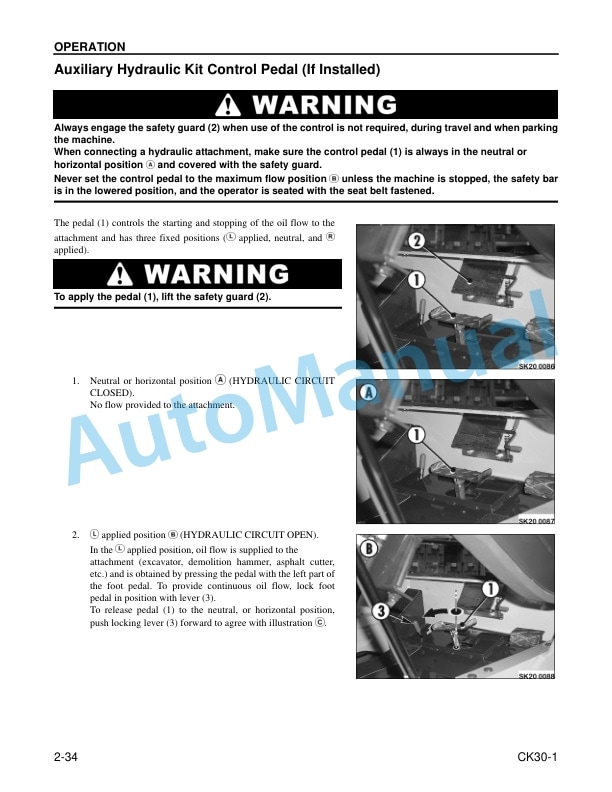
- 3.3.8. Auxiliary Hydraulic Kit Control Pedal (If Installed)
- 3.3.9. Battery Disconnect Switch
- 3.3.10. Fuses And Relays
- 3.4. GUARDS AND OPERATORS SEAT
- 3.4.1. Engine Hood
- 3.4.2. Rear Panel
- 3.5. OPERATING THE MACHINE
- 3.5.1. Checks Before Starting The Engine
- 3.5.2. Starting The Engine
- 3.5.3. Starting The Engine
- 3.5.4. Warming The Engine
- 3.5.5. Heating The Hydraulic Oil
- 3.5.6. Moving The Machine (Iso Pattern Control System)
- 3.5.7. How To Move The Machine (Optional Pattern Control System)
- 3.5.8. Hand And Foot Control System
- 3.5.9. Travel And Steering Control Joysticks
- 3.6. PARKING THE MACHINE
- 3.6.1. Parking On Level Ground
- 3.6.2. Parking On Slopes
- 3.7. STOPPING THE ENGINE
- 3.8. TRANSPORTING THE MACHINE
- 3.8.1. Loading And Unloading
- 3.8.2. Transport
- 3.9. HOW TO LIFT THE MACHINE
- 3.10. COLD WEATHER PRECAUTIONS
- 3.10.1. Fuel And Lubricants
- 3.10.2. Coolant
- 3.10.3. Battery
- 3.10.4. Other Precautions
- 3.10.5. Precautions To Be Taken At The End Of Work
- 3.11. WARM WEATHER PRECAUTIONS
- 3.12. OPERATING THE WORK EQUIPMENT
- 3.12.1. Lowering The Equipment In Case Of Machine Failure
- 3.12.2. Organizing The Work Area
- 3.12.3. Loading Heaped And Level Material
- 3.12.4. Loading Operations On Slopes
- 3.12.5. Digging Method
- 3.12.6. Changing The Bucket Or Attachment With Standard Quick Coupler
- 3.12.7. Using The Rubber Tracks
- 3.12.8. Long Periods Of Inactivity
- 3.13. TROUBLESHOOTING
- 3.13.1. How To Move The Machine
- 3.13.2. If The Fuel Has Been Completely Depleted
- 3.13.3. Battery Is Exhausted
- 3.13.4. Other Troubles
- 4. MAINTENANCE
- 4.1. GUIDE TO MAINTENANCE
- 4.2. MAINTENANCE NOTES
- 4.2.1. Notes Regarding The Engine
- 4.2.2. Notes Regarding The Hydraulic System
- 4.2.3. Notes Regarding The Electrical System
- 4.2.4. Notes Regarding Lubrication
- 4.2.5. Parts Subject To Wear That Periodically Need Changing
- 4.3. FUEL, COOLANT AND LUBRICANTS
- 4.3.1. Selection According To The Ambient Temperature
- 4.3.2. Grease
- 4.4. APPROVED SYNTHETIC BIODEGRADABLE LUBRICANTS TYPE HEES
- 4.5. LUBRICATION DIAGRAMS
- 4.5.1. General
- 4.6. PERIODIC REPLACEMENT OF COMPONENTS FOR SAFETY
- 4.6.1. Critical Parts For Safety
- 4.6.2. Super Flow Hydraulic System
- 4.7. TIGHTENING TORQUE
- 4.7.1. Standard Torque For Bolts And Nuts
- 4.7.2. Specific Torques
- 4.8. MAINTENANCE PLAN
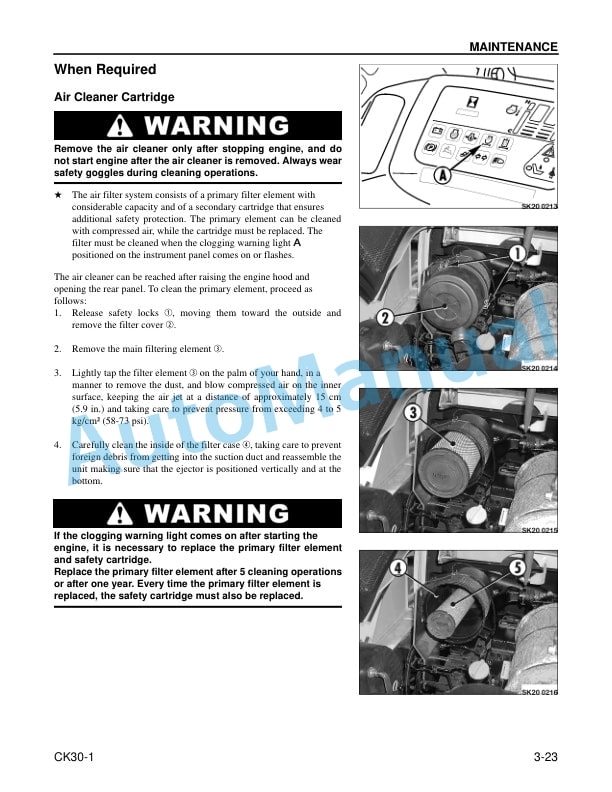
- 4.8.1. When Required
- 4.8.2. Checks Before Starting
- 4.8.3. After The First 50 Hours Of Operation
- 4.8.4. Every 50 Hours Of Operation
- 4.8.5. Maintenance After The First 250 Hours Of Operation
- 4.8.6. Every 250 Hours Of Operation
- 4.8.7. After The First 500 Hours Of Operation
- 4.8.8. Every 500 Hours Of Operation
- 4.8.9. Every 1000 Hours Of Operation
- 4.8.10. Every 2000 Hours Of Operation
- 4.8.11. When Required
- 4.8.12. Checks Before Starting
- 4.8.13. Maintenance After The First 50 Hours Of Operation
- 4.8.14. Maintenance Every 50 Hours Of Operation
- 4.8.15. First 250 Hours Of Operation
- 4.8.16. Every 250 Hours Of Operation
- 4.8.17. Maintenance After The First 500 Hours Of Operation
- 4.8.18. Maintenance Every 500 Hours Of Operation
- 4.8.19. Maintenance Every 1000 Hours Of Operation
- 4.8.20. Maintenance Every 2000 Hours Of Operation
- 5. SPECIFICATIONS
- 5.1. SPECIFICATIONS
- 5.1.1. Standard Machine Overall Dimensions
- 5.1.2. Technical Specifications
- 6. OPTIONS, ATTACHMENTS
- 6.1. AVAILABLE OPTIONAL ATTACHMENTS
- 6.1.1. Basic Precautions
- 6.1.2. Precautions Regarding The Installation Of Attachments
- 6.1.3. Characteristics Of The Standard Machine With Optional (Factory Supplied) Equipment
- 6.1.4. Characteristics Of The Optional (Factory Supplied) Equipment For The Machine With High Flow And Superflow Hydraulic Systems
- 6.1.5. Changing The Available Attachments
- 6.1.6. Connecting The Hydraulic Circuit
- 6.1.7. Connecting The Return Circuit With Direct Drainage Into The Tank
- 6.1.8. Preparing The Machine For Use With The Excavator
- 6.1.9. Using The Machine With The Excavator
- 6.1.10. Pallet Forks












There are no reviews yet.