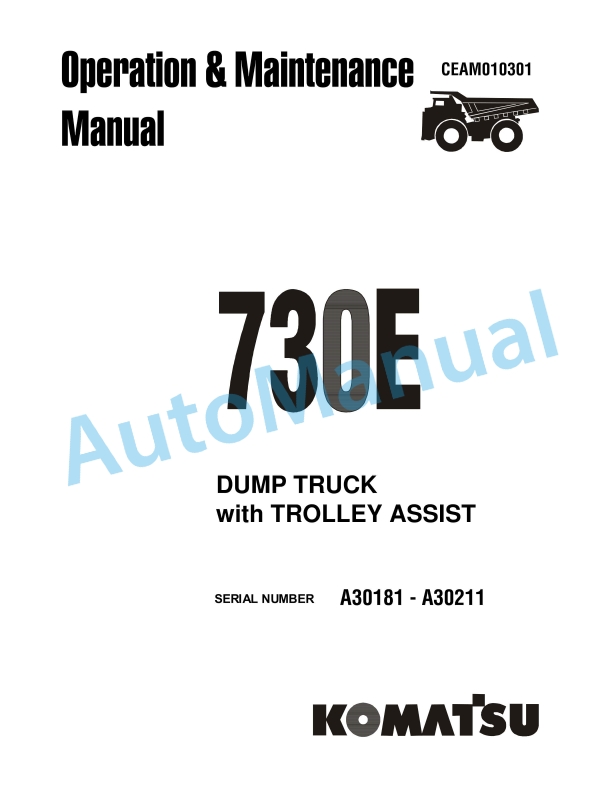
Komatsu HM350-2 Articulated Dump Truck Operation and Maintenance Manual CEAM017704
$30.00
- Type Of Manual: Operation and Maintenance Manual
- Manual ID: CEAM017704
- Format: PDF
- Size: 13.7MB
- Number of Pages: 300
Description
-
Model List:
- HM350-2 Articulated Dump Truck
- 1. INTRODUCTION
- 1.1. FOREWORD
- 1.2. SAFETY INFORMATION
- 1.2.1. Safety Labels
- 1.3. INTRODUCTION
- 1.3.1. Intended Use
- 1.4. LOCATION OF PLATES, TABLE TO ENTER SERIAL NO. AND DISTRIBUTOR
- 1.4.1. Product Identification Number (Pin)/Machine Serial No. Plate
- 1.4.2. EPA Regulations, Engine Serial No. Plate Position
- 1.4.3. Service Meter Position
- 1.4.4. Table to Enter Serial Numbers and Distributor
- 1.5. TABLE OF CONTENTS
- 2. SAFETY
- 2.1. SAFETY LABELS
- 2.2. SAFETY AND WARNING DECALS
- 2.2.1. Location of Safety Decals
- 2.2.2. Safety Labels
- 2.3. GENERAL SAFETY RULES AND PRECAUTIONS
- 2.3.1. General Safety Rules
- 2.3.2. Safety Features
- 2.3.3. Personal Protective Equipment
- 2.3.4. Fire and Explosion Prevention
- 2.3.5. Action if Fire Occurs
- 2.3.6. Fire Extinguisher and First Aid Kit
- 2.3.7. Fire Prevention and Suppression
- 2.3.8. Dust Hazard Precautions
- 2.3.9. Keep Operators Cab Clean
- 2.3.10. Unauthorized Modifications
- 2.3.11. Leaving Operators Compartment
- 2.3.12. Mounting and Dismounting
- 2.3.13. Crush or Pinch Point Dangers
- 2.3.14. Inside Operators Compartment
- 2.3.15. Precautions When Using ROPS
- 2.4. PRECAUTIONS BEFORE STARTING OPERATIONS
- 2.4.1. PreOperational Checks
- 2.4.2. Starting Your Work Operations
- 2.4.3. Work Site Hazards
- 2.4.4. Avoiding Dangerous Situations
- 2.4.5. Working Clearances
- 2.4.6. Operating on Snow or Icy Surfaces
- 2.4.7. Asbestos Hazard Alert
- 2.5. RULES FOR ROAD TRAVEL
- 2.5.1. Precautions When Traveling
- 2.5.2. When Traveling on Slopes
- 2.5.3. When Dumping a Load
- 2.5.4. Ensure Good Visibility
- 2.5.5. When Traveling in Reverse
- 2.5.6. Parking the Machine
- 2.6. PRECAUTIONS DURING MAINTENANCE OPERATIONS
- 2.6.1. Warning Tags
- 2.6.2. Equipment Storage
- 2.6.3. Working Under the Machine
- 2.6.4. Using Drop Lamps
- 2.6.5. Keeping the Machine Clean
- 2.6.6. Performing General Maintenance Procedures
- 2.6.7. Running the Engine During Maintenance
- 2.6.8. Proper Tools
- 2.6.9. Engine System Highvoltage
- 2.6.10. Welding, Grinding or Cutting
- 2.6.11. When Using Hammer
- 2.6.12. Refueling the Machine
- 2.6.13. Cooling System Precautions
- 2.6.14. Battery Precautions
- 2.6.15. Starting the Machine
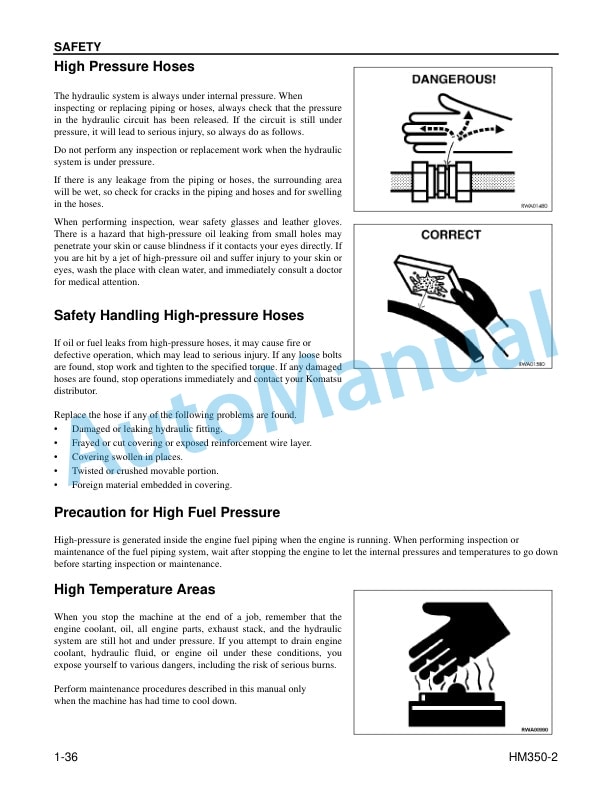
- 2.6.16. High Pressure Hoses
- 2.6.17. Safety Handling Highpressure Hoses
- 2.6.18. Precaution for High Fuel Pressure
- 2.6.19. High Temperature Areas
- 2.6.20. Disposal of Waste Materials
- 2.6.21. Accumulator
- 2.6.22. Critical Parts
- 2.7. HANDLING TIRES
- 2.7.1. Precautions When Storing Tires
- 2.8. TRANSPORTATION
- 2.8.1. Precautions When Transporting
- 2.8.2. Steps for Transportation
- 2.8.3. Method of Securing Machine
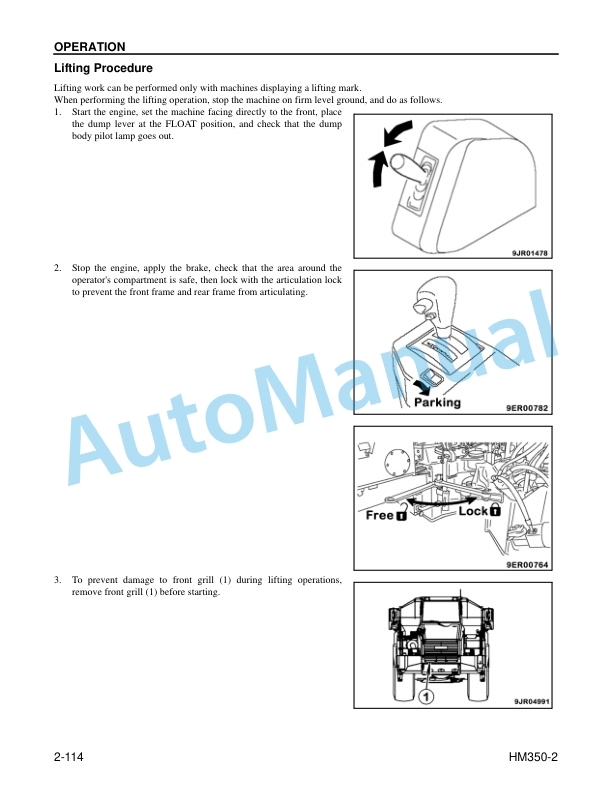
- 2.8.4. Method of Lifting Machine
- 2.8.5. Location of Lifting Points
- 2.9. TOWING MACHINE
- 3. OPERATION
- 3.1. GENERAL VIEW
- 3.1.1. Machine
- 3.1.2. Controls and Gauges
- 3.1.3. Machine Monitor
- 3.2. EXPLANATION OF COMPONENTS
- 3.2.1. Machine Monitor
- 3.2.2. Switches
- 3.2.3. Control Levers And Pedals
- 3.2.4. Body Pivot Pin
- 3.2.5. Articulate Lock
- 3.2.6. Location of Fire Extinguisher
- 3.2.7. Dust Indicator
- 3.2.8. Circuit Breaker
- 3.2.9. Fuses
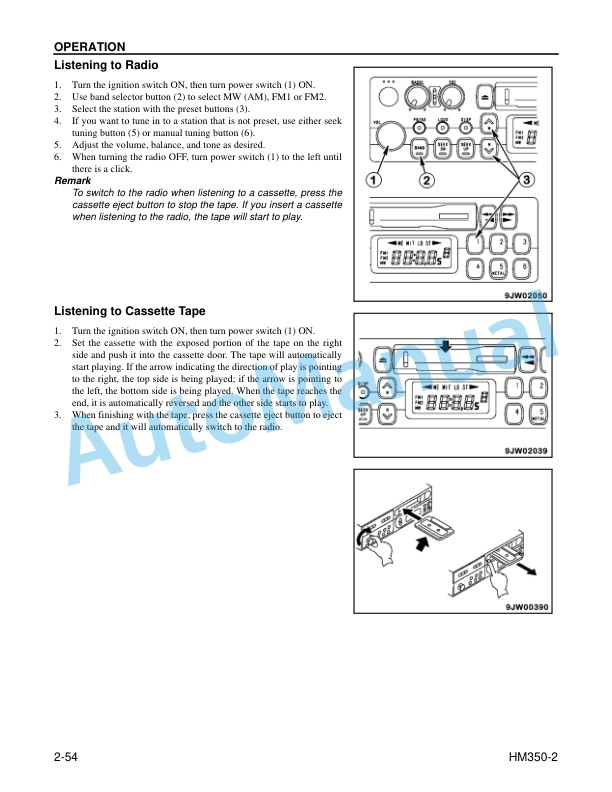
- 3.2.10. AM/FM Radiocassette Stereo
- 3.3. AIR CONDITIONER
- 3.3.1. General Locations on Control Panel
- 3.3.2. Method of Operation
- 3.4. OPERATION
- 3.4.1. Check Before Starting Engine
- 3.4.2. Checks Before Starting
- 3.4.3. Check Water Separator, Drain Water (If Equipped)
- 3.4.4. Adjustments Before Operation
- 3.4.5. Operations, Checks Before Starting
- 3.4.6. Starting the Engine
- 3.4.7. Operations, Checks After Starting Engine
- 3.4.8. Stopping Engine
- 3.4.9. Moving the Machine
- 3.4.10. Steering the Machine
- 3.4.11. Loading Operations
- 3.4.12. Handling Tailgate
- 3.4.13. Dump Operations
- 3.4.14. Cab Tilt Operation
- 3.4.15. Permissible Water Depth
- 3.4.16. Parking Machine
- 3.4.17. Checks After Completion of Work
- 3.4.18. Handling of KOMTRAX
- 3.4.19. Handling Tires
- 3.4.20. Determining and Maintaining Travel Road
- 3.5. TRANSPORTATION
- 3.5.1. Precautions When Transporting
- 3.5.2. Steps for Transportation
- 3.5.3. Method of Securing Machine
- 3.5.4. Method of Lifting Machine
- 3.6. COLD WEATHER OPERATION
- 3.6.1. Precautions for Low Temperature
- 3.6.2. Precautions After Completion of Work
- 3.6.3. After Cold Weather
- 3.7. LONGTERM STORAGE
- 3.7.1. Before Storage
- 3.7.2. During Storage
- 3.7.3. After Storage
- 3.8. TROUBLESHOOTING
- 3.8.1. After Running Out of Fuel
- 3.8.2. If Transmission has Trouble
- 3.8.3. Method of Lowering Dump Body in Emergency
- 3.8.4. Method of Towing Machine
- 3.8.5. When Parking Brake has Been Actuated in Emergency
- 3.8.6. Method of Releasing Parking Brake
- 3.8.7. When Final Drive, Differential, Transmission, Transfer Have Broken Down
- 3.9. PRECAUTIONS FOR CHARGING BATTERY
- 3.9.1. Charging Battery when Mounted on Machine
- 3.9.2. If Battery is Discharged
- 3.9.3. Removal and Installation of Battery
- 3.9.4. Starting Engine with Booster Cable
- 3.10. OTHER TROUBLE
- 3.10.1. Electrical System
- 3.10.2. Chassis
- 3.10.3. If Accelerator Pedal has Failed
- 3.10.4. Engine
- 3.11. ACTION CODE
- 4. MAINTENANCE
- 4.1. GUIDES TO MAINTENANCE
- 4.1.1. Check Service Meter
- 4.1.2. Komatsu Genuine Replacement Parts
- 4.1.3. Komatsu Genuine Oils
- 4.1.4. Always Use Clean Washer Fluid
- 4.1.5. Always Use Clean Oil and Grease
- 4.1.6. Checking Foreign Materials in Drained Oil and on Filters
- 4.1.7. Fueling
- 4.1.8. Welding Instructions
- 4.1.9. Do Not Drop Things Inside Machine
- 4.1.10. Dusty Work Sites
- 4.1.11. Avoid Mixing Oil
- 4.1.12. Locking Inspection Covers
- 4.1.13. Bleeding Air From Hydraulic Circuit
- 4.1.14. Precautions When Installing Hydraulic Hoses
- 4.1.15. Checks After Inspection and Maintenance
- 4.2. OUTLINES OF SERVICE
- 4.2.1. Handling Oil, Fuel, Coolant, and Performing Oil Clinic
- 4.2.2. Outline of Electric System
- 4.3. WEAR PARTS LIST
- 4.4. RECOMMENDED FUEL, COOLANT, AND LUBRICANT
- 4.5. USE OF FUEL, COOLANT AND LUBRICANTS
- 4.5.1. Selection According to Ambient Temperature
- 4.5.2. Recommended Brands, Recommended Quality for Products other than Komatsu Genuine Oil
- 4.6. STANDARD TIGHTENING TORQUES FOR BOLTS AND NUTS
- 4.6.1. Torque List
- 4.7. PERIODIC REPLACEMENT OF SAFETY CRITICAL PARTS
- 4.7.1. Safety Critical Parts
- 4.8. REGULAR SCHEDULED MAINTENANCE
- 4.8.1. Maintenance Schedule Chart
- 4.8.2. Initial 250 Hours Service (Only After the First 250 Hours)
- 4.8.3. When Required
- 4.8.4. Check Before Starting
- 4.8.5. Every 50 Hours Service
- 4.8.6. Every 250 Hours Service
- 4.8.7. Every 500 Hours Service
- 4.8.8. Every 1000 Hours Service
- 4.8.9. Every 2000 Hours Service
- 4.8.10. Every 4000 Hours Service
- 4.8.11. Every 6000 Hours Service
- 4.8.12. Every 8000 Hours Service
- 5. SPECIFICATIONS
- 5.1. SPECIFICATIONS
- 6. OPTIONS, ATTACHMENTS
- 6.1. HANDLING AUTOMATIC RETARDER, ACCELERATOR CONTROL(ARAC)
- 6.1.1. Explanation of Components
- 6.1.2. Method Of Operation
- 6.2. USE OF REAR VIEW MONITOR
- 6.2.1. Name and Function of Each Part of Rear View Monitor
- 6.2.2. Setting of Rear View Monitor
- 6.2.3. Cautions When Using Rear View Monitor
- 6.3. HANDLING DUMPING COUNTER
- 6.3.1. Method of Displaying, Resetting Dumping Counter
- 6.4. HANDLING BATTERY DISCONNECTOR SWITCH
- 6.5. HANDLING MACHINES EQUIPPED WITH KOMTRAX
- 6.5.1. Basic Precautions






There are no reviews yet.