
Description
-
Model List:
- WA250PT-5H Wheel Loader
- 1. FOREWORD
- 1.1. Foreword
- 1.2. Safety information
- 1.3. Introduction
- 1.3.1. Intended use
- 1.3.2. Directions of machine
- 1.4. Necessary information
- 1.4.1. Machine serial No. plate and position
- 1.4.2. Engine serial No. plate and position
- 1.4.3. ROPS/FOPSCab serial no. plate
- 1.4.4. Axle serial no. plate
- 1.4.5. Transmission serial no. plate
- 1.4.6. Seat operator serial no. plate
- 1.4.7. Position of service meter
- 1.4.8. Table to enter serial No. and distributor
- 1.5. Contents
- 1.6. Dimensions, weights and operating data
- 1.6.1. WA250PT5H Dimensions, weights and operating data
- 1.7. CEconforming equipment
- 1.7.1. CEconforming equipment
- 1.7.2. Manufacturersupplied CEconforming equipment, according to document 42193H1900
- 2. SAFETY
- 2.1. Safety labels
- 2.1.1. Location of safety labels
- 2.1.2. Presentation of safety labels
- 2.2. General precautions
- 2.2.1. Safety rules
- 2.3. Precautions for operation
- 2.3.1. Starting engine
- 2.3.2. Operation
- 2.3.3. Transportation
- 2.3.4. Battery
- 2.3.5. Towing
- 2.4. Precautions for maintenance
- 2.4.1. Safety instructions
- 2.5. Precautions with tires
- 2.5.1. Handling tires
- 2.5.2. Precautions when storing tires
- 3. OPERATION
- 3.1. General view
- 3.1.1. General view of machine
- 3.1.2. General view of controls and gauges
- 3.2. Explanation of components
- 3.2.1. Machine monitor
- 3.2.2. Switches
- 3.2.3. Control levers, pedals
- 3.2.4. Steering tilt lock lever
- 3.2.5. Cap and cover with lock
- 3.2.6. Safety bar
- 3.2.7. Towing pin
- 3.2.8. Grease pump
- 3.2.9. Cab door inner lock
- 3.2.10. Cab door open lock
- 3.2.11. Cab window open lock cancel knob
- 3.2.12. Fuse
- 3.2.13. Slow blow fuse
- 3.2.14. Power outlet
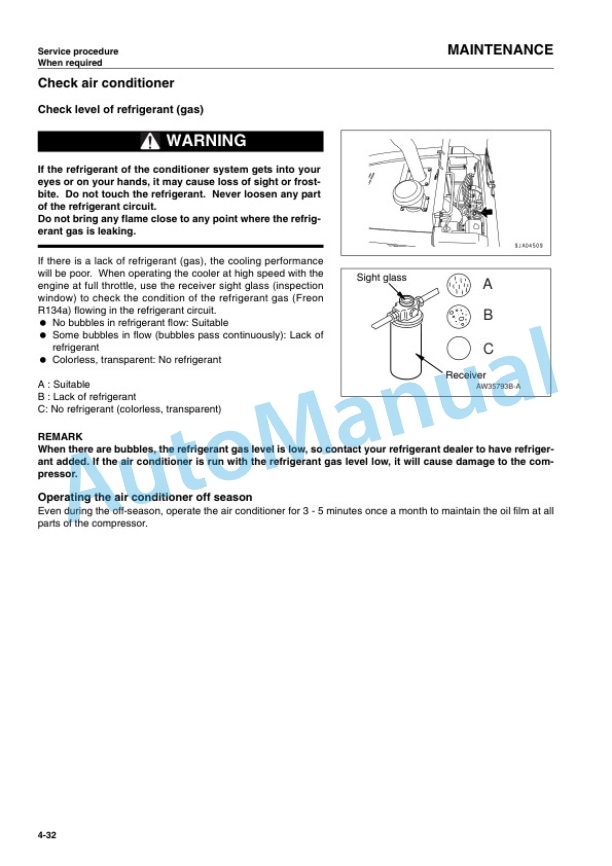
- 3.2.15. Air conditioner
- 3.2.16. Handling cab wiper
- 3.3. Operation
- 3.3.1. Check before starting engine, adjust
- 3.3.2. Starting engine
- 3.3.3. Operations and checks after starting engine
- 3.3.4. Stopping engine
- 3.3.5. Moving the machine (Directional, speed), stopping the machine
- 3.3.6. Turning
- 3.3.7. Operation of work equipment
- 3.3.8. Handling hydraulic quick coupler
- 3.3.9. Work possible using wheel loader
- 3.3.10. Precautions for operation
- 3.3.11. Adjusting work equipment posture
- 3.3.12. Parking machine
- 3.3.13. Check after stopping engine
- 3.3.14. Checks after completion of operation
- 3.3.15. Locking
- 3.3.16. Handling the tires
- 3.4. Transportation
- 3.4.1. Transportation procedure
- 3.4.2. Loading, unloading work with trailers
- 3.4.3. Lifting machine
- 3.5. Cold weather operation
- 3.5.1. Precautions for low temperature
- 3.5.2. Precautions after completion of work
- 3.5.3. After cold weather
- 3.5.4. Warmingup operation for steering hydraulic circuit in cold weather
- 3.6. Longterm storage
- 3.6.1. Before storage
- 3.6.2. During storage
- 3.6.3. After storage
- 3.7. Troubleshooting
- 3.7.1. When machine runs out of fuel
- 3.7.2. Towing the machine
- 3.7.3. If battery is discharged
- 3.7.4. Other trouble
- 4. MAINTENANCE
- 4.1. Guides to maintenance
- 4.2. Outlines of service
- 4.2.1. Handling oil, fuel, coolant, grease and performing oil clinic
- 4.2.2. Outline of electric system
- 4.3. Wear parts
- 4.3.1. Wear parts list
- 4.4. Fuel, coolant and lubricants
- 4.4.1. Lubrication chart
- 4.4.2. acea e5Proper selection of fuel, coolant and lubricants
- 4.5. Standard tightening torques for bolts and nuts
- 4.5.1. Torque list
- 4.6. Periodic replacement of safety critical parts
- 4.6.1. Safety critical parts
- 4.7. Maintenance schedule chart
- 4.7.1. Service schedule
- 4.8. Service procedure
- 4.8.1. Initial 50 hours service (only after the first 50 hours)
- 4.8.2. Initial 250 hours service (only after the first 250 hours)
- 4.8.3. When required
- 4.8.4. Check before starting
- 4.8.5. Every 50 hours service
- 4.8.6. Every 100 hours service
- 4.8.7. Every 250 hours service
- 4.8.8. Every 500 hours service
- 4.8.9. Every 1000 hours service
- 4.8.10. Every 2000 hours service
- 4.8.11. Every 4000 hours service
- 5. TECHNICAL DATA
- 5.1. Technical data
- 5.2. Noise emission levels
- 5.3. Vibration levels
- 5.3.1. Operating condition
- 5.3.2. Guide to Reduce Vibration Levels on Machine
- 6. ATTACHMENTS, OPTIONS
- 6.1. Selecting bucket and tires
- 6.2. Handling fork tool
- 6.2.1. Explanation of components
- 6.2.2. Operation
- 6.3. Method of using 3 levers
- 6.3.1. Explanation of components
- 6.3.2. Operation
- 6.4. Central lubrication system
- 6.4.1. Operating the central lubrication system
- 6.4.2. Display and control unit
- 6.4.3. Changing the lubrication interval times
- 7. INDEX
- 7.1. Index
- 8. NOTES
- 8.1. NOTES



There are no reviews yet.