
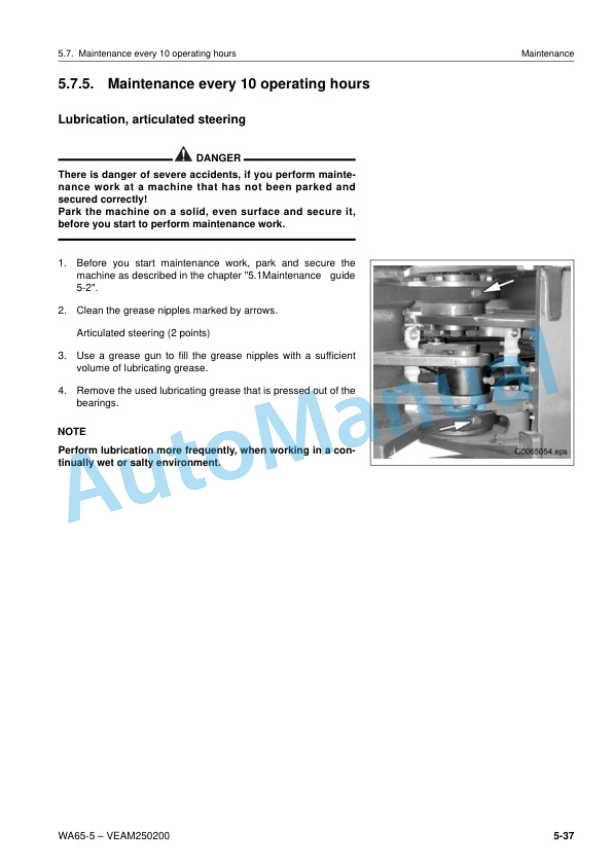
Description
-
Model List:
- WA65-5 Wheel Loader
- 1. MAIN MENU
- 2. Cover
- 3. Introduction
- 3.1. Product publications information
- 3.2. Foreword
- 3.2.1. EU Directives
- 3.3. Safety information
- 3.4. Introduction
- 3.4.1. Intended use
- 3.4.2. Breakingin the machine
- 3.5. Location of plates
- 3.5.1. Machine identification plate (PIN)
- 3.5.2. Engine nameplate
- 3.5.3. Axle serial no. plate
- 3.5.4. Transmission serial no. plate
- 3.5.5. ROPS/FOPSCab serial no. plate
- 3.5.6. Seat operator serial no. plate
- 3.5.7. Table to enter serial no. and distributor
- 3.6. Emission control warranty
- 3.6.1. Emission control warranty statement (Applies to Canada only)
- 3.7. Garantie sur le contr?le des ?missions
- 3.7.1. ?nonc? de garantie sur le contr?le des ?missions (applicable au Canada seulement)
- 3.8. Table of contents
- 3.9. Dimensions, weights and operating data
- 3.10. CEconforming equipment
- 3.10.1. CEconforming equipment part 1
- 3.10.2. CEconforming equipment part 2
- 3.10.3. Manufacturersupplied CEconforming equipment, according to document 42T9321080
- 3.11. Loading and securing
- 4. Table of contents
- 5. Safety
- 5.1. General safety measures
- 5.1.1. Safety instructions
- 5.1.2. Safety devices
- 5.1.3. Emergency exit
- 5.1.4. Clothing and personal protection
- 5.1.5. Machine modifications
- 5.1.6. Before you leave the drivers seat
- 5.1.7. Mounting and dismounting
- 5.1.8. Fire prevention and fire fighting
- 5.1.9. Protection against asbestos dust
- 5.1.10. Protection against injuries
- 5.1.11. Working at high temperatures
- 5.1.12. Rollover protection system (ROPS)
- 5.1.13. Attachment for protection against falling objects (FOPS)
- 5.1.14. Attachments
- 5.1.15. Battery
- 5.2. Safety precautions during operation
- 5.2.1. Prior to daily starting up
- 5.2.2. Machine operation
- 5.2.3. Transport
- 5.3. Precautions for maintenance
- 5.3.1. Personnel
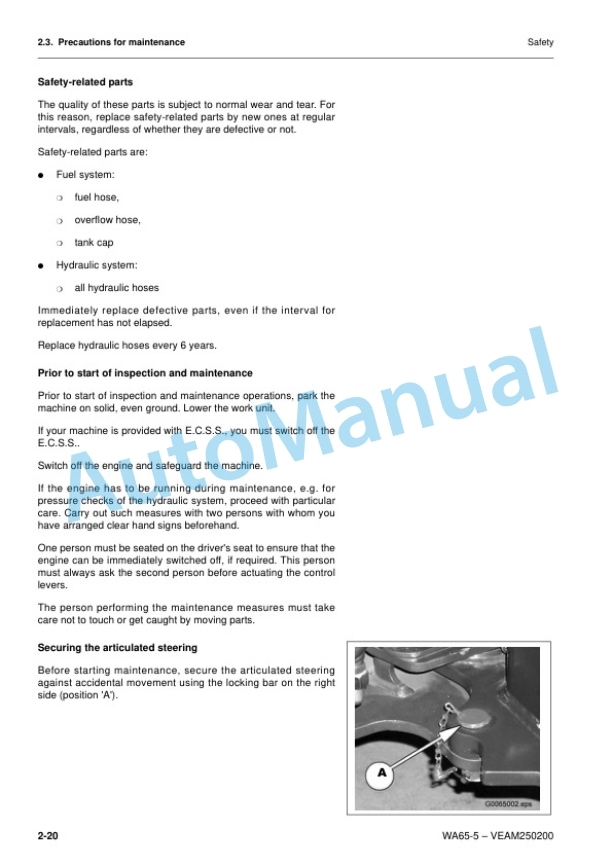
- 5.3.2. Before carrying out maintenance
- 5.3.3. During maintenance
- 5.3.4. Tires
- 5.4. Safety labels on the machine
- 5.4.1. Positions and order numbers of information labels
- 5.4.2. Positions and order numbers of safety labels
- 6. Operation
- 6.1. General view
- 6.1.1. General view of the machine
- 6.1.2. Controls and indicators
- 6.2. Description of the individual elements
- 6.2.1. Instrument panel
- 6.2.2. Switches
- 6.2.3. Control levers and pedals
- 6.2.4. Articulated steering catch
- 6.2.5. Traction device
- 6.2.6. Socket (12 V)
- 6.2.7. Door unlocking system
- 6.2.8. Alarm horn for reverse driving option
- 6.2.9. Fuses
- 6.2.10. Slowblowing fuses
- 6.2.11. Adjusting the heater and ventilation system
- 6.2.12. Airconditioning
- 6.3. Operation
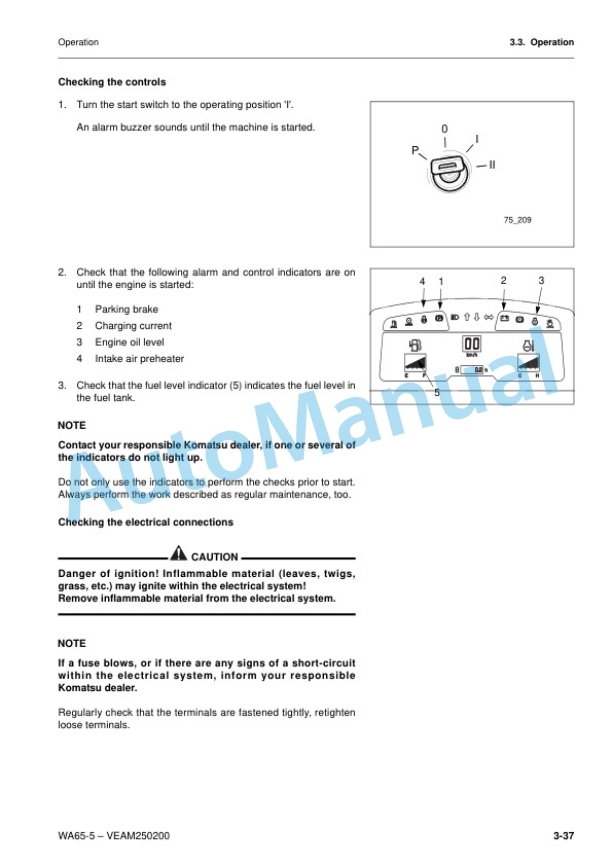
- 6.3.1. Prestart checks
- 6.3.2. Starting the engine
- 6.3.3. Driving with the machine
- 6.3.4. Changing the driving direction
- 6.3.5. Turning and steering
- 6.3.6. Braking
- 6.3.7. Stopping the machine
- 6.3.8. Operating the work equipment
- 6.3.9. Working with the wheeled loader
- 6.3.10. Precautions for special operations
- 6.3.11. Adjusting the position of the work equipment
- 6.3.12. Parking the machine
- 6.3.13. Switching off the engine
- 6.3.14. Check after stopping the engine
- 6.3.15. Locking
- 6.3.16. Tire handling
- 6.4. Transporting the machine
- 6.4.1. Securing the articulated steering
- 6.4.2. Lifting the machine
- 6.4.3. Driving the machine onto loading area of transport vehicle
- 6.4.4. Securing the machine during the transport
- 6.4.5. After transport
- 6.5. Cold weather operation
- 6.5.1. Before the cold season
- 6.5.2. Precautions after completion of work
- 6.5.3. After the cold season
- 6.6. Longterm storage
- 6.6.1. Before storage
- 6.6.2. During storage
- 6.6.3. After storage
- 7. Troubleshooting
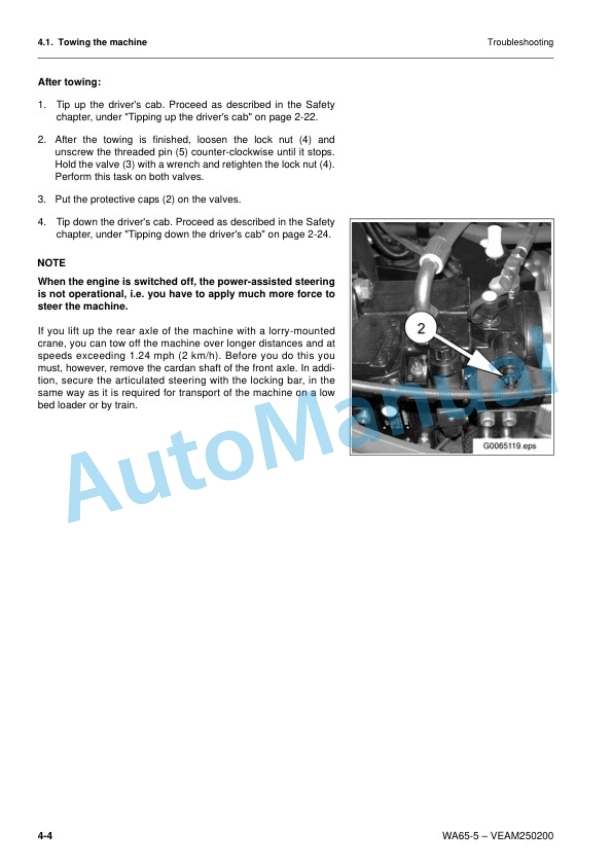
- 7.1. Towing the machine
- 7.2. Starting the engine with a booster cable
- 7.3. For insufficient braking effect
- 7.3.1. Checking the service brake
- 7.3.2. Checking the parking brake function
- 7.4. Emergency steering properties
- 7.5. Emergency lowering
- 7.6. Other troubles
- 7.6.1. Electrical system
- 7.6.2. Engine
- 7.6.3. Hydraulic system
- 7.6.4. Brakes
- 7.6.5. Steering
- 7.6.6. Axles
- 7.6.7. Drivers cab
- 8. Maintenance
- 8.1. Maintenance guide
- 8.2. Maintenance basics
- 8.2.1. Oil, fuel and coolant specifications
- 8.2.2. Specifications of the electrical system
- 8.2.3. Wearing parts list
- 8.3. Lubricants, fuels and filling capacities
- 8.3.1. Lubrication chart
- 8.4. Tools and standard tightening torques (bolts,nuts)
- 8.4.1. Introduction of recommended tools
- 8.4.2. Torque list
- 8.5. Periodical replacement of safetycritical parts
- 8.6. Maintenance schedule chart
- 8.7. Service procedure
- 8.7.1. Prestart checklist
- 8.7.2. Maintenance upon demand
- 8.7.3. Maintenance after the first 50 operating hours
- 8.7.4. Maintenance after the first 250 operating hours
- 8.7.5. Maintenance every 10 operating hours
- 8.7.6. Maintenance every 50 operating hours
- 8.7.7. Maintenance every 250 operating hours
- 8.7.8. Maintenance every 500 operating hours
- 8.7.9. Maintenance every 1000 operating hours
- 8.7.10. Maintenance every 1500 operating hours
- 8.7.11. Maintenance every 2000 operating hours
- 8.7.12. Maintenance every 4000 operating hours
- 9. Technical data
- 9.1. Technical data
- 9.2. Noise emission levels
- 9.3. Vibration level
- 9.4. Limit values for slopes
- 10. Special equipment and attachments
- 10.1. E.C.S.S.
- 10.1.1. Structure and functioning principle of the E.C.S.S.
- 10.1.2. Precautionary measures for switching on the E.C.S.S.
- 10.1.3. Operating the E.C.S.S.
- 10.1.4. Precautions when handling the accumulator
- 11. Index
- 12. Notes




There are no reviews yet.