
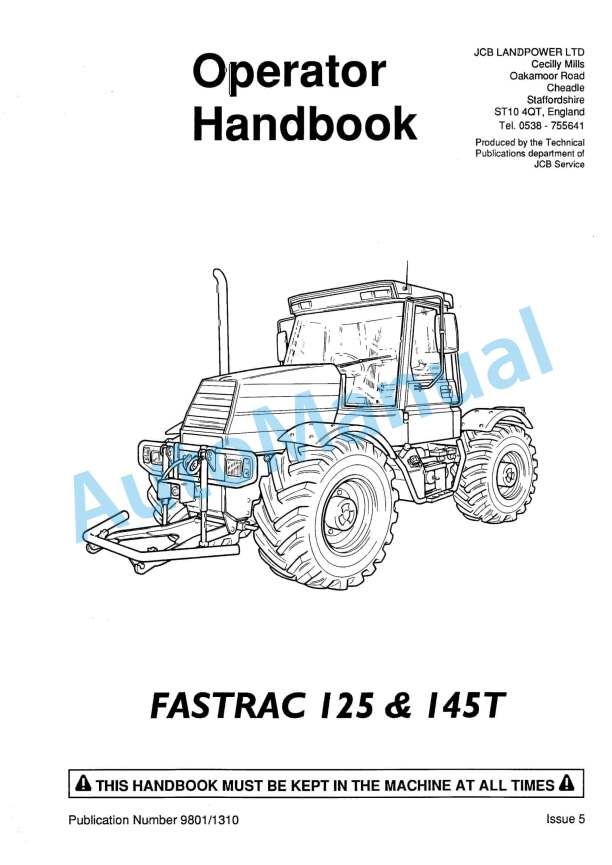
Description
-
Model List:
- 2.0, 2.5, 3.0, 3.5 Teletruk
- 1. SAFETY CHECKLIST
- 2. Introduction 1
- 3. Safety First – Yours And Other People’s 1
- 4. General Safety 2
- 5. Operating Safety 3
- 6. Maintenance Safety 5
- 7. INTRODUCTION
- 8. ABOUT THIS HANDBOOK
- 9. Machine Models 8
- 10. Using this Handbook 8
- 11. Location of Handbook 9
- 12. Units of Measurement 9
- 13. Page Numbering 9
- 14. Left Side-Right Side 9
- 15. Using the Machine 10
- 16. Differential Lock Selection (3.5D 4×4 Only) 10
- 17. THE JCB TELETRUK
- 18. Machine Description 11
- 19. Special Features 11
- 20. Major Components 11A
- 21. IDENTIFYING YOUR MACHINE
- 22. Vehicle Identification Number (VIN) 13
- 23. Unit Identification 13
- 24. Typical Engine Serial Number 14
- 25. SAFETY DECALS
- 26. General 15
- 27. INSTRUMENTS AND CONTROLS
- 28. General 16
- 29. Steering Column 17
- 30. Driving Light-Indicator Stalk 18
- 31. Instruments Fitted in Standard Build 19
- 32. Instruments Fitted as Optional Extras 20
- 33. Console (Basic Fit) 22
- 34. Console (Optional Extras) 23
- 35. Load Moment Indicator
- 36. (Up to Serial No. 0893470) 25
- 37. Checking the Load Moment Indicator
- 38. (Up to Serial No. 0893470) 26
- 39. Load Moment Indicator (LMI)
- 40. (From Serial No. 0893471) 26A
- 41. Checking the Load Moment Indicator
- 42. (From Serial No. 0893471) 26C
- 43. Setting the Volume and Brightness
- 44. (From Serial No. 0893471)) 26D
- 45. Diagnostic Fault Codes
- 46. (From Serial No. 0893471) 26E
- 47. Transmission Controls
- 48. – Forward and Reverse Lever (IT – Basic Fit) 27
- 49. – Forward and Reverse Lever (TCR – Basic Fit)28
- 50. Transmission Controls – Twin Pedal (Option) 29
- 51. Transmission Controls – Twin Pedal (Option) 29
- 52. Boom and Carriage Controls (Placing Pattern) 31
- 53. Boom and Carriage Controls (Loading Pattern) 32A
- 54. Seat and Seatbelt 33
- 55. QUICKHITCH OPTION
- 56. Engaging the Shovel-Attachments 34
- 57. Disengaging the Shovel-Attachments 35
- 58. Quick Release Couplings – Do’s and Don’ts 36
- 59. CENTRE OF GRAVITY
- 60. BASIC PRINCIPLES
- 61. Introduction 37
- 62. Centre of Gravity of a Simple Payload 37
- 63. Centre of Gravity of a Combined Payload 37
- 64. Centre of Gravity of a Complex Payload 38
- 65. Centre of Gravity of the Teletruk 38
- 66. LONGITUDINAL MOMENTS
- 67. Maximum Payload With Boom Retracted 39
- 68. Result of Extending the Boom 39
- 69. Payload With Boom Retracted 40
- 70. Result of Extending the Boom 40
- 71. LATERAL MOMENTS
- 72. Evenly Balanced Payload 41
- 73. Offset Payload 41
- 74. VERTICAL MOMENTS
- 75. General 42
- 76. Lowered Position 42
- 77. Raised Position 42
- 78. COMBINED MOMENTS
- 79. Centre of Gravity – Optimum Position 43
- 80. LIFTING AND TRANSPORTING
- 81. TRANSPORTING
- 82. Loading the Machine onto a Trailer 44
- 83. LIFTING
- 84. Lifting the Machine 46
- 85. OPERATING PROCEDURES
- 86. ROLLOVER 47
- 87. EMERGENCY EXIT
- 88. Cab with Rear Screen Opening 48
- 89. Cab with Fixed Rear Screen 50
- 90. RATED PAYLOAD LIFTING CAPACITY 51
- 91. GENERAL SAFETY
- 92. Passengers 52
- 93. Bystanders 52
- 94. Moving Parts 52
- 95. GROUND CONDITIONS
- 96. General 53
- 97. Soft Ground 53
- 98. Puddles 53
- 99. Obstructions and Debris 53
- 100. Uneven Tyre Wear 53
- 101. USING THE MACHINE
- 102. Before Using the Machine 54
- 103. Entering the Cab 54
- 104. Leaving the Cab 54
- 105. Loose Articles 55
- 106. Adjusting the Seat 55
- 107. Fasten the Seat Belt 55
- 108. Starting the Engine 56
- 109. 4-Wheel Drive Selection 56
- 110. Testing of Brakes 57
- 111. Stopping the Engine 57
- 112. DRIVING TECHNIQUES
- 113. Driving Forward 58
- 114. Braking 58
- 115. Restricted View 58
- 116. Reversing 58
- 117. Turning 58
- 118. Parking 58
- 119. Gradients 59
- 120. BASIC LOADING TECHNIQUES
- 121. General 60
- 122. Position of Load on the Teletruk 60
- 123. Fork Level Indicator (if fitted) 61
- 124. Security of the Load 62
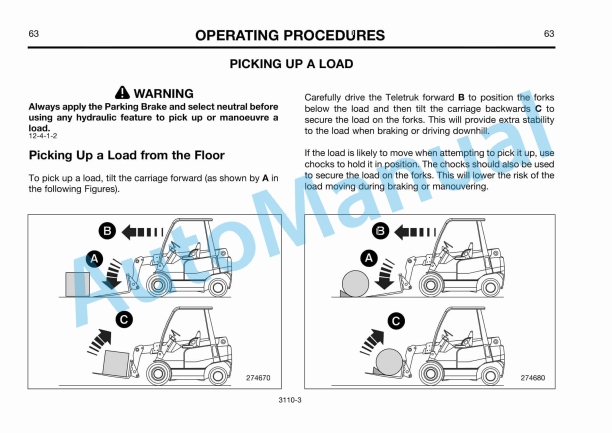
- 125. PICKING UP A LOAD
- 126. Picking Up a Load from the Floor 63
- 127. Picking Up a Load Above Ground Level 64
- 128. LOWERING A LOAD
- 129. Lowering a Load onto the Floor 65
- 130. Lowering a Load onto Other Objects 66
- 131. LIFTING OPERATIONS ON GRADIENTS
- 132. Longitudinal Stability 67
- 133. Lateral Stability 67
- 134. MAINTENANCE
- 135. LUBRICANTS – HEALTH AND SAFETY
- 136. Hygiene 71
- 137. Storage 71
- 138. Waste Disposal 71
- 139. Handling 72
- 140. First Aid When Handling Oil 72
- 141. SERVICE REQUIREMENTS
- 142. Introduction 73
- 143. Maintenance 73
- 144. Owner-Operator Support 74
- 145. Service-Maintenance Agreements 74
- 146. ACCESS PROCEDURES FOR MAINTENANCE
- 147. Operators Enclosure-Cab 75
- 148. Daily Inspection Cover 79
- 149. Front Cover 79
- 150. Daily Inspection Rear Cover 80
- 151. Belly Plate (4WD Machines) 81
- 152. Optional Trash Guard 82
- 153. SERVICE SCHEDULES
- 154. Introduction 83
- 155. Every 10 Operating Hours or Daily 84
- 156. Every 50 Operating Hours or Weekly 84
- 157. First 250 Operating Hours Only 85
- 158. Every 500 Operating Hours or 6 Monthly 86
- 159. Every 1000 Operating Hours or Yearly 88
- 160. Every 2000 Operating Hours or 2 Yearly 88
- 161. CLEANING THE MACHINE 89
- 162. OPERATORS ENCLOSURE AND SEAT BELT
- 163. Checking the Operators Enclosure 91
- 164. Checking Seat Belt Condition and Security 91
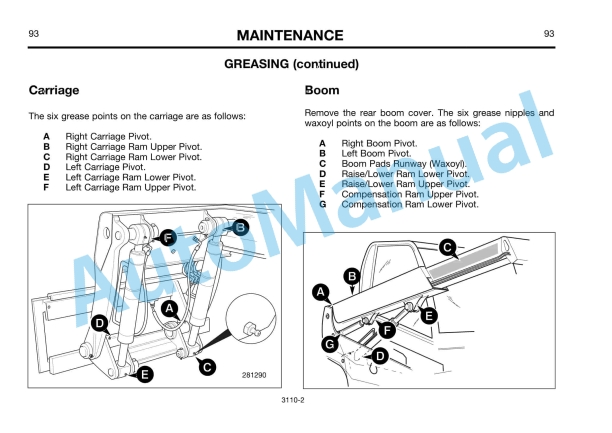
- 165. GREASING
- 166. General 92
- 167. Location of Greasing Points 92
- 168. Greasing Procedure 92
- 169. Carriage 93
- 170. Boom 93
- 171. Rear Axle 94
- 172. Sideshift (Optional) 94
- 173. ENGINE OIL
- 174. Checking the Oil Level 95
- 175. AIR FILTER
- 176. Changing the Elements 95A
- 177. ENGINE COOLING SYSTEM
- 178. Checking the Coolant Level 96
- 179. DIESEL FUEL SYSTEM
- 180. Types of Fuel 98
- 181. Filling the Tank 99
- 182. Draining the Sediment Bowl 100
- 183. LPG FUEL SYSTEM
- 184. General 101
- 185. Filling the LPG Tank 102
- 186. Changing the LPG Tank 102
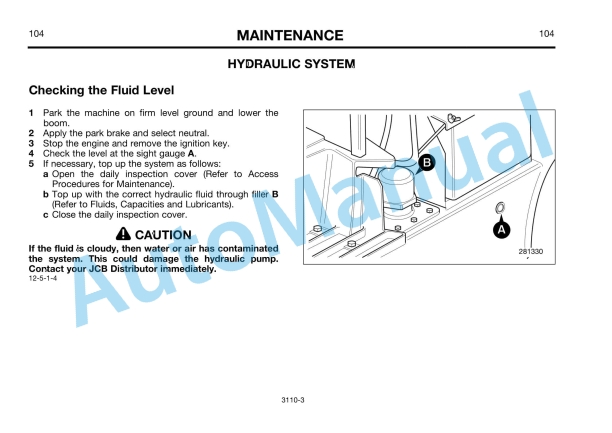
- 187. HYDRAULIC SYSTEM
- 188. Checking the Fluid Level 104
- 189. Checking for Leaks 105
- 190. Checking the Hoses and Pipework 105
- 191. ELECTRICAL SYSTEM
- 192. General 106
- 193. Bulbs 106
- 194. Fuses 106
- 195. Primary Fuses 106
- 196. Main Fuses 107
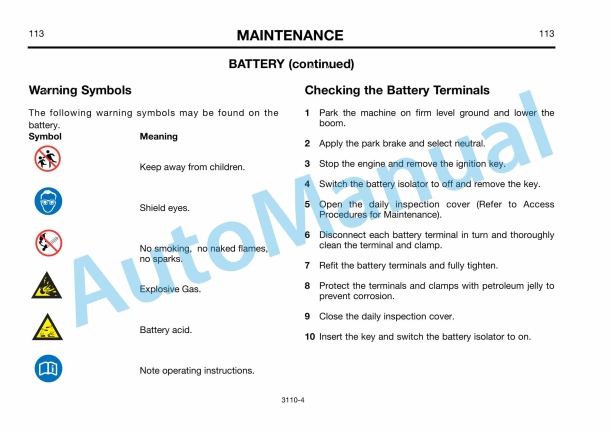
- 197. BATTERY
- 198. Safety 111
- 199. First Aid – Electrolyte 111
- 200. Warning Symbols 112
- 201. Checking the Battery Terminals 112
- 202. Battery Isolator 114
- 203. FAN BELT (Diesel and LPG Engine)
- 204. Checking the Fan Belt Tension 115
- 205. FORKS
- 206. Inspecting the Forks 116
- 207. Changing the Forks 117
- 208. SPECIAL PROCEDURES
- 209. WHEELS AND TYRES
- 210. General 121
- 211. Inflating the Tyres 121
- 212. Changing a Wheel 123
- 213. Changing a Solid Tyre 125
- 214. Changing a Pneumatic Tyre 126
- 215. FUEL SYSTEM
- 216. Bleeding the Fuel System 129
- 217. JACKING POINTS
- 218. Raising the Teletruk 131
- 219. Lowering the Teletruk 131
- 220. JUMP STARTING
- 221. Safety 132
- 222. Procedure 133
- 223. RECOVERING A DISABLED MACHINE 134
- 224. RECOVERY HITCH 136
- 225. STORAGE
- 226. Storing the Machine 137
- 227. FLUIDS AND LUBRICANTS 140
- 228. SPECIFICATIONS
- 229. Static Dimenisons 142
- 230. Noise 143
- 231. Attachments 143
- 232. Tyre sizes and pressures 144






There are no reviews yet.