
Description
-
Model List:
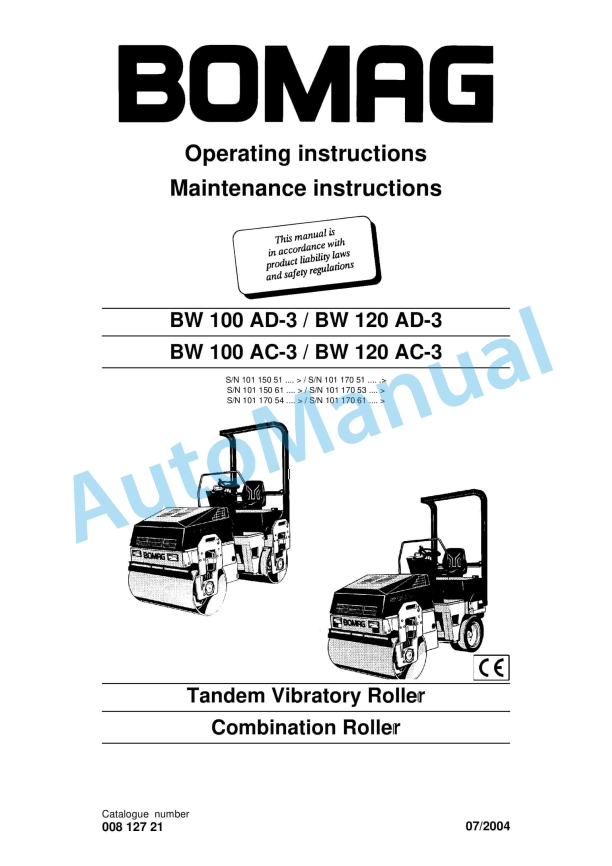
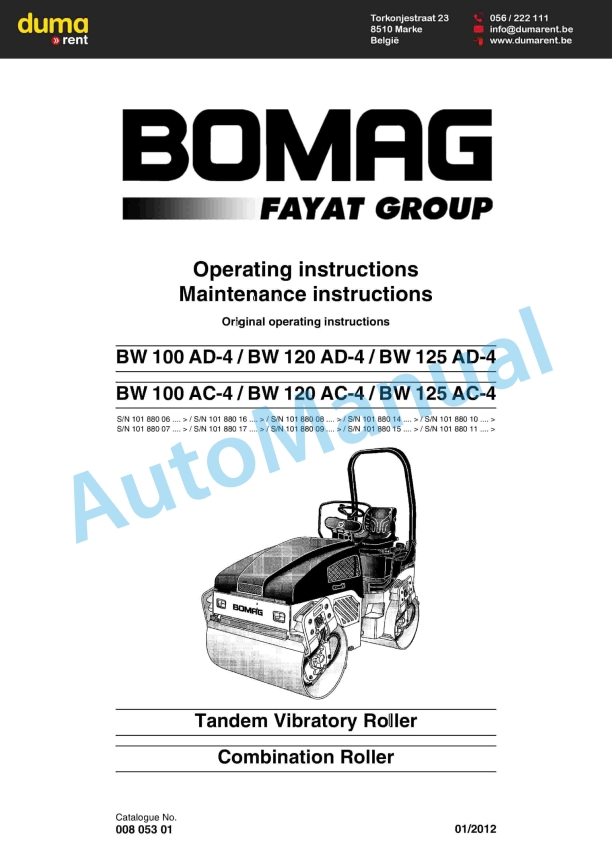
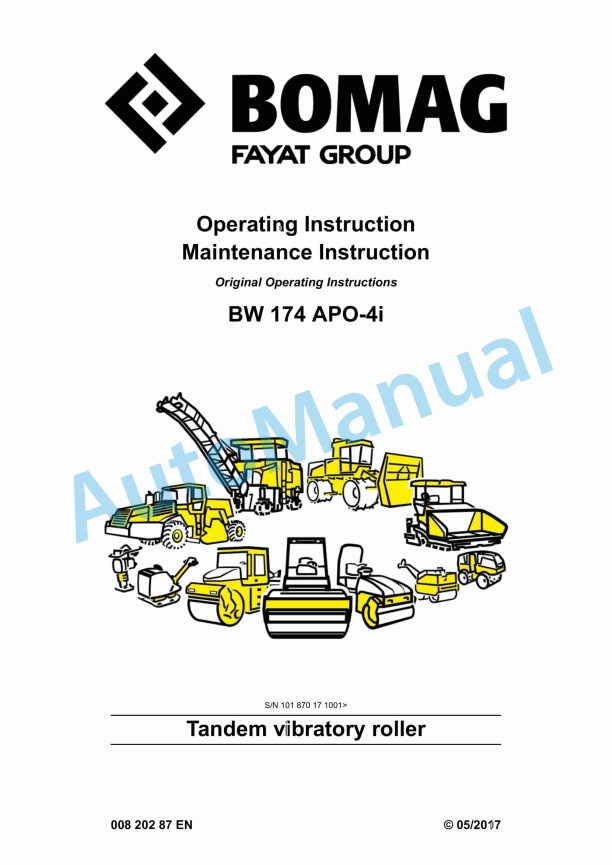
- BW 100 AD-3 Tandem Vibratory Roller
- BW 100 AC-3 Tandem Vibratory Roller
- BW 120 AD-3 Tandem Vibratory Roller
- BW 120 AC-3 Tandem Vibratory Roller
- 1. BW 100 AD3 / BW 120 AD3
- 2. BW 100 AC3 / BW 120 AC3
- 2.1. S/N 101 150 51 …. > / S/N 101 170 51 …. .>
- 2.2. S/N 101 150 61 …. > / S/N 101 170 53 …. >
- 2.3. S/N 101 170 54 …. > / S/N 101 170 61 …. >
- 3. Tandem Vibratory Roller
- 4. Combination Roller
- 4.1. BOMAG machines are products from the wide range of BOMAG compaction equipment.
- 4.2. BOMAGs vast experience in connection with stateoftheart production and testing methods, such …
- 4.3. Please note
- 4.4. For your own personal safety you should only use original spare parts from BOMAG.
- 4.5. In the course of technical development we reserve the right for technical modifications without p…
- 4.6. Please fill in
- 4.7. BW 100 AD3
- 4.8. BW 120 AD3
- 4.9. BW 100 AD3
- 4.10. BW 120 AD3
- 4.11. Weights
- 4.12. Dimensions
- 4.13. Travel characteristics
- 4.14. Steering
- 4.15. Vibration system
- 4.16. Water sprinkler system
- 4.17. BW 100 AC3
- 4.18. BW 120 AC3
- 4.19. BW 100 AC3
- 4.20. BW 120 AC3
- 4.21. Weights
- 4.22. Dimensions
- 4.23. Travel characteristics
- 4.24. Steering
- 4.25. Vibration system
- 4.26. Water sprinkler system
- 4.27. The following noise and vibration values according to the ECdirective for machines, edition (98/…
- 4.28. During operation these values may vary because of the existing operating conditions.
- 4.29. Noise value
- 4.30. Vibration value
- 4.31. General Notes
- 4.32. Intended use
- 4.33. Unintended use
- 4.34. Who has permission to operate the machine
- 4.35. Conversions and changes to the machine
- 4.36. Notes on safety in the operating and maintenance instructions
- 4.37. Information and safety stickers/decals on the machine
- 4.38. Loading the machine
- 4.39. Towing the machine
- 4.40. Checking the roll over protection structure (ROPS)
- 4.41. Starting the machine
- 4.42. Driving the machine
- 4.43. Parking the machine
- 4.44. Filling the fuel tank
- 4.45. Maintenance work
- 5. General notes
- 6. Description of indicators and control elements
- 6.1. Fig. 10
- 6.2. Fig. 11
- 6.3. Fig. 12
- 6.4. Fig. 13
- 6.5. Fig. 14
- 6.6. Fig. 15
- 6.7. Fig. 16
- 6.8. Fig. 17
- 6.9. Fig. 18
- 6.10. Fig. 19
- 6.11. Ball valve for 3stage vibration
- 7. General notes
- 8. Inspections before starting operation
- 9. Starting the engine
- 9.1. Fig. 26
- 9.2. Fig. 27
- 9.3. Fasten/release your seat belt .
- 10. Starting with jump wires
- 10.1. Fig. 34
- 11. Driving the machine
- 11.1. Fig. 35
- 11.2. Fig. 36
- 11.3. Fig. 37
- 12. Stopping the machine / applying the brake
- 12.1. Fig. 38
- 13. Switching the vibration on and off
- 13.1. Preselecting vibration (only AD)
- 13.2. Preselecting vibration (3 stages, only AD)
- 13.3. Switch the vibration on
- 13.4. Switching the vibration off
- 14. Switching the gravity sprinkling system on and off
- 14.1. Fig. 43
- 15. Switching the tire sprinkling system on and off
- 15.1. Fig. 44
- 16. Switching the pressure sprinkler system on or off
- 16.1. Fig. 45
- 16.2. Fig. 46
- 16.3. Fig. 47
- 16.4. Fig. 48
- 17. Stopping the engine/machine
- 17.1. Fig. 49
- 17.2. Fig. 50
- 17.3. Fig. 51
- 18. Adjusting the drivers seat
- 18.1. Fig. 52
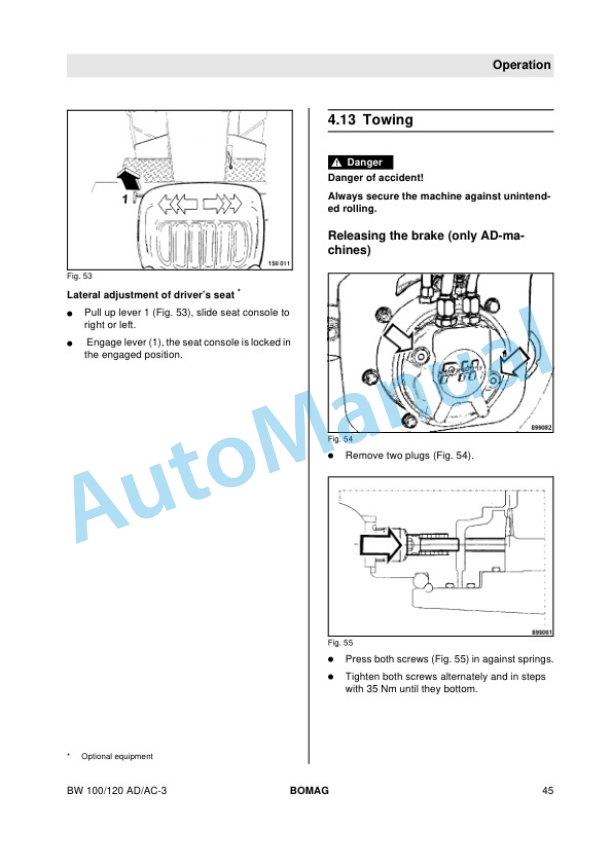
- 18.2. Fig. 53
- 18.3. Lateral adjustment of drivers seat
- 19. Towing
- 19.1. Releasing the brake (only ADmachines)
- 19.2. Releasing the brakes on drum and rubber wheels (only ACmachines)
- 19.3. Towing the machine
- 19.4. After towing
- 20. Loading and transport
- 20.1. Fig. 61
- 20.2. Fig. 62
- 20.3. Fig. 63
- 20.4. Loading weight See technical data.
- 20.5. After transport
- 21. Foldable roll over protection structure (ROPS)
- 21.1. Split foldable roll over protection structure (ROPS)
- 21.2. Central fourpoint lifting facility
- 22. General notes on maintenance
- 22.1. Notes on the fuel system
- 22.2. Notes on the engine performance
- 22.3. Notes on the hydraulic system
- 23. Fuels and lubricants
- 23.1. Engine oil
- 23.2. Oil viscosity
- 23.3. Regular lubrication oil changes
- 23.4. Oil quality
- 23.5. Lubrication oil change intervals
- 23.6. Lubrication oil quality classes
- 23.7. Winter fuel
- 23.8. Mineral oil based hydraulic oil
- 23.9. Biodegradable hydraulic oil
- 23.10. Lubrication grease
- 24. Fuels, lubricants and filling capacities
- 24.1. Assembly
- 24.2. Fuel or lubricant
- 24.3. Quantity approx.
- 25. Runningin instructions
- 25.1. The following maintenance work must be performed when running in new machines or overhauled engines
- 25.2. After 50 operating hours
- 26. Maintenance chart
- 26.1. With all maintenance intervals perform also the work for shorter preceding service intervals.
- 26.2. Designation
- 26.3. Every 10 operating hours
- 26.4. Every 50 operating hours
- 26.5. Every 250 operating hours
- 26.6. Every 500 operating hours
- 26.7. Every 1000 operating hours
- 26.8. Every 2000 operating hours
- 26.9. Every 3000 operating hours
- 26.10. Every 5000 operating hours
- 26.11. As required
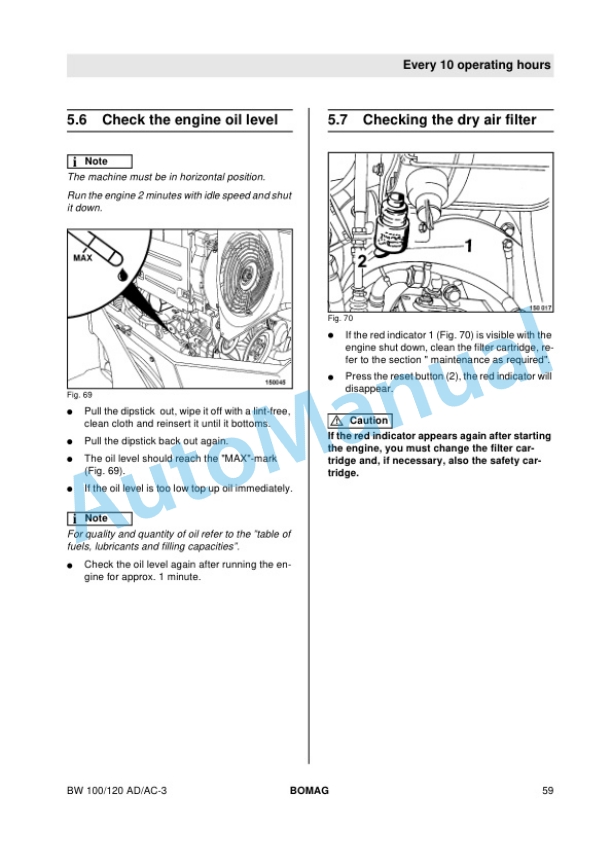
- 27. Check the engine oil level
- 27.1. Fig. 69
- 28. Checking the dry air filter
- 28.1. Fig. 70
- 29. Checking the hydraulic oil level
- 29.1. Fig. 71
- 30. Checking the hydraulic oil filter element
- 30.1. Fig. 72
- 31. Checking the fuel level
- 31.1. Fig. 73
- 32. Checking the water level
- 32.1. Fig. 74
- 33. Checking the emulsion oil level
- 33.1. Fig. 75
- 34. Lubricating the articulated joint
- 34.1. Fig. 76
- 35. Cleaning cooling fins and engine oil cooler
- 35.1. Fig. 77
- 36. Cleaning the hydraulic oil cooler
- 36.1. Fig. 78
- 37. Adjust the scrapers
- 37.1. Fig. 79
- 37.2. Fig. 80
- 38. Checking the battery condition, greasing the poles
- 38.1. Fig. 81
- 38.2. Maintenance free batteries
- 38.3. Serviceable batteries
- 39. Draining the slurry from the fuel tank
- 39.1. Fig. 82
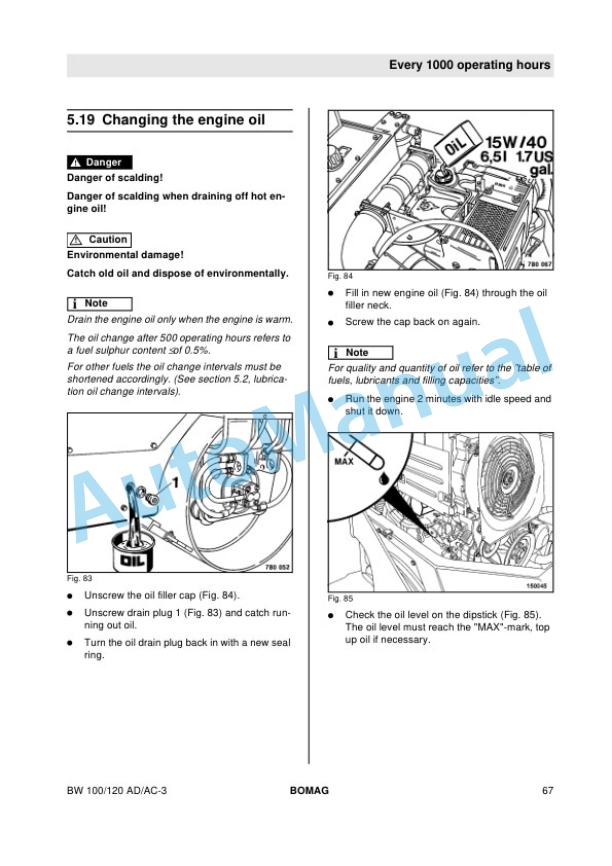
- 40. Changing the engine oil
- 40.1. Fig. 83
- 40.2. Fig. 84
- 40.3. Fig. 85
- 41. Change the engine oil filter cartridge
- 41.1. Fig. 86
- 42. Check, adjust the valve clearance
- 42.1. Valve clearance
- 42.2. Checking the valve clearance
- 42.3. Adjusting the valve clearance
- 43. Checking, tensioning, changing the Vbelt
- 43.1. Checking the Vbelt
- 43.2. Tensioning the Vbelt
- 43.3. Changing the Vbelt
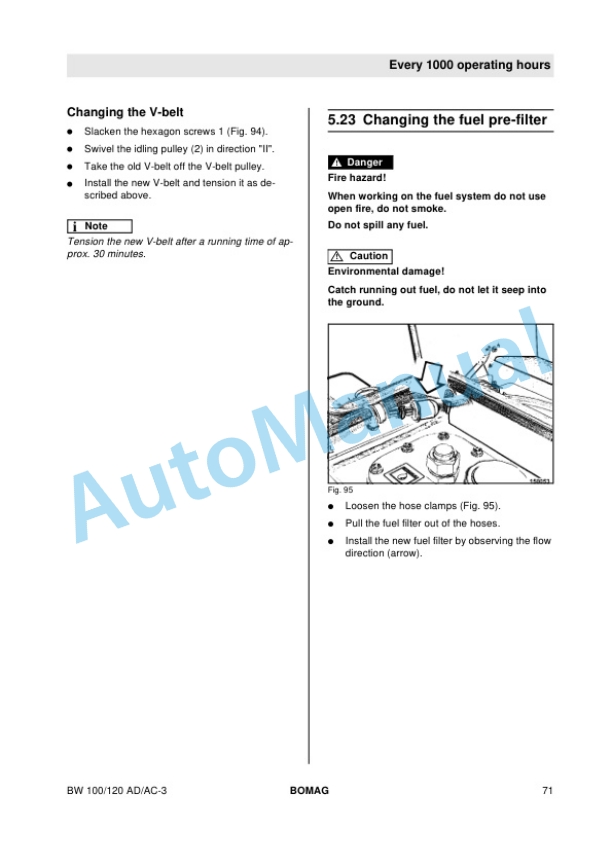
- 44. Changing the fuel prefilter
- 44.1. Fig. 95
- 45. Changing the fuel filter cartridge
- 45.1. Fig. 96
- 46. Changing the hydraulic oil
- 46.1. Fig. 97
- 46.2. Fig. 98
- 46.3. Bleeding the hydraulic system
- 47. Changing the hydraulic oil filter element
- 47.1. Fig. 99
- 48. Checking the injection valves
- 49. Replacing the toothed belt
- 49.1. Fig. 100
- 50. Checking the tire pressure
- 50.1. Fig. 101
- 50.2. Nominal value approx.2.2 bar
- 51. Cleaning, changing the dry air filter
- 51.1. Fig. 102
- 51.2. Fig. 103
- 51.3. Dry cleaning
- 51.4. Wet cleaning
- 52. Cleaning the water tank
- 52.1. Fig. 104
- 53. Water sprinkler system, maintenance in the event of frost
- 53.1. Fig. 105
- 54. Engine conservation
- 54.1. Anticorrosion oils are all oils complying with the specification MILL21260 B or TL 9150 037/2…
- 55. Tightening torques for screws with metric unified thread
- 55.1. Fig. 106
- 56. General notes
- 56.1. The following work must only be carried out by qualified and trained personnel or by the BOMAG sa…
- 56.2. Please observe strictly the safety regulations in chapter 2 of these operating and maintenance in…
- 57. Engine problems
- 57.1. Possible cause


There are no reviews yet.